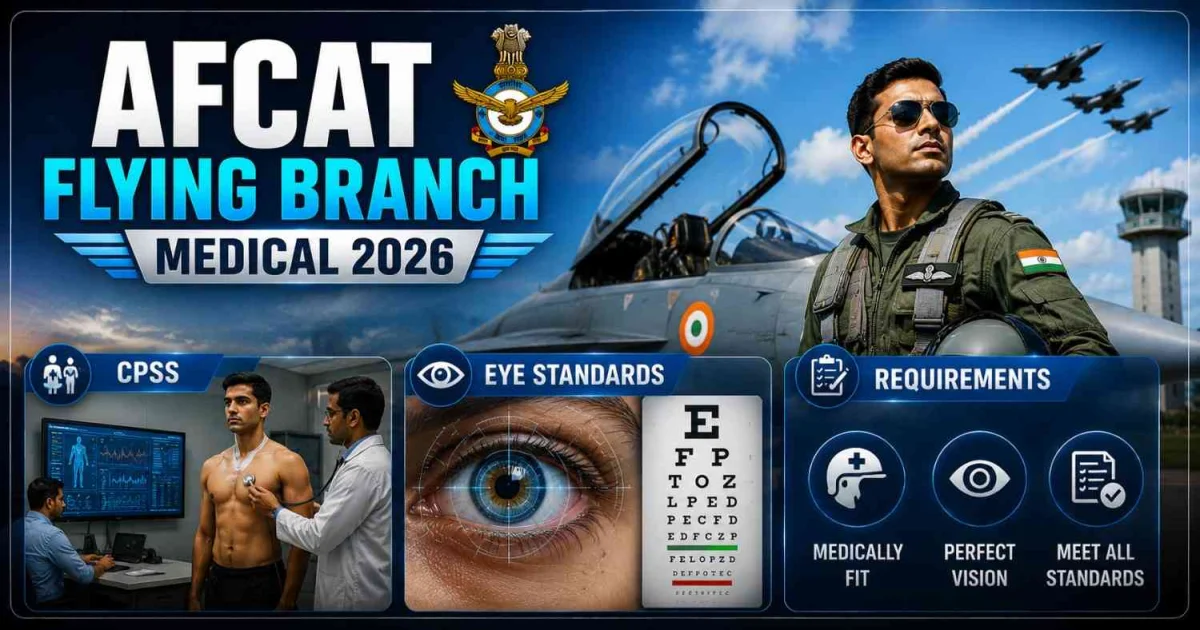
Eyesight Standards for NDA, CDS and AFCAT 2027: Power Limits, Colour Vision and LASIK Rules
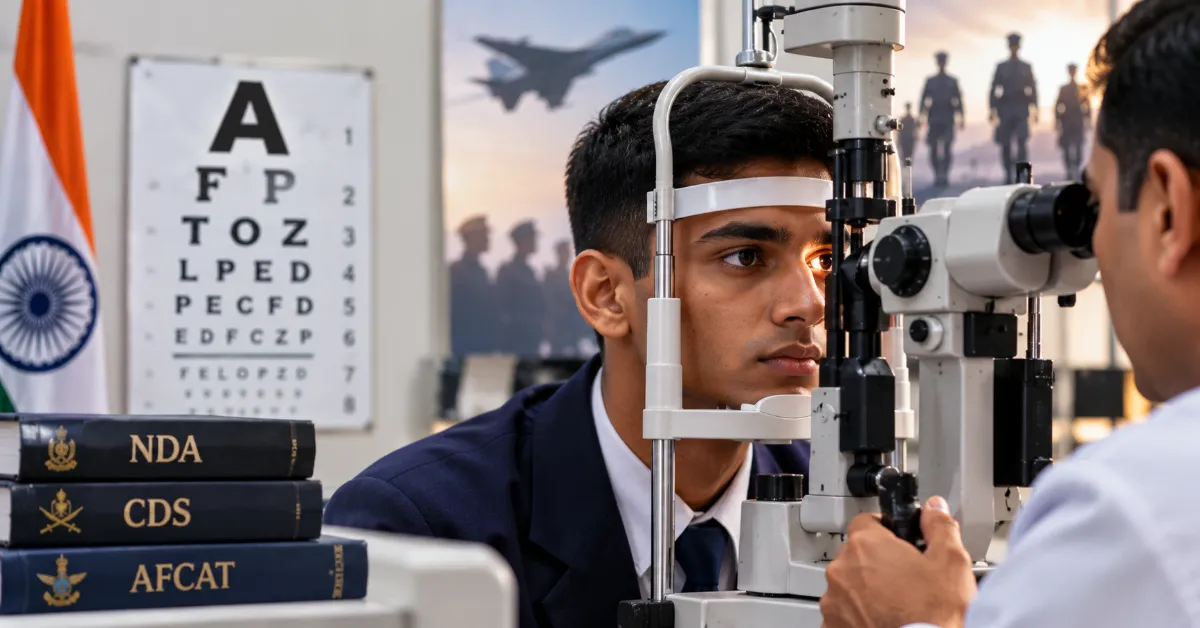
Many candidates clear the written exam, perform well at the SSB interview, and then get rejected at the medical stage because their vision falls outside the permitted range. NDA eyesight standards, CDS vision requirements 2026, and AFCAT thresholds are not advisory guidelines. They are hard eligibility gates, applied by the medical board without exception. If you wear glasses, have had LASIK surgery, or are uncertain about your colour perception, this article gives you the exact figures and rules before you spend months preparing for the wrong branch. That applies equally to AFCAT eyesight standards for the flying branch.
Why Vision Standards Matter More Than You Think
The written exam and SSB interview assess your knowledge and personality. The medical examination assesses your body, and vision is one of its most scrutinised components. According to the UPSC NDA and NA official notification, candidates are evaluated under AFMSF medical standards, which set branch-specific visual acuity thresholds that differ entirely from civilian norms. This is especially relevant when it comes to NDA eyesight standards.
Wearing spectacles during the written exam has no bearing on your medical outcome. The SSB medical examination is a completely separate gate, conducted by defence physicians, and it is the final word on enrolment. A candidate who scores 400 on the NDA written paper can still be rejected if their uncorrected distant vision falls outside the permitted range for their chosen arm. Keep this in mind when considering LASIK allowed for NDA CDS AFCAT.
Several branches, including the Flying Branch under AFCAT and the Air Force Academy entry under CDS, require your eyes to perform well without any correction at all. Even candidates applying for Ground Duty roles must meet minimum corrected vision thresholds with glasses. Checking your refractive error before you apply is not optional. It is the first step of a serious application, particularly when thinking about colour vision standard Indian Army Air Force.
The Join Indian Army official portal confirms that medical fitness, including vision, is assessed independently of written merit and that no concession is granted based on exam rank. The same holds for weak eyesight defence exam disqualification.
NDA Eyesight Standards 2027: Distant, Near and Colour Vision
The eyesight requirement for NDA differs depending on which service arm you are entering through. All three wings, Army, Navy, and Air Force, use NDA as the common entry point but apply separate vision criteria at the SSB medical stage. This distinction matters just as much as the overall eyesight requirement for NDA.
For the Army wing, acceptable uncorrected distant vision is 6/6 in the better eye and 6/18 in the worse eye. Corrected vision must reach 6/6 in both eyes. Near vision must meet the N5 N6 near vision benchmark, meaning N5 in the better eye and N6 in the worse. Myopia must not exceed minus 3.5 dioptres, and hypermetropia must not exceed plus 3.5 dioptres. Astigmatism is permitted up to 0.75 dioptres.
For the Navy wing, uncorrected distant vision standards are stricter: 6/6 in both eyes without glasses. The near vision requirement stays at N5 in the better eye. Colour perception must be CP-II or better.
For the Air Force wing entering through NDA, the standard mirrors Flying Branch criteria. Uncorrected distant vision must be 6/6 in each eye, corrected to 6/6 with or without glasses, within a refraction limit of plus or minus 2.0 dioptres. Colour perception must be CP-I, the highest grade.
The SSB medical examination tests each of these values formally. Candidates should get a certified optometric evaluation well before applying, because the vision power limits defence entrance boards apply are non-negotiable.
CDS Eyesight Standards 2027: IMA, INA, AFA and OTA Entry
CDS vision requirements 2026 follow OTA IMA INA medical criteria that vary considerably by entry stream. The four streams are IMA (Indian Military Academy), INA (Indian Naval Academy), AFA (Air Force Academy), and OTA (Officers Training Academy).
IMA entry (Army): Uncorrected distant vision of 6/6 in the better eye and 6/18 in the worse eye. Near vision at N5 in the better eye and N6 in the worse. Acceptable myopia up to minus 3.5 dioptres. Colour perception grade CP-III or better qualifies.
INA entry (Navy): Uncorrected distant vision of 6/6 in both eyes. Near vision at N5. Colour perception at CP-II or better. The Navy maintains consistently tight uncorrected vision standards across both NDA and CDS routes.
AFA entry (Air Force Academy): The Air Force Academy Flying Branch mirrors the Flying Branch standard exactly. Uncorrected vision must be 6/6 in each eye, refraction must fall within plus or minus 2.0 dioptres, and colour perception must be CP-I. This is the strictest stream in CDS.
OTA entry: OTA carries the most relaxed thresholds on the CDS list. Corrected vision with glasses to 6/6 is acceptable, myopia up to minus 5.0 dioptres is permitted, near vision at N5, and colour perception at CP-III is sufficient. For candidates with moderate refractive errors, OTA is the most accessible route.
AFCAT Eyesight Standards 2027: Flying Branch vs Ground Duty
AFCAT eyesight standards for the flying branch are the most demanding of any defence entry route. The Air Force Academy Flying Branch requires uncorrected distant vision of 6/6 in each eye, corrected vision of 6/6, a permitted refractive range of minus 2.0 to plus 2.0 dioptres, astigmatism not exceeding 0.75 dioptres, and colour perception at CP-I. Night vision testing is also conducted as part of the flying medical, making it a comprehensive ocular assessment.
Ground Duty roles under AFCAT are considerably more forgiving. Uncorrected distant vision can be as low as 6/60, provided it corrects to 6/6 with glasses. Myopia can reach minus 7.0 dioptres and hypermetropia up to plus 5.0 dioptres for Ground Duty entries. Near vision at N6 in the worse eye is acceptable, and colour perception at CP-III qualifies for most Ground Duty specialisations.
AFCAT Technical and NCC Special Entry slots follow Ground Duty standards unless the candidate is applying for a flying role within the technical stream, in which case Flying Branch criteria apply. Candidates uncertain about their stream's applicable standard should cross-reference their AFCAT application category with the Indian Air Force official medical standards page before appearing for the SSB medical examination.
Side-by-Side Comparison Table: NDA vs CDS vs AFCAT Vision Limits
The table below consolidates the vision power limits defence entrance boards apply across all three exams and their main branches. Use it to identify immediately whether your refractive error falls within the accepted range.
Can Weak Eyesight or Minus Power Disqualify You?
Yes. Weak eyesight defence exam disqualification is a real outcome, and it depends on your specific refractive error and target branch. Understanding myopia hypermetropia astigmatism limits for each entry stream is essential before you apply.
For Flying Branch roles, covering NDA Air Force wing, AFA under CDS, and AFCAT Flying, any myopia beyond minus 2.0 dioptres is disqualifying. Hypermetropia beyond plus 2.0 dioptres is equally disqualifying, and astigmatism above 0.75 dioptres bars a candidate from flying duty entirely. These limits reflect the precision visual acuity dioptres requirements of cockpit environments.
For Army and Ground Duty roles, the thresholds are considerably wider. Myopia up to minus 3.5 dioptres qualifies for IMA and the Army wing of NDA. OTA and AFCAT Ground Duty accept myopia up to minus 5.0 and minus 7.0 dioptres respectively, provided corrected vision reaches 6/6.
Progressive myopia disqualification applies where a candidate's myopia is documented as worsening year on year. Medical boards review optometric records, and a history of rapid myopia progression can result in rejection even when the current power falls within the permitted range. The board treats progressive conditions as a future operational risk.
Additional disqualifying conditions include:
-
Any degree of squint (strabismus) that impairs binocular vision
-
Macular degeneration or retinal pathology
-
Colour vision below the required CP grade for the chosen branch
-
Uncorrected vision below the branch minimum that cannot be corrected to 6/6
Candidates who fall near the borderline should get a formal ophthalmic assessment at a recognised hospital and carry those records to the SSB medical examination.
Is LASIK Eye Surgery Allowed for NDA, CDS and AFCAT?
This is among the most searched questions on defence preparation forums. LASIK allowed for NDA CDS AFCAT depends on the branch and on whether specific procedural conditions have been met.
For Ground Duty roles across all three exams, LASIK is generally permitted provided the surgery was performed at least 12 months before the SSB medical examination. The LASIK waiting period armed forces boards enforce is not negotiable. Candidates who appear within 12 months of surgery are rejected outright, even if vision has fully stabilised. The Indian Air Force LASIK eligibility page confirms this 12-month minimum for Ground Duty AFCAT entries.
For Flying Branch roles, the position is stricter. LASIK is not accepted for the Flying Branch under AFCAT or AFA under CDS. The IAF requires natural, unaided vision within the prescribed limits for all flying duties. A candidate who has undergone LASIK remains ineligible for pilot or observer roles regardless of the post-surgical outcome.
Candidates appearing after LASIK must carry:
-
Pre-operative refraction records showing the original refractive error
-
Surgical notes from the operating ophthalmologist
-
Post-operative records confirming stable vision over at least 12 months
-
A certificate from a recognised eye hospital confirming no complications
Even with all documentation in place, the medical board retains the right to reject a candidate if post-LASIK vision is unstable or if the pre-operative myopia exceeded the original limits for that branch.
Colour Vision and Night Vision Standards Explained
Colour vision standard Indian Army Air Force entries follow the CP-I CP-II colour perception grade framework defined under AFMSF medical standards. The CP scale runs from CP-I, the strictest, to CP-IV, the most lenient. Each grade is assessed using Ishihara plates and the Martin lantern test during the SSB medical.
CP-I is mandatory for all Flying Branch entries, including NDA Air Force wing, AFA under CDS, and AFCAT Flying. This grade requires the candidate to correctly identify all standard Ishihara test plates and pass the Martin lantern test without error. Pilots depend on precise colour differentiation in cockpits, on runways, and during low-visibility operations, which is why CP-I admission leaves no room for borderline results.
CP-II is required for Navy entries across NDA and INA under CDS. The Navy assigns colour-coded signals and navigation lights that demand reliable colour discrimination, though to a slightly lower threshold than the Air Force.
CP-III qualifies a candidate for Army roles, OTA entry, and AFCAT Ground Duty. This grade means the candidate is colour safe in practical operational terms, able to distinguish mission-critical colours without error under standard field conditions.
Night vision testing defence boards conduct is relevant primarily for Flying Branch candidates. Low-luminance visual acuity and dark adaptation are assessed separately from the standard visual acuity dioptres test. Ground Duty candidates are not routinely assessed for night vision.
Contact lenses SSB medical rules are clear: candidates must not wear contact lenses during any vision test at the SSB. All measurements are taken with the naked eye first, then with spectacle correction if required. Wearing contact lenses to a medical board is treated as misrepresentation of vision status.
FAQs
Can I apply for NDA with minus 2.5 power?
For the Army wing, yes. The myopia limit for NDA Army is minus 3.5 dioptres, so minus 2.5 dioptres falls within the acceptable range. For the Air Force wing, no. The Flying Branch limit is minus 2.0 dioptres, so minus 2.5 dioptres would result in disqualification from that stream.
What is the LASIK waiting period before SSB medical for AFCAT Flying Branch?
LASIK surgery does not qualify a candidate for the AFCAT Flying Branch at all. For AFCAT Ground Duty, the mandatory LASIK waiting period armed forces boards require is 12 months from the date of surgery before the SSB medical examination.
Are contact lenses allowed during the SSB medical exam?
No. Contact lenses SSB medical rules prohibit their use during any phase of the vision assessment. The board tests uncorrected distant vision first, and presenting with contact lenses already in place is treated as a disciplinary matter.
What colour vision grade is needed for Indian Army vs Air Force entry?
The colour vision standard Indian Army entry requires CP-III at minimum. Air Force entry through any route, NDA, CDS AFA, or AFCAT Flying, requires CP-I. This is the single largest colour vision gap between the two services.
If I wear glasses, can I still join the Indian Army through CDS?
Yes. IMA entry under CDS accepts corrected vision with glasses up to 6/6, provided the underlying myopia does not exceed minus 3.5 dioptres. Glasses are permitted for Army service. This is a common point of confusion among aspirants deciding between Army and other branches. For a broader comparison of service conditions, see our guide on Indian Army vs Navy After 12th.
Does progressive myopia automatically disqualify an NDA candidate?
Not automatically, but it is a serious risk factor. Medical boards review optometric records spanning at least two to three years. If progressive myopia disqualification criteria are met, meaning the candidate's power is documented as increasing by more than 0.5 dioptres per year, the board can reject the candidate even when the current power sits within permitted limits. A stable vision history is essential for a clean medical clearance.