AFCAT Maths Preparation 2026: Topics, Tricks & Strategy
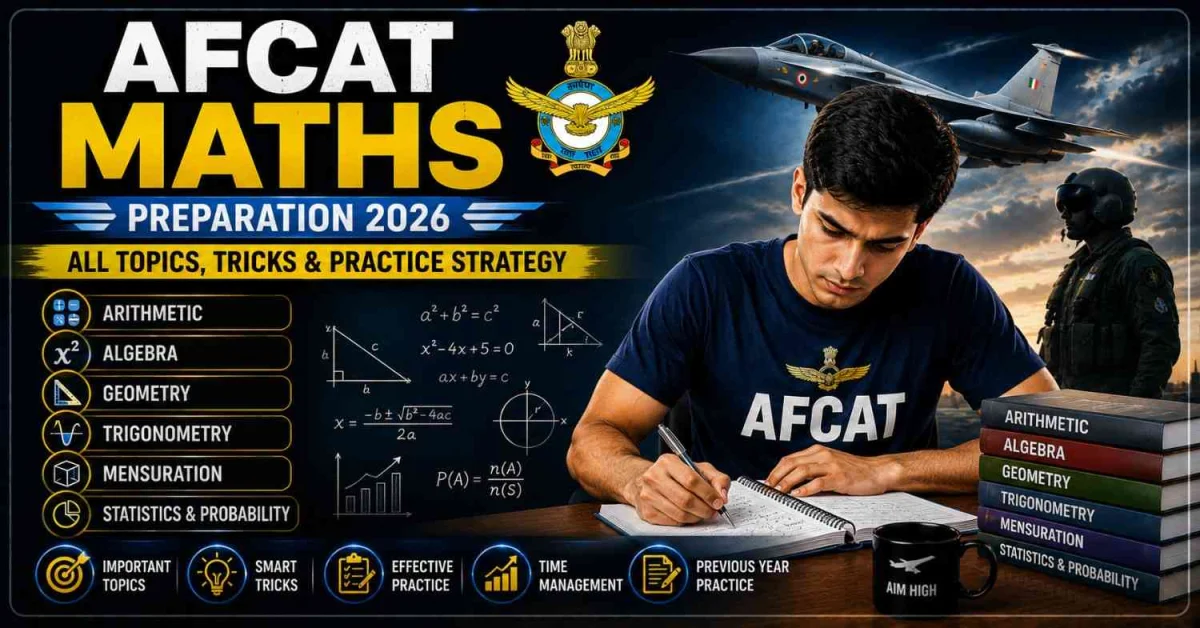
AFCAT Maths Preparation 2026: All Topics, Tricks & Practice Strategy
For many defence aspirants, the Mathematics section in AFCAT becomes one of the biggest challenges during preparation. Some students fear calculations, while others struggle with speed and accuracy under time pressure. However, the truth is that AFCAT Maths is not extremely difficult if approached with the right strategy.
The Numerical Ability section in AFCAT mainly tests basic aptitude, logical calculations, and problem-solving speed. Most questions are based on Class 10 level mathematics, which means the focus is more on accuracy and time management rather than advanced concepts.
Still, many candidates lose marks because they either ignore Maths completely or prepare it in the wrong way. Some spend too much time on difficult topics, while others practice without understanding concepts properly.
If you are preparing for AFCAT 2026, this complete guide will help you understand all important Maths topics, shortcut tricks, preparation methods, and practice strategies needed to score well in the exam.
Recent AFCAT exam analysis continues to show that Arithmetic and basic aptitude dominate the Numerical Ability section.
Understanding the AFCAT Maths Section
Before starting preparation, candidates must clearly understand the role of Maths in AFCAT.
The Numerical Ability section is designed to test:
-
Calculation speed
-
Logical thinking
-
Basic mathematical understanding
-
Problem-solving ability
Unlike engineering-level competitive exams, AFCAT does not ask highly advanced mathematics questions. Most questions are direct and manageable if your basics are strong.
The challenge is not difficulty it is solving questions quickly and accurately within limited time.
AFCAT Maths Exam Pattern
The Maths section is part of the AFCAT written examination.
Although the number of Maths questions is not extremely high, this section can significantly affect your overall score because many candidates lose time here.
A strong Maths strategy can therefore create a major advantage.
Why Many Students Struggle in AFCAT Maths
One of the biggest reasons candidates struggle in AFCAT Maths is fear. Many students believe Maths requires exceptional intelligence, but AFCAT aptitude questions are mostly formula-based and practice-oriented.
Another common mistake is inconsistent practice. Numerical Ability improves only through daily problem-solving.
Candidates also waste time memorizing difficult shortcut tricks without understanding concepts first. In AFCAT, clarity is more important than complicated techniques.
Important Topics for AFCAT Maths 2026
The AFCAT Maths syllabus mainly focuses on arithmetic and basic aptitude topics.
Understanding topic priority is important because not every chapter carries equal weightage.
Arithmetic Topics
Arithmetic forms the core of AFCAT Maths preparation.
Percentage
Percentage-based questions appear very frequently in AFCAT.
Candidates should learn:
-
Percentage increase/decrease
-
Profit and loss percentage
-
Percentage conversion tricks
Strong percentage understanding also helps in many other chapters.
Ratio and Proportion
Ratio questions are usually straightforward but require fast calculations.
Focus on:
-
Direct proportion
-
Partnership problems
-
Ratio simplification
This topic is scoring if practiced properly.
Average
Average is one of the easiest chapters in AFCAT Maths.
Questions may involve:
-
Simple averages
-
Weighted averages
-
Combined averages
Learning shortcut formulas can save time here.
Profit and Loss
Profit and Loss questions are highly common in AFCAT.
Important concepts include:
-
Discount
-
Marked price
-
Successive percentage changes
Most questions are formula-based and easy to solve with practice.
Time, Speed and Distance
This chapter tests practical problem-solving ability.
Important areas include:
-
Relative speed
-
Trains
-
Boats and streams
Candidates often lose time here because of calculation mistakes.
Time and Work
Time and Work is another scoring topic if concepts are clear.
Focus on:
-
Efficiency method
-
Work equivalence
-
Pipe and cistern questions
Practice is the key to mastering this chapter.
Simple and Compound Interest
Questions from SI and CI are usually direct and formula-based.
Candidates should memorize:
-
Interest formulas
-
Growth calculations
-
Compound percentage tricks
This topic becomes easy once formulas are revised regularly.
Number System Topics
Number System questions test mathematical logic and calculation ability.
Divisibility Rules
Basic divisibility concepts save significant calculation time.
Candidates should know:
-
Prime numbers
-
Factors and multiples
-
Remainder concepts
HCF and LCM
These are simple but important chapters.
Questions may involve:
-
Least common multiple
-
Greatest common divisor
-
Word-based problems
Strong basics are enough to solve most questions.
Algebra Basics
AFCAT may include basic algebraic aptitude questions.
Focus on:
-
Linear equations
-
Simplification
-
Basic identities
Advanced algebra is generally unnecessary for AFCAT preparation.
Geometry and Mensuration
Geometry questions in AFCAT are usually formula-oriented.
Mensuration
Candidates should memorize formulas related to:
-
Area
-
Volume
-
Perimeter
-
Surface area
Questions are generally direct and scoring.
Basic Geometry
Important concepts include:
-
Angles
-
Triangles
-
Circles
-
Quadrilaterals
Visual understanding helps more than memorization here.
Data Interpretation Basics
Although AFCAT DI questions are usually simple, candidates must practice:
-
Tables
-
Pie charts
-
Graph interpretation
The focus is mainly on quick calculation ability.
Smart Strategy for AFCAT Maths Preparation
Many students study Maths inefficiently. Smart preparation matters more than studying for endless hours.
Build Concepts Before Shortcuts
One major mistake candidates make is directly memorizing tricks without understanding concepts.
Shortcut methods work only when fundamentals are clear.
Start with:
-
Basic formulas
-
Standard methods
-
Concept clarity
Once your understanding improves, shortcuts naturally become easier.
Practice Daily Without Fail
Maths is a skill-based subject. Reading formulas alone will never improve speed.
Even solving 20–30 questions daily creates huge improvement over time.
Consistency matters more than intensity.
Focus More on Accuracy Than Speed Initially
Many aspirants rush to improve speed immediately and start making mistakes.
First focus on:
-
Correct methods
-
Concept understanding
-
Calculation accuracy
Speed automatically improves with repeated practice.
Use Timed Practice Sessions
After building confidence, start solving questions with timers.
This helps in:
-
Time management
-
Mental pressure handling
-
Faster calculations
AFCAT is a speed-based exam, so timed practice is extremely important.
Best Shortcut Tricks for AFCAT Maths
Shortcuts can save valuable seconds during the exam.
Percentage to Fraction Conversion
Memorizing common conversions helps solve aptitude questions quickly.
Examples:
These small tricks improve speed significantly.
Multiplication Approximation Techniques
Learning approximation methods helps in DI and arithmetic calculations.
Instead of exact, lengthy calculations, smart approximations can often provide the answer faster.
Vedic Maths Basics
Basic Vedic Maths techniques may help in:
-
Fast multiplication
-
Squaring numbers
-
Simplification
However, candidates should avoid depending completely on advanced Vedic methods.
Importance of Mock Tests in AFCAT Maths
Mock tests are extremely important because they simulate real exam pressure.
Many students perform well during practice but panic during actual exams.
Mock tests help improve:
-
Confidence
-
Speed
-
Time allocation
-
Pressure handling
They also reveal weak chapters that need more revision.
How to Analyze Maths Mistakes
Simply solving tests is not enough.
After every mock test, analyze:
-
Which chapters consumed most time?
-
Where did calculation errors happen?
-
Which formulas were forgotten?
This analysis improves performance much faster than random practice.
Best Books for AFCAT Maths Preparation
Choosing too many books creates confusion. Limited and reliable resources work best.
Strong basics matter more than difficult advanced-level books.
30-Day AFCAT Maths Practice Plan
A structured routine helps maintain consistency.
Week 1
Focus on:
-
Percentage
-
Ratio
-
Average
Week 2
Study:
-
Profit and Loss
-
Time and Work
-
SI & CI
Week 3
Cover:
-
Number System
-
Mensuration
-
Geometry basics
Week 4
Focus completely on:
-
Mock tests
-
Timed practice
-
Revision
This structured approach prevents confusion.
Common Mistakes Candidates Make in AFCAT Maths
Many students reduce their score because of avoidable mistakes.
Some major errors include:
-
Ignoring basics
-
Memorizing tricks blindly
-
Lack of daily practice
-
Poor revision
-
Fear of Maths
The biggest mistake is avoiding Maths completely.
Even average students can improve significantly with consistent practice.
Can Weak Maths Students Score Well in AFCAT?
Yes, absolutely.
The AFCAT Maths level is moderate, and many non-maths students clear the exam every year.
The key is:
-
Strong basics
-
Daily practice
-
Formula revision
-
Mock test exposure
You do not need advanced mathematical talent to score well in AFCAT.
Final Tips for AFCAT Maths 2026
The smartest approach for AFCAT Maths preparation is balance.
Do not:
-
Ignore Maths completely
-
Spend excessive time on difficult tricks
-
Panic because of calculations
Instead:
-
Focus on basics
-
Practice consistently
-
Revise formulas regularly
-
Solve timed mock tests
Improvement in Maths happens gradually, not overnight.
Conclusion
AFCAT Maths 2026 is not about advanced mathematics it is about smart preparation, speed, and consistent practice. Candidates who focus on fundamentals, practice daily, and revise regularly can comfortably score well in the Numerical Ability section.
Instead of fearing Maths, approach it as a skill that improves with repetition. With the right strategy, even average students can turn Numerical Ability into a scoring section in AFCAT.
Your first goal should not be perfection it should be steady improvement every day.
FAQs on AFCAT Maths Preparation
Is AFCAT Maths difficult?
No, the level is moderate and mostly based on Class 10 mathematics.
Which topics are most important in AFCAT Maths?
Arithmetic topics like Percentage, Ratio, Profit & Loss, and Time & Work are very important.
Can non-maths students crack AFCAT?
Yes, many non-maths students successfully clear AFCAT every year.
How many Maths questions come in AFCAT?
Around 18 questions are generally asked from Numerical Ability.
Are shortcut tricks important for AFCAT Maths?
Yes, but concepts and accuracy should be prioritized before shortcuts.