AFCAT for Women 2027: Branches Open, Eligibility Criteria
Quick summary
Women can apply for every branch in AFCAT 01/2027. Check age limits, qualifications, height standards, SSC and PC terms and the steps to apply before 11 December 2026.
Women can apply for the Flying Branch and both Ground Duty streams (Technical and Non-Technical) through AFCAT 01/2027. The age limit is 20 to 24 years for Flying and 20 to 26 years for Ground Duty, as on 1 January 2028. Online applications open on 12 November 2026. Branch-wise vacancy numbers await the detailed notification.
You open the AFCAT notification and still cannot find a straight answer to the one question that matters: which of these branches will take you? Most roundups list eligibility for all candidates together. Women end up piecing together height rules, degree conditions and commission types from three different pages.
This guide on AFCAT for women puts it all in one place. It covers branch-by-branch eligibility, the physical standards that filter female applicants, and what Short Service and Permanent Commission mean for your career. It also walks you through the online form step by step, before the window closes on 11 December 2026.
Which Branches Can Women Apply for in AFCAT 01/2027?
Every branch offered in this cycle is open to female candidates. The only gender-specific differences are minimum height in Ground Duty and the type of commission available in the Flying Branch. Your degree decides your branch, not your gender. Use this snapshot as a first filter on AFCAT for women, then check the detailed branch rules below.
Branch-Wise Eligibility Criteria for Female Candidates
Eligibility in AFCAT is decided branch by branch, and three filters apply to every applicant: age, academic stream and marks. Age is calculated against a fixed reference date, not the exam date. Marital status also matters. Candidates must be unmarried when the course begins.
The rules below come from the short notice for this cycle and earlier official notifications. Full qualifications and medical standards sit in the detailed notification on afcat.edcil.co.in. Treat this section as a working summary and confirm your branch there before you pay the fee.
Flying Branch: Age, Education and Vision Requirements for Women
Your date of birth must fall between 2 January 2004 and 1 January 2008, both dates inclusive. Holders of a valid DGCA Commercial Pilot Licence can apply up to 26 years.
Academically, you need Physics and Maths at 10+2 with at least 50% in each. On top of that, you need one of these: a graduation in any discipline with 60%, a BE/B.Tech with 60%, or Sections A and B of the Institution of Engineers (India) or Aeronautical Society of India exam with 60%. The 10+2 condition follows you even if your degree is in arts.
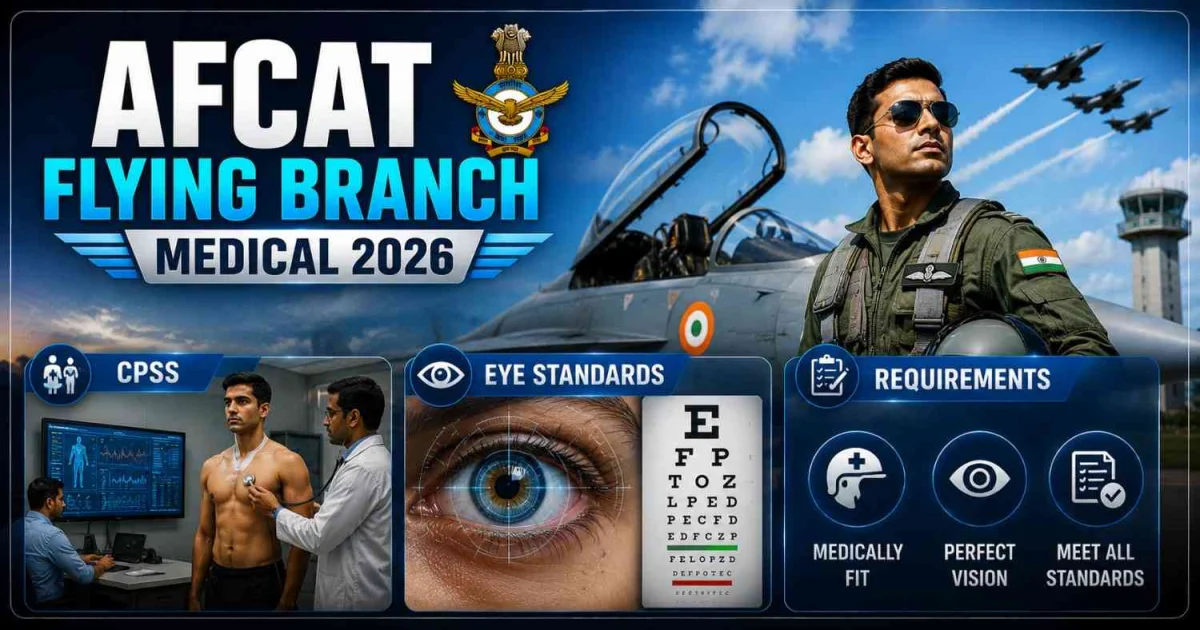
Vision is the strictest filter here, and the standards are tighter than for Ground Duty. Confirm the exact limits in the detailed notification. Flying aspirants also take the Computerised Pilot Selection System (CPSS) at the selection board, so practise coordination and instrument-reading drills well before that stage.
Ground Duty (Technical): Is It Open to Women via AFCAT?
Yes. Women can enter the Aeronautical Engineer branches, AE(L) and AE(M), through AFCAT.
Technical applicants sit an extra paper, the Engineering Knowledge Test. It is held immediately after AFCAT on the same day and runs for 45 minutes, with 50 questions carrying 150 marks.
A second route exists for engineers with a valid score: GATE Score Entry, which charges no application fee. If your degree discipline is not listed in the notification, you cannot apply for a technical branch, whichever route you pick.
Ground Duty (Non-Technical): Administration, Logistics, Accounts, Education
Your date of birth for any Ground Duty branch must fall between 2 January 2002 and 1 January 2008. That wider window makes these AFCAT branches open to women a realistic option for postgraduates and working graduates.
Weapon Systems: Class 12 with Maths and Physics, plus a three-year graduation in any discipline or a four-year BE/B.Tech.
Accounts: B.Com (minimum 3 years), BBA (Finance), BMS (Finance), BBS (Finance) or B.Sc. with a Finance specialisation.
Education: a graduate degree plus a postgraduate degree in any discipline. Check the marks required in the detailed notification.
Ground Duty vision standards are more relaxed than Flying, and correction is permitted within limits.
Meteorology Branch
This branch suits women with a strong science background, particularly graduates in Physics and Mathematics or related engineering fields. It rewards analytical work on weather, wind and ocean data, the forecasts that every sortie and naval-air operation depends on.
Meteorology sits within Ground Duty, so the Ground Duty age band applies. The accepted B.Sc. and engineering disciplines, and the marks required in each, are set out in full only in the detailed notification. The short notice for this cycle lists just a B.Sc. with Physics and Maths or an eligible four-year engineering degree, so read the official PDF line by line before applying. A clear summary of the cycle is available in this AFCAT 01/2027 notification breakdown, but the official document remains the final authority.
AFCAT 2027 Women Vacancies: Flying, Ground Duty and Meteorology
Recent notifications list vacancies separately for men and women, and those seat counts have not yet been released for this cycle.
Seat numbers change from one cycle to the next. Treat any figure you see before the detailed AFCAT 01 2027 notification appears on afcat.edcil.co.in as unconfirmed. This report on the AFCAT 01/2027 launch covers the official announcement.
Physical Standards for Female AFCAT Candidates in 2027
Height is the standard that separates women’s eligibility by branch, and the gap is wide. Measure yourself against this table before you aim for an IAF women officer vacancy in 2027.
Weight charts and colour vision grades appear only in the detailed notification. Confirm both there before you apply.
Short Service Commission vs Permanent Commission: What Women Get Through AFCAT
Through AFCAT, women are commissioned on Short Service Commission (SSC) in the Flying Branch, and on either SSC or Permanent Commission (PC) in Ground Duty. In the Flying Branch, SSC runs for 14 years from the date of commissioning. Ground Duty (Technical and Non-Technical) SSC carries an initial 10 years. An extension of 4 years may be granted based on service needs, vacancies, willingness, suitability and merit.
The type of commission is one of the few real differences in AFCAT flying branch women eligibility. The short notice lists Permanent Commission courses for Ground Duty as open to men and women, but the Flying PC course under NCC Special Entry is listed for men only. Check the detailed notification for the current rules, and plan your Flying career on the SSC tenure until those rules confirm otherwise.
Branches Women Cannot Enter Through AFCAT 01/2027
No branch is closed to women because of gender, apart from the Flying Permanent Commission course under NCC Special Entry, which is listed for men only. What stops most female applicants is a mismatch between the entry route and their qualifications. Check these three points before you use the AFCAT apply online form:
NCC Special Entry without NCC eligibility: This is a separate entry that covers the Flying Branch only. It charges no fee. You must meet the NCC criteria set out in the detailed notification.
Technical branches without a listed engineering degree: Neither the AFCAT route nor GATE Score Entry will accept your application.
Non-AFCAT entries: This exam does not lead to any branch outside the Flying and Ground Duty streams.
Getting AFCAT for women right means matching your degree and certificates to the entry route, not just choosing a branch.
Step-by-Step AFCAT 01/2027 Application Guide for Women
The AFCAT apply online process takes less than an hour if your documents are ready. Most rejections happen because of a wrong branch choice or a careless upload, and those errors are hard to fix later. The six steps below follow the order of the official portal.
Keep one point in mind throughout: the short notice is a summary. Full qualifications, physical standards and medical rules appear only in the detailed notification. Read it before you begin. Set aside two quiet sessions. Use the first to prepare files and the second to fill and submit the form.
Step 1: Check the Official Notification at afcat.edcil.co.in
Start with the official portal named in the IAF announcement, afcat.edcil.co.in. Use only this official address. Ignore forwarded PDFs on messaging groups, which are often outdated or edited.
As you read, note three things. First, check your branch’s date-of-birth window. Second, confirm the degree and marks conditions for your stream. Third, look at the height and vision standards that apply to women. Training for this cycle is scheduled to begin in the first week of January 2028. The exam date, admit card release and AFSB interview schedule are still to be announced.
Step 2: Register and Create Your Login
Register with an email address and mobile number that you will keep active until training begins. Every update, including the admit card notice and the AFSB call, reaches you through these contact details. A college email that expires after graduation is a common trap.
Enter your name exactly as it appears on your Class 10 certificate. Spelling, initials and surname order should match across every document you upload later. Save your login credentials in two places. Many candidates lose access just before the deadline and waste hours on password recovery.
Step 3: Fill the Online Application Form (Branch Selection Tips for Women)
The form asks for personal details, academic records and branch preferences. Enter percentages exactly as printed on your marksheets. Do not round 59.6% up to 60%, because the cut-off is applied strictly.
Branch selection deserves the most care. Use these checks:
Height first: If you are below the Flying Branch minimum covered above, list Ground Duty branches you actually qualify for.
Stream match: Choose Accounts only with a finance degree. Choose a technical branch only with a listed engineering discipline.
Technical paper: Selecting Ground Duty (Technical) adds the EKT to your exam day, so plan your preparation for both papers.
Step 4: Upload Documents (Photo, Signature, Thumb Impression)
Scan everything before you log in. You will typically upload a recent photograph, your signature and your thumb impression (left thumb for men, right thumb for women). Keep your Class 10 certificate for date of birth, your 10+2 marksheet and your degree certificate or marksheets ready for the later selection stages. File size, format and dimensions are set in the detailed notification, so resize to those exact limits.
Photos cause the most trouble. Use a plain light background, face the camera directly and keep your face fully visible. Sign on white paper in dark ink. Final-year students should check how the notification treats candidates whose results are still pending, and upload whatever proof it asks for.
Step 5: Pay the Application Fee
Candidates applying through AFCAT Entry pay a non-refundable examination fee of ₹550 plus GST. Payment is made online. The fee follows previous AFCAT cycles, so confirm the final amount in the detailed notification.
Pay a few days before the last date, not on it. Payment gateways slow down sharply during the final hours. If money leaves your account but the portal shows the payment as failed, do not pay again immediately. Note the transaction ID, wait for the status to update and contact the helpdesk listed in the notification. Because the fee is non-refundable, verify your branch choice before you pay.
Step 6: Download and Save the Confirmation Page
After a successful submission, the portal generates a confirmation page. Download it as a PDF, print two copies and email one to yourself. It is your proof of application if anything goes wrong later.
Check the printout carefully against your documents. Look at your name, date of birth, branch preferences and category. If you spot an error, find out whether the portal allows corrections during the application window. Then plan your preparation around the written test. It has 100 questions carrying 300 marks over 2 hours. Each wrong answer costs 1 mark.
Document Checklist for Female AFCAT Applicants
Gather these before you open the portal, and tick each one off as you scan it. One clean folder saves you from hunting for files mid-application.
Matriculation (Class 10) certificate: your accepted proof of date of birth.
10+2 marksheet: it must show separate Physics and Maths marks for Flying or technical branches.
Degree marksheets: every semester or year, plus the final or provisional certificate.
ID proof: original Aadhaar (mandatory for registration) and a second government photo ID such as PAN or passport, for exam day.
Photograph, signature and thumb impression: recent scans, sized to the detailed notification’s specification.
Caste or category certificate: only if applicable.
NCC certificate: required for NCC Special Entry women applicants.
Keep originals and self-attested copies together. Later selection stages will ask for them.
Common Mistakes Female AFCAT Applicants Must Avoid
Each of these errors can cost you a full cycle, so check them before you submit.
Wrong stream for the branch: An arts graduate without Physics and Maths at 10+2 cannot enter Flying, however strong her degree marks.
Underestimating Flying vision: Get a proper eye test before you list Flying first.
Ignoring commission type: SSC tenure differs between Flying and Ground Duty, as covered above. Pick the career length that suits you.
Non-compliant photos: Selfies, dark backgrounds or wrong dimensions invite rejection.
Skipping the vacancy check: Confirm in the detailed notification whether your branch offers SSC or PC seats before you submit.
FAQs
Which branches are open for women in AFCAT 01/2027?
All of them. That includes Flying, Ground Duty (Technical) and Ground Duty (Non-Technical), as listed in the snapshot table above.
What is the age limit for female candidates in AFCAT 2027?
The limits are the same as for men. See the branch-wise eligibility section above.
Can women get Permanent Commission through AFCAT?
Entry in the Flying Branch is on SSC, while Ground Duty lists PC courses open to men and women. Check the detailed notification for the current PC terms.
How many vacancies are available for women in AFCAT 2027 Flying Branch?
The numbers have not been released yet. Watch the official portal for them.
What is the minimum height for female AFCAT candidates?
It depends on the branch. See the physical standards table above.
What is the step-by-step process for women to apply for AFCAT 01/2027?
Follow the six steps above, from registration to saving your confirmation page.
Tags
- AFCAT for women
- AFCAT 2027 eligibility for women
- AFCAT 01/2027
- AFCAT women height
- AFCAT flying branch women eligibility
- AFCAT ground duty women
- AFCAT SSC and PC women
- IAF women officer vacancy 2027
- AFCAT application guide
- AFCAT age limit 2027