AFCAT English Preparation: Cloze Test, Comprehension and Error Detection


Quick summary
The AFCAT English section rewards steady practice. Learn how to handle cloze tests, comprehension and error detection, with a 4-week plan and a timing rule.
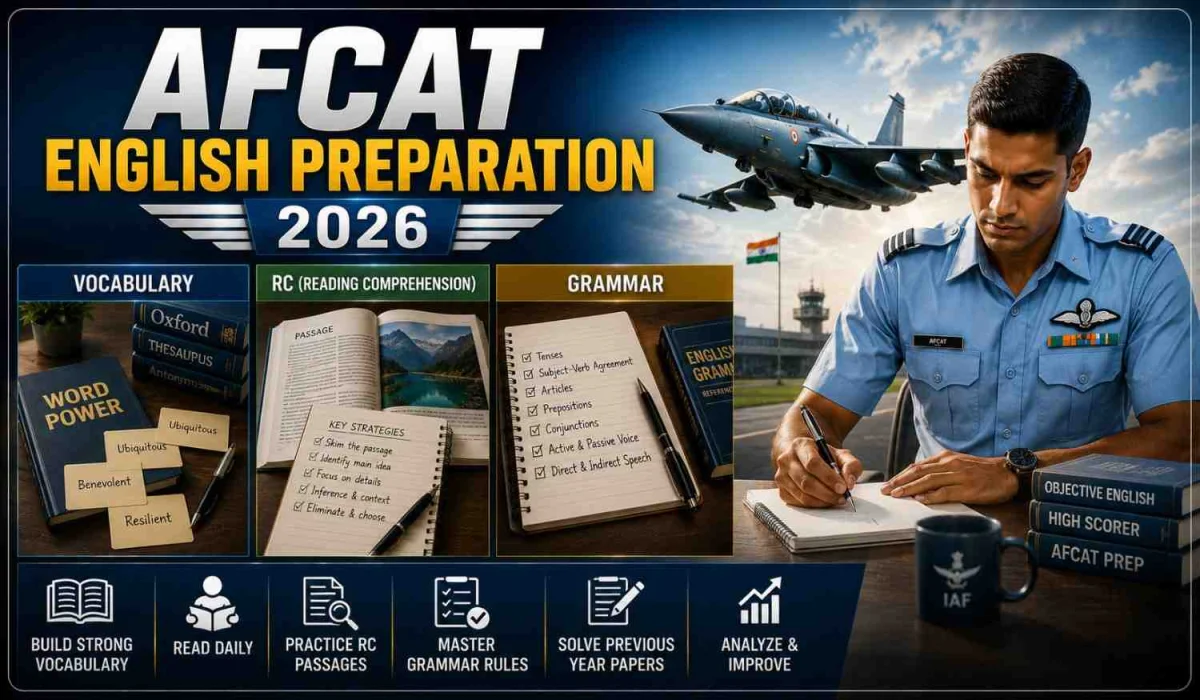
The Verbal Ability in English section is usually the most scoring part of AFCAT, because it rewards habits you can build in weeks. This guide covers the three question types that need the most practice, with a short plan and a timing rule.
What the English Section Covers
Recent papers have mixed comprehension, cloze passages, error detection, sentence completion, synonyms, antonyms and idioms. The exact question count varies between cycles, and one 2-hour timer covers all four sections, so check the current notification and track your own pace.
Cloze Test
A cloze test is a passage with gaps, each with four options.
- Read the whole passage first. Skim once without looking at the options, so you know the topic and tone.
- Use grammar clues. Check tense, number, prepositions and whether the gap needs a noun, verb or adjective.
- Check word pairs. Many answers are fixed combinations such as "take place" or "in charge of".
- Fill the easy gaps first. The answers often help you with the harder ones.
- Reread the sentence with your answer. If it sounds wrong, change it.
Comprehension
Passages are usually short, and questions test main idea, tone, inference and vocabulary in context.
- Skim the passage, then read the questions. Go back to the text for each one.
- Answer from the passage only. Outside knowledge and personal opinion lose marks.
- Watch extreme words. Options with "always", "never" or "only" are often wrong.
- For main idea questions, pick the option that covers the whole passage, not one detail.
- For vocabulary in context, substitute each option into the sentence.
Practise with a daily editorial or article from a newspaper such as The Hindu or The Indian Express. After each one, write the main idea in one sentence.
Error Detection
You find the part of a sentence that has a mistake. Check these in order:
- Subject-verb agreement: "The team of players are..." is wrong.
- Tense consistency within the sentence.
- Prepositions: "discuss about", "comprise of" and "despite of" are common traps.
- Articles: a, an and the used or missing.
- Pronouns: a pronoun must match its noun in number and person.
- Parallel structure: "She likes reading, to swim and cooking" breaks it.
If an option says "no error", do not choose it unless you have checked all six points. Read the sentence aloud in your head, because your ear often catches what your eye misses.
Vocabulary in Five Minutes a Day
Synonyms, antonyms and idioms need steady exposure, not cramming.
- Learn 8 to 10 new words a day, with a sentence for each.
- Group words by meaning, such as words for "praise" or "criticise".
- Keep a short idiom list and revise it every few days.
- Note any word you got wrong in a mock, and revise it the next day.
Time and Negative Marking
AFCAT gives +3 for a correct answer and −1 for a wrong one, so the break-even point is a 25% chance of being right. Guess only when you can remove at least one option, and skip questions where you can't.
There is no separate timer for English, so aim to finish the section in about 25 to 30 minutes, leaving time for the other three. Adjust this after your first few mocks.
A 4-Week Plan
| Week | Focus |
|---|---|
| Week 1 | Grammar rules for error detection, 10 sentences a day, plus daily vocabulary |
| Week 2 | One comprehension passage and one cloze test daily, with errors logged |
| Week 3 | Sectional tests, timed at 25 minutes, and review of every wrong answer |
| Week 4 | Two full AFCAT mocks and revision of your error log |
Common Mistakes
- Reading passages word by word. Skim first, then search for answers.
- Choosing options that sound clever. Pick the one the text supports.
- Skipping the error log. The same mistakes repeat until you write them down.
- Ignoring negative marking. Wild guesses cost more than blanks.
- Leaving English for the last week. It improves slowly, so start early.
FAQs
Which English topics matter most for AFCAT?
Comprehension, cloze tests and error detection give you the most to practise, along with vocabulary and sentence completion. The mix varies by cycle, so use recent papers to see what comes up most.
How can I improve my English for AFCAT quickly?
Read one editorial a day, solve 10 grammar questions, and learn a few words with sentences. Review your mistakes every evening. Four weeks of this routine is enough to see a clear improvement.
Should I attempt every English question?
No. Because wrong answers cost 1 mark, attempt a question only if you can eliminate at least one option. Skip the ones you can't narrow down.
Tags
- AFCAT English preparation
- AFCAT cloze test
- AFCAT comprehension
- AFCAT error detection
- Verbal Ability in English AFCAT
- AFCAT English syllabus
- AFCAT vocabulary
- AFCAT negative marking