What Does "Conference Out" Actually Mean in SSB?
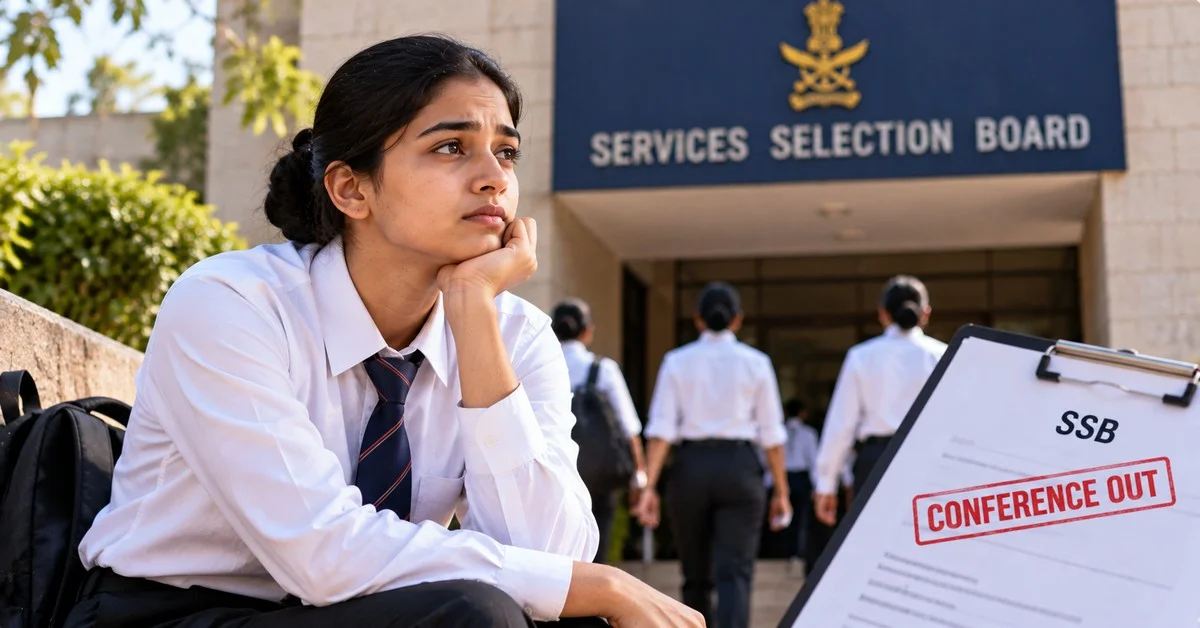
Got conference out in SSB? Learn what the result really means, how the IO, GTO and Psychologist reach a decision, the key difference from screening out, the most common reasons, and a 90-day plan to clear SSB on your next attempt.
Conference Out in SSB: Why It Happens and What to Change Next Time
Getting conference out in SSB is one of the most disorienting results a defense aspirant can receive. You completed five full days of testing, survived every stage, sat through the conference, and still came home without a recommendation. That stings differently from a Day 1 screen-out, and it should, because the two outcomes mean very different things about where you stand, particularly when it comes to understanding why candidates get conference out in SSB.
This article explains exactly what the conference out result means, why it happens, and what a structured recovery looks like. Whether this is your first conference out or your second, the path forward starts with an honest read of what went wrong, and the same principle applies when thinking about screened out vs conference out SSB.
Conference out in SSB refers to the outcome where a candidate completes the full SSB five-day assessment but is not recommended by the board of assessors at the final conference stage. The candidate passed Day 1 screening, participated in all psychological tests, GTO tasks, and the personal interview, yet the collective assessor panel decided the Officer Like Qualities observed were insufficient for a recommendation. This distinction matters when comparing screened out vs conference out SSB.
The conference itself is a structured discussion held on Day 5 of the Services Selection Board process. All three assessors, the Interviewing Officer (IO), the Group Testing Officer (GTO), and the Psychologist, present their individual evaluations of each candidate. The board then arrives at a consensus decision: recommended or conference out. Keeping this process in mind is essential for anyone thinking about how to clear SSB after conference out.
A critical point that many aspirants overlook: being conference out means you were evaluated in full. The board had five days of data on you. They saw your responses in WAT TAT exercises, your behavior in GTO tasks, and your answers during the Personal Interview SSB session. The decision to not recommend you was made with complete information, which makes it both harder to hear and more useful to analyze. This applies equally to SSB interview rejection reasons.
According to sources at SSBCrack, only about 1 in 30 candidates who appear for SSB ultimately gets recommended, which places the conference out outcome firmly in the majority category. Understanding it clearly is the first step toward changing it, and that matters just as much for SSB interview rejection reasons.
Screened Out vs Conference Out: Key Difference
The confusion between screened out and conference out is genuinely common, and it matters because the two outcomes carry completely different implications for your next attempt, especially when considering SSB assessors evaluation criteria.
Screened out means elimination on Day 1, specifically after the Officer Intelligence Rating (OIR) test and the Picture Perception and Discussion Test (PPDT). A screened-out candidate never enters the SSB five-day assessment proper. They return home after the first day without any exposure to GTO tasks, psychological testing, or the personal interview.
Conference out, by contrast, means the candidate completed all stages of the assessment and still was not recommended at the final board review. The gap between these two outcomes is significant. A conference-out candidate has demonstrated enough initial potential to pass screening, which is itself a filter that eliminates a large portion of applicants. As Centurion Defence Academy notes, conference-out candidates are often closer to the standard than they realize. They fell short at the final review, not at the entry point.
This distinction should reframe how you approach your SSB repeat attempt strategy. A screened-out candidate needs to rebuild from foundational aptitude. A conference-out candidate needs a precision audit of OLQ demonstration across five days, because the raw material was there and the expression of it simply was not convincing enough.
Both outcomes allow for future attempts within the eligibility window, but preparation must be calibrated to the specific failure point.
How the SSB Conference Round Decision Is Made
The SSB conference round operates on a three-assessor consensus model. The IO, GTO, and Psychologist each independently form a view of the candidate's Officer Like Qualities (OLQs) across 15 defined traits. These include effective intelligence, social adaptability, courage, initiative, and stamina, among others.
During the conference, each assessor presents their findings. For a candidate to receive an SSB board recommendation, all three assessors must broadly agree that the candidate meets the officer standard. When two assessors are positive but one has significant reservations, the borderline candidate will frequently end up conference out. A single dissenting assessor, backed by specific behavioral evidence from their domain, carries enough weight to shift the outcome.
This structure explains why isolated strong performances are not enough. A candidate who dominated GTO tasks but gave inconsistent PIQ form answers and had a weak Psychologist assessment will face divergent assessor views at the conference table. The IO's read of the personal interview, the GTO's read of group and individual tasks, and the Psychologist's read of SSB psychological tests must all point in the same direction.
The SSB assessors evaluation criteria are not based on a single test score. They are based on behavioral patterns observed across multiple tasks and contexts. Candidates who perform well in one domain but underperform in another create conflicting profiles that assessors find difficult to recommend with confidence.
7 Common Reasons Candidates Get Conference Out in SSB
Understanding why candidates get conference out in SSB requires looking at the full five-day picture rather than any single moment. The most frequently observed reasons include:
-
Cross-stage inconsistency: Acting assertive in GTO tasks but hesitant during the personal interview, or writing bold WAT responses that contradict a passive group discussion style. Assessors compare notes and inconsistencies raise doubt.
-
Weak OLQ demonstration in GTO tasks: Participating in tasks without leading, following without taking initiative, or failing to demonstrate GTO tasks leadership at a moment when the situation clearly called for it.
-
Poor PIQ form answers: The Personal Information Questionnaire is the foundation of the IO's interview. Vague or generic PIQ entries give the IO little to probe, and shallow probing produces a thin behavioral record.
-
Low WAT TAT consistency: Psychological tests are designed to reveal stable personality patterns. Responses that vary dramatically in tone, values, or focus signal an inconsistent personality profile to the Psychologist.
-
Lack of a defining peak moment: Assessors look for at least one clear instance where a candidate's OLQs stood out unmistakably. Candidates who were uniformly average across all tasks, never rising to a moment, tend not to generate the kind of positive assessor recall needed at conference.
-
Body language disconnects: Confident written responses paired with closed or uncertain body language during the personal interview creates a credibility gap that the IO notes explicitly.
-
No self-awareness during the Psychologist assessment: Candidates who cannot articulate their own strengths, weaknesses, and past behavior with honesty and specificity give the Psychologist an incomplete picture to work with.
Honest Self-Audit: Questions to Ask After a Conference Out
Before planning your next attempt, a structured self-audit is essential. The goal is not to feel worse about what happened but to pinpoint the specific gaps that produced divergent assessor views. Work through each of the following questions honestly.
-
Was my IO performance consistent with my GTO performance? Did I present the same person in both contexts, or did my persona shift between formal interview and outdoor tasks?
-
Did I lead or only participate? Can I identify three specific moments during GTO tasks where I took initiative, not just contributed?
-
Was my PIQ story reflected in my interview answers? If my PIQ mentioned a leadership experience, did that story come through with behavioral detail during the personal interview SSB session?
-
Did my WAT TAT consistency hold across the full psychological testing phase? Were my responses grounded in actual values I can explain, or were they aspirational answers I thought the board wanted to hear?
-
Was there a moment in the five days where I clearly stood out, not just performed adequately?
-
Did my body language during the personal interview match the confidence I intended to project?
-
Could I clearly articulate what kind of officer I would be, or were my answers generic?
Write the answers down. This exercise converts a vague sense of failure into a concrete gap list that can drive specific preparation.
Actionable 90-Day Plan to Clear SSB After Conference Out
Knowing how to clear SSB after conference out requires a phased approach, not a volume increase in generic practice. The 90-day window breaks into three distinct phases.
Phase 1 (Days 1 to 30): Gap Analysis and OLQ Mapping. Use your self-audit answers to map which OLQs were likely weak. Study the 15 OLQs in depth and identify two or three where your behavior during the last attempt was inconsistent or absent. Read your PIQ responses again and revise them to include specific, behavioral examples rather than trait claims.
Phase 2 (Days 31 to 60): Structured Practice. Join a GTO practice group and focus specifically on leadership moments, not just participation. Run WAT TAT consistency drills by writing responses under timed conditions and reviewing them for thematic coherence. Practice speaking about your PIQ stories aloud until the narration is specific, confident, and consistent with your written answers. This is the phase where OLQ demonstration becomes habitual rather than performed.
Phase 3 (Days 61 to 90): Mock SSB and Feedback. Participate in a full mock SSB conducted by experienced evaluators. The goal is external feedback on cross-stage consistency, not just task performance scores. Peer feedback on body language and interview presence should be built into this phase. Use the feedback to calibrate, not to rebuild entirely. According to guidance from SSBCrack, the most effective improvement after conference out comes from targeted behavioral change, not from attempting more tests.
If You Were Conference Out Twice: What Must Change
Two conference-out results in a row send a clear signal: the preparation approach itself needs to change, not just the intensity. Many second-time conference-out candidates made the mistake of preparing harder at the same things rather than identifying what was fundamentally missing from their assessor profile.
The core issue is personality trait authenticity. Candidates who coach themselves to perform OLQs, rather than genuinely developing them, tend to produce the kind of inconsistency that creates dissenting assessor views. The IO, GTO, and Psychologist are trained to identify coached behavior. If your WAT TAT responses reflect one personality and your group discussion behavior reflects another, that gap shows up at the conference table.
For repeat-attempt candidates, the SSB repeat attempt strategy must prioritize genuine behavioral development. Spend time in real-world situations that require the OLQs you identified as weak. Lead actual groups, manage real responsibilities, and develop the habit of situational awareness in daily life. When assessors observe consistent behavior across five days and across three independent domains, that consistency is the product of who you actually are, not what you rehearsed.
Two conference-out results also mean you know the Services Selection Board process better than most candidates walking in for the first time. Use that familiarity as an advantage by preparing differently, not just more.
FAQs
What is conference out in SSB?
Conference out in SSB means a candidate completed the full five-day assessment but was not recommended by the board of assessors at the final conference stage due to insufficient Officer Like Qualities observed across the evaluation period.
What is the difference between screened out and conference out?
Screened out occurs on Day 1 after the OIR and PPDT tests, eliminating candidates before the main assessment begins. Conference out occurs on Day 5, after all five days of testing, when assessors determine during the conference that the candidate does not meet the OLQ standard for a recommendation.
How is the conference out decision made in SSB?
The IO, GTO, and Psychologist each present their independent evaluation of the candidate's OLQs. The board reaches a consensus. If the three assessors cannot agree that the candidate meets the officer standard, the candidate is conference out. One dissenting assessor can determine the outcome in borderline cases.
What percentage of SSB candidates get conference out vs recommended?
Approximately 1 in 30 candidates who appear for SSB receives a final recommendation. The remainder are either screened out on Day 1 or conference out after completing the full assessment, making conference out a very common outcome rather than an exceptional failure.
Can I clear SSB after being conference out twice?
Yes, but only if the preparation approach changes substantially. Two conference-out results indicate a consistent gap in OLQ demonstration or cross-stage inconsistency that more volume of the same preparation will not fix. Authentic behavioral development, targeted gap analysis, and mock SSB with structured feedback are necessary.
How many SSB attempts are allowed after conference out?
The number of permitted attempts depends on the specific entry, such as NDA, CDS, or Technical Entry, and the age eligibility window for that entry. Conference out does not permanently disqualify a candidate. Aspirants should check the notification for their chosen entry to confirm how many attempts remain within their eligibility window and plan their SSB repeat attempt strategy accordingly.