SSB Screening Test: How to Clear OIR and PPDT on Day 1
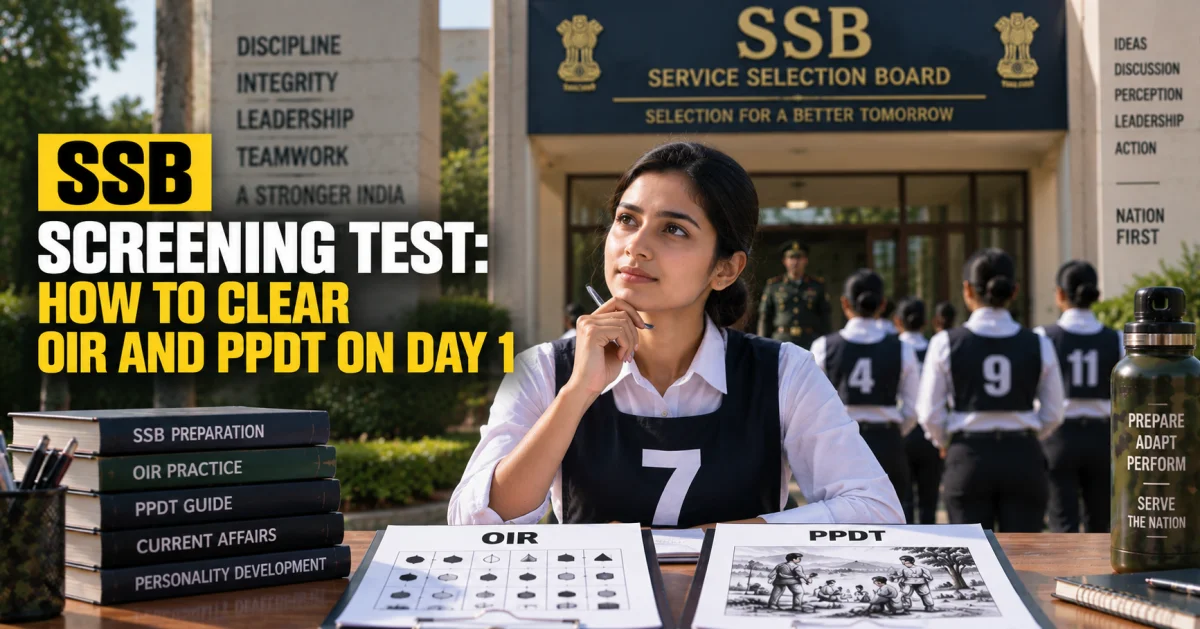
Learn how the SSB Screening Test works on Day 1, including OIR, PPDT, story writing, group discussion, and key strategies to clear screening.
Most candidates who reach the SSB screening test have already cleared a competitive written exam, whether NDA or CDS. The academic groundwork is done. What many of them lack is a clear picture of what actually happens on Day 1, how long each activity takes, what assessors are watching, and why roughly half the batch goes home that same evening. This guide walks through the entire day, section by section, in the order it unfolds, including what it actually takes to clear SSB Day 1.
The SSB screening test is not purely an intelligence check. It combines a structured reasoning assessment with a group observation exercise, and both components carry real weight in the screening decision. Understanding the format before you walk in is your first genuine advantage, and that applies just as much to the SSB PPDT group discussion as it does to the OIR.
What Happens on SSB Day 1: The Full Sequence
Reporting at an SSB board typically begins early, usually between 6:00 AM and 7:00 AM depending on the location. On arrival, candidates go through document verification, where original certificates, admit letters, and identity proof are checked against records. It is a procedural step, but a missing document can end your participation before the first test begins. Keep this in mind well before your board date, especially if you are tracking verbal nonverbal OIR questions for SSB preparation.
After verification, candidates are numbered and assigned to batches. The rest of the day follows a fixed sequence:
-
Officer Intelligence Rating (OIR) test, consisting of two booklets administered back to back with a short break between them.
-
Picture Perception and Description Test (PPDT), starting with a 30-second image exposure.
-
Individual story narrations, where each candidate reads aloud the story written during PPDT.
-
Group discussion on the same picture, leading to a common story agreed upon by the group.
-
Announcement of screened-in candidates, typically by late afternoon.
Candidates who clear this screening move on to Day 2 for psychological testing in defence and the subsequent GTO and interview stages. Those who do not are thanked and sent home the same day. Knowing this sequence ahead of time is part of what gives well-prepared candidates a genuine sense of calm during the SSB Day 1 procedure, rather than anxiety about what comes next.
For a detailed breakdown of each stage, the Defence Study explainer on SSB Stage 1 screening covers the procedural flow in full, including what document verification at SSB actually involves.
OIR Test Explained: Format, Difficulty, and What Assessors Measure
The OIR test in SSB, short for Officer Intelligence Rating, is a timed psychometric assessment that measures reasoning ability across two domains. Each domain comes as a separate booklet, and candidates will have timing, timings can vary slightly by board.
Booklet 1 covers verbal reasoning. Question types include analogies, number and letter series, vocabulary-based reasoning, and logical sentence completion. Booklet 2 covers nonverbal reasoning, built around pattern recognition, figure series questions, mirror images, and spatial arrangements.
Combined performance across both booklets produces an Officer Intelligence Rating on a scale of OIR grade 1 to 5, with Grade 1 being the highest. This grade is not announced to candidates, but it feeds directly into the screening decision, weighted alongside PPDT performance.
The difficulty is moderate by competitive exam standards. What makes the OIR test genuinely demanding is time pressure, not complexity. A candidate who can solve each question type comfortably will still struggle if they have not practiced at the actual pace. Accuracy matters because negative marking may apply, and a cluster of wrong attempts on pattern questions can pull the grade down considerably.
The Services Selection Board uses the OIR rating as an objective data point inside a screening process that is otherwise heavily observational. This makes the OIR the one component where structured practice has the most direct, measurable return on preparation time.
How to Prepare for the OIR Test: Verbal and Nonverbal Strategy
Preparing for verbal nonverbal OIR questions in SSB requires timed practice, not casual revision. Solving questions without a clock builds familiarity but does not build the speed the test actually demands. Start with topic-specific sets at your own pace to understand the question logic, then shift immediately to full timed booklets.
For verbal sections, focus on these areas in order of frequency:
-
Analogies based on relationships between words, numbers, or concepts.
-
Series completion for both letters and numbers, including mixed alternating patterns.
-
Vocabulary questions testing synonyms, antonyms, and odd-word-out formats.
For nonverbal reasoning, figure series questions and pattern completion are the most common types and also the fastest to answer once you identify the underlying rule. Prioritize these in practice because a strong nonverbal booklet can offset slower verbal performance.
Use a skip-and-return rule during the actual test. If a question takes more than 20 seconds and the answer is not coming, mark it and move on. Returning to skipped questions after finishing the rest protects your attempt rate without sacrificing accuracy on questions you can answer confidently.
Target an OIR Grade 2 or better for a competitive screening outcome. Grade 3 is technically a pass but may not hold up if PPDT performance is also average. The goal is to reach the PPDT with a strong OIR score already behind you.
The DDE complete guide on the SSB screening test includes worked examples of verbal and nonverbal question types that are worth going through as practice material.
PPDT Story Writing: What to Write in 4 Minutes
PPDT story writing in SSB begins with a hazy, ambiguous image shown for exactly 30 seconds. Once the image is removed, candidates have 4 minutes to write a complete story based on what they perceived. The short window forces quick, confident decisions about the scene rather than deliberating over multiple possible interpretations.
A functional PPDT story follows a three-part structure: situation, action, and outcome. The situation sets the context, the action shows your named hero responding to a challenge, and the outcome resolves the story positively. Three to five sentences cover this structure comfortably within 4 minutes.
The hero must be named. Anonymous protagonists like "a man" or "the person" weaken the story because assessors look for specificity and confident perception. Give the character a name, assign them a clear role, and show them taking initiative in response to a defined problem.
Avoid passive or negative heroes. A character who waits to be told what to do, who fails without trying, or who acts selfishly registers as poor officer material. The picture perception test is partly a personality window. Write a hero who acts, involves others, and brings resolution through teamwork rather than individual heroics.
Positive themes consistently produce stronger narratives. Disaster response, community leadership, overcoming adversity, and collaborative problem-solving all work well with assessors. Stay within the visual cues of the image and do not construct an entirely different setting from what was shown.
PPDT Group Discussion: How to Stand Out Without Standing Alone
Any practical SSB PPDT group discussion tips have to start with what assessors are actually measuring. The group discussion is not a debate. Nobody wins by proving their story is better than a peer's. Assessors observe how candidates communicate, whether they initiate or respond constructively, and whether the group moves toward a coherent common story by the end of the allotted time.
Opening the discussion is an advantage, but only if your opening is structured. State your story's core briefly, name the main character, and invite others to share their perception. This positions you as a leadership initiator without shutting down the room.
Common story convergence is the objective. By the final two to three minutes, the group should be building a single agreed narrative from elements contributed by multiple candidates. Candidates who keep arguing for their original version past this point are visibly working against group cohesion, and assessors notice.
If a peer makes a strong, logical point, acknowledge it and build on it. This demonstrates collaborative thinking, which is closer to what the Services Selection Board is looking for than conversational dominance. Going completely silent is equally damaging. Contribute at least two to three clear points during the session, even if the discussion is already active when you speak.
Body language matters throughout. Sit upright, make eye contact with peers when speaking, and avoid interrupting mid-sentence. These are visible signals that assessors read alongside the verbal content of the discussion.
Common Reasons Aspirants Get Screened Out on Day 1
Understanding why candidates fail the SSB screening test is as useful as knowing what to do right. The following patterns appear consistently across boards and entries:
-
Low OIR grade: A Grade 4 or 5 on the Officer Intelligence Rating is very difficult to overcome, even with a strong PPDT performance. Both scores feed into the combined screening decision.
-
Passive or negative story hero in PPDT: A character who complains, gives up, or acts unethically signals poor officer material to assessors reviewing the written sheets.
-
Dominating the GD without convergence: Candidates who speak loudly and frequently but do not help the group reach a common story often score lower on group cohesion markers than quieter, more cooperative participants.
-
Going silent in the GD: Non-participation is read as lack of confidence or disengagement. Both work against screening.
-
No convergent common story at the close: When a group ends the discussion still arguing over individual versions, every member risks being penalized for the collective failure to collaborate.
-
Poor body language: Slouching, avoiding eye contact, or looking disinterested during narrations and discussion are noted by SSB assessors who are observing continuously, not just during formal test windows.
Most of these failure points are preventable with deliberate practice before the board date.
SSB Screening Pass Rate: What the Numbers Tell You
The SSB interview pass percentage is frequently misunderstood. The overall final selection rate across most entries is very low, sometimes in the range of 1 to 5 percent of all candidates who appear at a board. This figure causes unnecessary alarm among first-timers, but it conflates two very different filters.
The Day 1 screening itself eliminates approximately 50 to 60 percent of candidates across most boards. That means 40 to 50 percent of the batch clears screening and proceeds to Days 2 through 5. For an NDA SSB interview batch of 30 candidates, that typically works out to 12 to 15 individuals moving forward after screening day.
For CDS SSB screening, the numbers follow a similar pattern, though batch sizes and board intensity can vary by entry type. The key point is that clearing the SSB screening test is an achievable, well-defined goal. The real filter for officer selection happens during the psychological testing, GTO tasks, and personal interview on the days that follow.
Walk into Day 1 with the goal of clearing screening, not with the weight of the entire selection process pressing down on you. A strong OIR grade, a positive PPDT story, and constructive participation in the group discussion are sufficient to move forward. What comes after is a separate preparation challenge entirely.
FAQs
What is the SSB screening test and what does it test on Day 1?
The SSB screening test is the first-day evaluation conducted by the Services Selection Board to shortlist candidates for the main five-day interview. It involves two components: the Officer Intelligence Rating test, which measures verbal and nonverbal reasoning, and the PPDT, which assesses perception, communication, and group behavior. Day 1 determines whether a candidate proceeds to psychological testing and the stages that follow.
How difficult is the OIR test in SSB and what type of questions are asked?
The OIR test in SSB is moderate in difficulty but highly time-pressured. Verbal questions cover analogies, series, and vocabulary. Nonverbal questions include figure series questions, pattern recognition, and spatial reasoning. Most candidates find individual questions manageable but struggle to complete both booklets accurately within the allotted time without prior timed practice.
How should I write a PPDT story for SSB and what format works best?
PPDT story writing in SSB works best with a named hero, a clear conflict drawn from the image, and a resolution achieved through initiative and teamwork. Use the situation-action-outcome structure and keep the story positive. Write for the 4-minute window; 3 to 5 sentences is the right length. Avoid vague characters and negative endings.
What happens in the PPDT group discussion and how are candidates assessed?
Each candidate narrates their story, and the group then discusses the image collectively to build one common story. SSB assessors observe communication quality, leadership initiation, and cooperative behavior. The goal is common story convergence, not winning the argument. Candidates who help the group reach agreement are assessed more favorably than those who dominate or disengage.
What is the pass percentage for SSB Day 1 screening?
Across most boards and entries, SSB Day 1 screening eliminates approximately 50 to 60 percent of candidates. The remaining 40 to 50 percent proceed to the main interview stages. The SSB interview pass percentage for final conference recommendation is much lower, but that figure should not shape how you approach Day 1 preparation specifically.
What are the most common reasons candidates get screened out in SSB?
The primary reasons include a low OIR grade 1 to 5 score, a passive or negative story hero in PPDT, failure to contribute constructively during the group discussion, and an inability to steer the group toward a common story by the close of the session. Poor body language during observation periods is also a documented factor in screening decisions.