PPDT Story Writing: Format, Sample Stories and Mistakes That Get You Screened Out
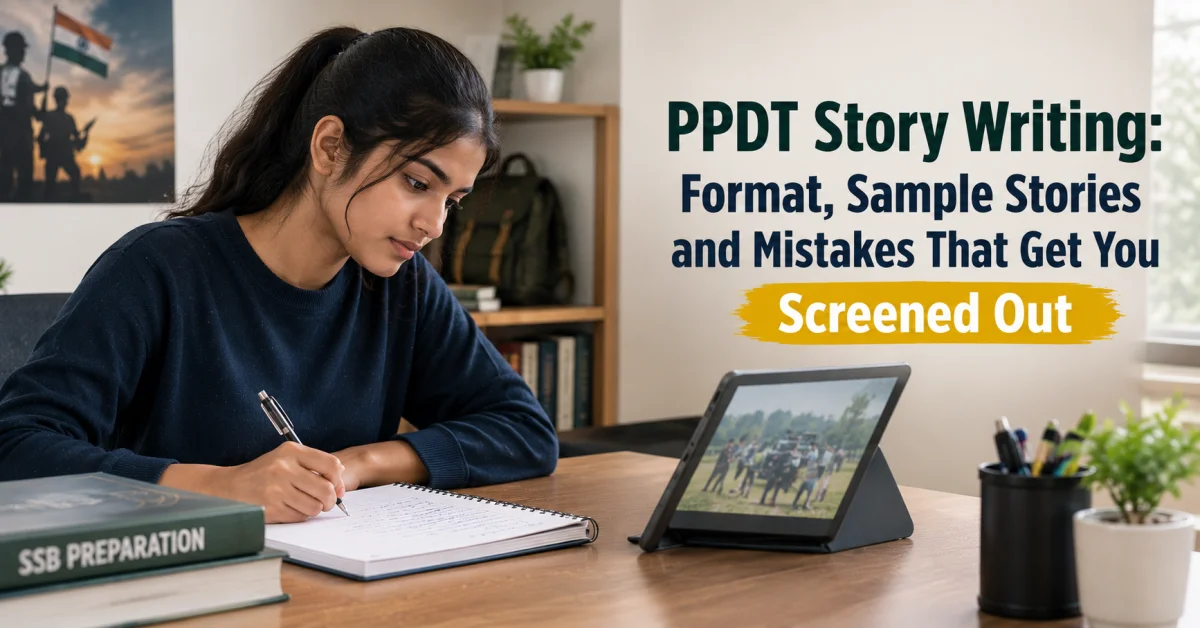
Master PPDT story writing with the right format, sample stories, key points to include, common mistakes to avoid, and simple tips for better narration and group discussion during SSB screening.
Most candidates lose their SSB screen-in opportunity not because they lack officer potential, but because their written story gives the assessor nothing to work with. PPDT story writing is the first concrete evidence of your personality that the board sees, and a weak story can end your SSB before the group discussion even begins.
What Is PPDT and Why Your Story Decides the Screen-In
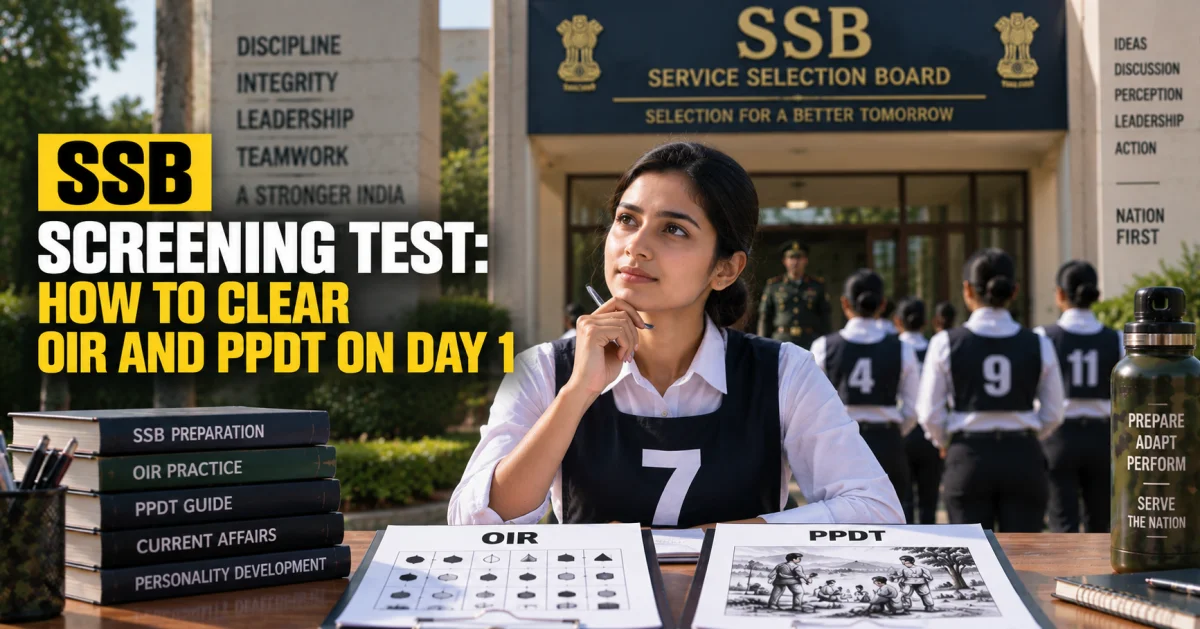
The Picture Perception and Description Test is the opening filter on SSB Day 1. You are shown a hazy image for 30 seconds, then given four minutes to write a story about it. That story goes straight to the psychologist before you say a single word aloud. The assessor is not reading for grammar or vocabulary. They are reading to find out whether you can perceive a situation clearly, identify a capable individual taking purposeful action, and bring things to a constructive conclusion.
This is why PPDT story writing carries more weight than most candidates expect. The written story is scored independently before the narration and group discussion phases begin. A vague or negative story limits how well you can recover in those later stages.
PPDT Story Format: Structure, Word Count and Time Limit
The recommended length for a PPDT story is 100 to 120 words, written within four minutes. That works out to roughly three short paragraphs. The PPDT story format SSB assessors respond to follows a clear three-part structure: an opening situation, a central action by a named hero, and a socially relevant outcome.
Stick to one hero. Assessors need to evaluate Officer-Like Qualities against a single individual, and splitting the action across two or three characters dilutes that entirely. Mention the age and number of people you perceive in the image before your story begins, and note whether the mood of the picture reads as positive, negative, or neutral to you.
5 Story Elements SSB Assessors Actually Look For
A PPDT story should be 100 to 120 words, written in four minutes, structured in three parts: situation, action by a positive hero, and a socially relevant outcome. Beyond that basic structure, assessors are specifically checking for five things.
-
The mood of the picture as you perceived it, stated clearly at the start.
-
A named, singular hero whose age fits the image.
-
An action that reflects OLQs such as initiative, courage, or concern for others.
-
Logical progression from the situation to the hero's response.
-
A constructive resolution that benefits someone beyond the hero himself.
Candidates who treat sample PPDT story with positive hero examples as templates often miss the point. The assessor wants to see your perception and your values, not a memorised structure filled with generic details.
Sample PPDT Story: Annotated Walkthrough
Below is a complete sample PPDT story with a positive hero at its centre, followed by notes on what each part achieves.
Perceived details: Three characters, approximate age 25, positive mood.
Story: "Arjun, a 25-year-old civil engineer, was inspecting a bridge construction site when he noticed a crack forming near the central support pillar. The labourers seemed unaware of the risk. Without hesitating, Arjun halted all work, directed the men to a safe distance, and called the site supervisor to arrange an emergency structural assessment. He stayed on-site, coordinated with the arriving engineers, and ensured temporary reinforcement was placed before anyone returned to work. Because of his quick thinking, a potential collapse was avoided and thirty workers went home safely that evening."
Word count: 97 words. Situation: crack detected, workers unaware. Action: Arjun halts work, organises a response, stays to see it through. Outcome: thirty people protected. The PPDT word count stays within range, the hero is named and singular, and the resolution is socially constructive rather than personally rewarding.
7 PPDT Story Mistakes That Get Candidates Screened Out
These common PPDT mistakes SSB candidates make are worth knowing before you sit down to write.
-
Vague hero identity: If the assessor cannot tell who is acting, they cannot score any OLQs.
-
Negative ending: A story that ends in failure or tragedy signals a pessimistic outlook and contradicts the constructive personality indicator assessors are looking for.
-
Multiple heroes: Two characters sharing the action means neither gets fully evaluated.
-
Ignoring the image: Writing a story that has no connection to the perceived mood or character count shows poor observation.
-
Exceeding the word count: Going past 130 words usually means the structure has broken down into rambling detail.
-
Passive hero: A character who only reacts, waits, or seeks help from others does not demonstrate initiative.
-
Copied themes: Assessors read hundreds of stories involving fires, floods, and accidents. A predictable scenario needs genuinely strong OLQ execution to still work.
PPDT vs. TAT: Key Differences on SSB Day 1 vs. Day 2
Candidates sometimes confuse PPDT vs TAT SSB, since both involve writing stories from pictures. The differences matter.
-
Picture count: PPDT uses one picture. TAT uses 11 pictures plus one blank card.
-
Time per picture: PPDT gives 30 seconds to observe and 4 minutes to write. TAT gives 30 seconds to observe and 4 minutes per story.
-
Group discussion: PPDT is followed by a narration round and a group discussion to arrive at a common story. TAT has no group phase.
-
Evaluator focus: In PPDT, the psychologist is partly assessing how you function in a group setting. In TAT, the focus stays entirely on your individual thematic perception.
The SSB picture perception discussion test is a social exercise as much as a writing one. How you present your story during narration, and how you engage in the group discussion, both feed into the overall Day 1 assessment.
Quick Tips for PPDT Narration and Group Discussion After Story Writing
Writing a solid story is only half the task. Here is what to keep in mind once the pen goes down.
-
During narration, present your story in under 60 seconds. Speak clearly, maintain eye contact with the group, and state your perceived details before the story itself.
-
In the group discussion, listen actively before speaking. The goal is to build a common story that the group agrees on, not to defend your own version at all costs.
-
Push for inclusion of strong OLQ elements from any candidate's story, not just your own. Assessors notice candidates who improve the group's output rather than compete within it.
-
Avoid interrupting or talking over others. Dominance without contribution is one of the fastest ways to attract a negative assessor note on SSB screening test Day 1.
FAQs
What should you prioritize for PPDT story writing?
Write with the assessor's checklist in mind: named hero, clear OLQ-driven action, socially constructive outcome, and a PPDT word count between 100 and 120 words. Everything else, including sentence style and vocabulary, is secondary to those four points.
For further reading, see PPDT Pictures with Stories: A Complete Guide 2026 and PPDT Pictures with Stories: Quick Guide 2026 for SSB.