SSB Interview Current Affairs: Important Defence and National Topics
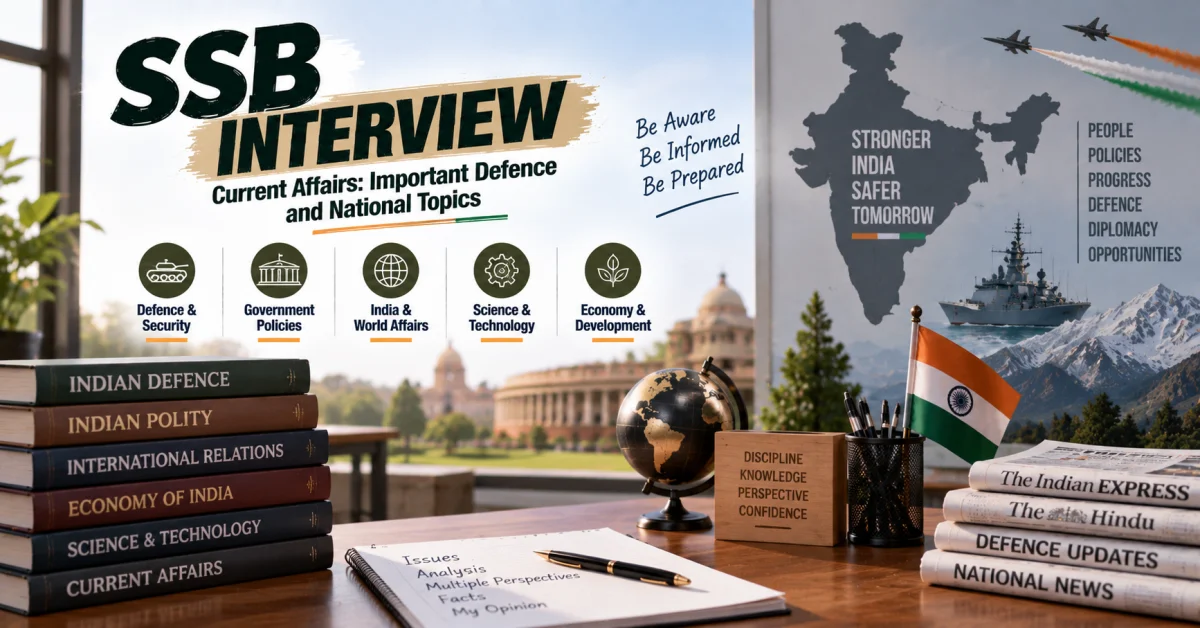
Prepare for the SSB Interview with important current affairs across defence, national security, international relations, technology and major national issues. Learn what to follow and how to discuss current topics with clarity.
What current affairs should you prepare for an SSB interview? This is a common question because candidates often collect hundreds of news headlines without knowing which ones actually matter.
For the SSB Interview, current affairs preparation is not simply about remembering dates, names and headlines. You should understand important developments, especially those connected with defence, national security, technology, international relations, the economy and major issues affecting India.
This guide covers the areas worth following, how to prepare them, how to form your own view and how to handle SSB Interview Current Affairs Questions without sounding memorised.
Why Current Affairs Matter in the SSB Interview
The SSB process includes the Personal Interview along with GTO tasks, psychology tests and the conference. UPSC describes the assessment as holistic, with the Interviewing Officer, GTO and Psychologist assessing the candidate across the selection process.
That is why current affairs should not be treated as a separate memory test.
An interviewer may use a recent event to understand how you think. For example, a question about a defence agreement can move toward India's strategic interests, military preparedness, technology or your own opinion about the issue.
A candidate who only remembers the headline may struggle with the follow-up.
A candidate who understands the issue, background, impact and possible way forward has more room to give a clear answer.
So while preparing Current Affairs for SSB Interview, focus on understanding news rather than collecting news.
What Current Affairs Should I Prepare for SSB Interview?
You do not need to follow every story appearing in the news.
Build your preparation around a few broad areas that have a clear connection with India, defence or national development.
1. Indian Defence and Military Developments
Defence should be one of your core areas.
Follow major developments involving the Indian Army, Indian Navy and Indian Air Force, along with important developments involving India's wider defence establishment.
Focus on topics such as:
-
New weapons and defence systems
-
Military exercises
-
Defence acquisitions
-
Indigenous defence production
-
Defence exports
-
Military technology
-
Modernisation of the armed forces
-
Border infrastructure
-
Joint operations and tri-service developments
-
Major defence agreements
-
Defence research and innovation
But don't stop at knowing what happened.
For every major defence story, ask:
What happened?
Why does it matter?
Which capability does it improve?
How can it affect India's security?
What challenges could remain?
That turns a headline into usable interview knowledge.
2. National Security
National security goes beyond the armed forces.
Keep track of issues related to:
-
Border management
-
Terrorism
-
Internal security
-
Cybersecurity
-
Maritime security
-
Intelligence and surveillance
-
Drone threats
-
Critical infrastructure
-
Disaster response
-
Emerging security technologies
For example, if drones are being discussed because of their increasing use in military operations, don't just remember the name of a particular drone.
Understand how unmanned systems can be used for surveillance, logistics, intelligence and combat, along with their limitations.
That gives you a stronger base for SSB Current Affairs discussions.
3. India and Neighbouring Countries
India's neighbourhood is highly relevant for defence and foreign policy preparation.
Follow important developments involving countries such as:
-
China
-
Pakistan
-
Nepal
-
Bhutan
-
Bangladesh
-
Myanmar
-
Sri Lanka
-
Maldives
You do not need to memorise every diplomatic statement.
Instead, understand major developments related to:
-
Border issues
-
Trade
-
Maritime security
-
Connectivity
-
Defence cooperation
-
Regional organisations
-
Strategic partnerships
-
Political developments affecting India's interests
Try to understand the Indian perspective and the broader regional context before forming your own view.
4. International Relations
International developments can directly affect India's security, economy and foreign policy.
Important areas include:
-
India's relations with major powers
-
Strategic partnerships
-
International conflicts
-
Global security developments
-
Multilateral organisations
-
Major summits
-
International defence cooperation
-
Global trade developments
-
Energy security
For each major international event, ask:
What is India's position?
What could be the impact on India?
Does it affect India's security or economy?
What are the possible challenges?
These questions help you move beyond headline-based preparation.
5. Defence Technology and Artificial Intelligence
Technology is becoming increasingly important in modern defence.
Keep an eye on developments involving:
-
Artificial intelligence
-
Drones and unmanned systems
-
Cybersecurity
-
Space technology
-
Electronic warfare
-
Surveillance systems
-
Robotics
-
Autonomous systems
-
Missile technology
-
Satellite-based systems
The point is not to become an engineer overnight.
You should understand the basic purpose, military application, advantage and limitation of important technologies.
For example, if asked about AI in defence, you could discuss areas such as intelligence analysis, surveillance, logistics, decision-support systems and autonomous platforms.
You should also understand the risks, including cybersecurity, reliability, human oversight and misuse.
Important National Topics for SSB Current Affairs
Defence is important, but your preparation should not become limited to military news.
The SSB interview can also move toward major national developments.
Economy and Development
Follow major economic developments that have a direct impact on India.
Useful areas include:
-
Union Budget
-
Economic growth
-
Inflation
-
Employment
-
Manufacturing
-
Infrastructure
-
Defence spending
-
Startups
-
Digital economy
-
Energy security
-
Atmanirbhar Bharat and domestic manufacturing
A simple way to prepare is to connect economic developments with national priorities.
For example:
Defence manufacturing → domestic production → jobs → technology development → strategic independence
This creates a connected understanding instead of isolated facts.
Science and Space
Science and space developments are useful areas for Current Affairs for SSB.
Follow major developments involving:
-
Space missions
-
Satellites
-
Human spaceflight
-
Space-based communication
-
Navigation systems
-
Defence applications of space technology
-
Biotechnology
-
Artificial intelligence
-
Semiconductor technology
-
Emerging technologies
You don't need technical depth unless the topic is directly connected with your academic background.
Know what happened, why it matters and where the technology can be applied.
Government Policies and Major National Initiatives
You should also know about major government policies and initiatives that have national importance.
Focus on initiatives connected with:
-
Defence
-
Education
-
Employment
-
Infrastructure
-
Manufacturing
-
Technology
-
Agriculture
-
Energy
-
Digital services
-
National security
Avoid memorising scheme names without understanding their purpose.
If you mention a government initiative during an interview, be prepared to explain what it does and why it was introduced.
SSB Interview Current Affairs Questions You Should Practise
There is no single fixed list of SSB Interview Current Affairs Questions.
Questions can change with the news cycle and the candidate's background.
However, you can practise questions around these patterns.
Defence-Based Questions
-
What are the latest major developments in India's defence sector?
-
Why is indigenous defence production important for India?
-
What are the challenges in modernising the armed forces?
-
Why are military exercises important?
-
How is technology changing modern warfare?
-
What is the importance of jointness among the armed forces?
-
How can drones affect battlefield operations?
-
Why is border infrastructure important?
National Security Questions
-
What are the major security challenges facing India?
-
Why is cybersecurity important for national security?
-
How can India deal with drone-related security threats?
-
What role does technology play in border surveillance?
-
Why is maritime security important for India?
International Relations Questions
-
What are India's major strategic interests in the Indo-Pacific?
-
How do developments in neighbouring countries affect India?
-
Why are strategic partnerships important?
-
How can international conflicts affect India's economy and security?
-
What role does India play in major international organisations?
National Issue Questions
-
What is your view on a major issue currently being discussed in India?
-
What are the main challenges related to unemployment?
-
How can India improve defence manufacturing?
-
What is the importance of infrastructure development?
-
How can technology contribute to national development?
Notice the pattern.
These questions are not asking you to recite an article.
They are testing whether you can understand an issue and discuss it logically.
How to Prepare Current Affairs for SSB Interview
A common mistake is trying to read everything.
You don't need ten news sources and hundreds of daily headlines.
Build a simple system.
Step 1: Follow News Consistently
Read current affairs regularly instead of trying to cover six months in one week.
Give priority to:
-
Defence
-
National issues
-
International relations
-
Science and technology
-
Economy
-
Government policies
-
Major national developments
Consistency matters more than volume.
Step 2: Separate Headlines From Important Issues
Not every headline deserves the same amount of preparation.
Use three levels:
Level 1: Headline
Know what happened.
Level 2: Context
Understand why it happened and what led to it.
Level 3: Analysis
Understand its possible impact, challenges and India's interests.
For major issues, aim for Level 3.
For smaller stories, Level 1 may be enough.
Step 3: Make Short Notes
Don't create 10-page notes for one news event.
Use a simple format:
Topic
What happened?
Background
Why is it important?
Impact on India
Challenges
My view
This structure makes revision much easier.
Step 4: Connect News With Your Background
Your academic and personal background can influence the direction of your interview.
For example, an engineering student may be asked more about technology.
A commerce student may encounter questions around the economy.
Someone from a border state may be asked about regional security or geography.
This does not mean the interviewer will follow a fixed pattern.
It simply means you should know the major current issues connected with your own area of study, interests and surroundings.
Step 5: Practise Speaking
Reading current affairs silently is not enough.
Pick one topic every day and speak about it for two to three minutes.
Use this structure:
Issue → Background → Current development → Impact → Your view
Don't memorise sentences.
Practise explaining the topic in your own words.
How to Give Your Opinion on Current Affairs in SSB
This is where many candidates become uncomfortable.
They either give an extreme opinion or try to avoid taking a position completely.
You can keep your answer balanced without sounding vague.
Use this structure:
First, state the issue.
Then explain the main reason.
Mention its benefits or positive side.
Acknowledge important challenges.
End with your practical view.
For example, if discussing AI in defence, you can say that AI can improve areas such as surveillance and data analysis, but human oversight, cybersecurity and reliability remain important.
That is much stronger than saying:
“AI is the future of defence.”
The second statement sounds impressive but says very little.
How to Handle an SSB Current Affairs Question You Don't Know
You will not know everything.
And trying to bluff can create more problems.
If you don't know the answer, don't invent facts.
You can say:
“Sir, I am not aware of the exact details of this development.”
If you know something related to the topic, explain only what you are confident about.
For example:
“I don't remember the exact figure, but I understand that the development is related to India's defence manufacturing capability.”
This is better than confidently giving an incorrect number.
The goal of preparation is not to create the impression that you know every news story.
It is to develop enough awareness to think clearly when a current issue comes up.
Common Mistakes in Current Affairs Preparation for SSB
Reading Without Understanding
Remembering headlines does not mean understanding the issue.
Always ask why the development matters.
Memorising Model Answers
Current affairs answers should not sound rehearsed.
Your answer should reflect your understanding.
Focusing Only on Defence
Defence is central to the interview environment, but national issues, technology, economy and international affairs can also become relevant.
Following Too Many Sources
More sources can create more confusion.
Choose a manageable routine and revise consistently.
Ignoring Old Major Developments
Current affairs does not always mean news from yesterday.
Major developments from recent months can remain relevant if they continue to affect India's security, economy or foreign relations.
Giving Strong Opinions Without Facts
An opinion becomes stronger when you can explain why you hold it.
Avoid making absolute statements when the issue is complex.
Current Affairs Preparation Tips for SSB Interview
Use these practical habits during your preparation:
-
Read every day instead of cramming.
-
Give extra attention to defence and national security.
-
Track major international developments affecting India.
-
Understand the background behind important stories.
-
Make short revision notes.
-
Practise speaking about one issue daily.
-
Connect current events with your academic background and interests.
-
Revise major developments from the recent months before reporting.
-
Never invent statistics or facts during an answer.
-
Form your own opinion instead of memorising someone else's.
A Simple 30-Minute Daily Routine
You don't need to spend your entire day on current affairs.
A focused routine can look like this:
10 minutes — Read
Cover major national, defence and international developments.
10 minutes — Understand
Choose one important story and understand its background, impact and challenges.
5 minutes — Note
Write five or six points in your own words.
5 minutes — Speak
Explain the issue aloud without looking at your notes.
Do this consistently and your preparation becomes much more manageable.
Final Checklist for SSB Interview Current Affairs
Before your SSB, ask yourself:
-
Can I explain the major defence developments of recent months?
-
Do I know India's important security concerns?
-
Can I discuss major developments involving India's neighbours?
-
Do I understand important international events affecting India?
-
Can I explain major technology developments?
-
Do I know important national issues?
-
Can I discuss basic economic developments?
-
Can I form a reasoned opinion?
-
Can I explain both opportunities and challenges?
-
Can I admit when I don't know something?
If the answer to these questions is yes, your preparation is moving in the right direction.
Final Takeaway
SSB Interview Current Affairs preparation is not about becoming a walking newspaper.
It is about staying aware of what is happening around you and being able to discuss important issues with facts, context and your own reasoning.
Give priority to defence, national security, international relations, technology, economy and major national developments. Then practise explaining these topics in simple language.
When a current-affairs question comes up in the interview, don't search your memory for a perfect answer.
Understand the issue, think for a moment and explain what you genuinely know.
That is far more useful than memorising a prepared response.