SSB Stage 1 Screening: OIR Test & PPDT Explained
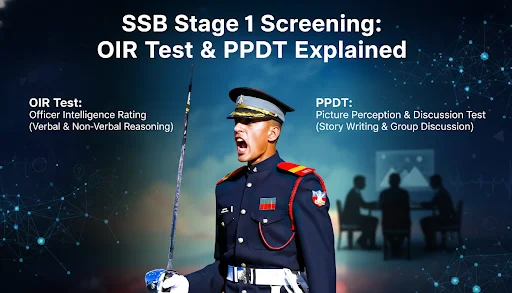
The SSB Stage 1 Screening is the first and most important step in the selection process, where candidates are filtered through the OIR Test and PPDT. The OIR test assesses reasoning and intelligence, while PPDT evaluates personality, communication, and teamwork. Success depends on a balanced performance in both, along with clarity of thought, confidence, and regular practice.
The SSB Stage 1 Screening is the first and most crucial step in the Services Selection Board (SSB) interview process. It acts as a filtering stage where a large number of candidates are screened out on the very first day.
Every year, thousands of candidates appear for SSB interviews through entries like NDA, CDS, and AFCAT, but only a limited number proceed beyond Stage 1. To clear this stage, candidates must perform well in two key components: the OIR Test and PPDT.
Understanding the structure, evaluation process, and preparation strategy for these tests can significantly improve your chances of getting screened in.
Overview of SSB Stage 1 Screening
Stage 1 of the SSB interview is conducted on the very first day and acts as an elimination round. Candidates are divided into groups and are tested through a combination of intelligence and personality-based tasks.
The final decision of screening in or screening out is based on your combined performance in both tests. This means even if one part is slightly weak, strong performance in the other can balance it.
What is OIR Test in SSB?
The OIR (Officer Intelligence Rating) Test evaluates a candidate’s basic intelligence and reasoning ability.
Key Features of OIR Test
The test usually consists of two booklets with increasing difficulty levels.
Types of Questions in OIR Test
Verbal Reasoning
-
Analogies
-
Coding-decoding
-
Series completion
-
Blood relations
-
Direction sense
Non-Verbal Reasoning
-
Pattern recognition
-
Figure completion
-
Mirror images
-
Embedded figures
The OIR test is divided into two main categories: verbal reasoning and non-verbal reasoning.
Verbal reasoning includes questions like coding-decoding, analogies, number series, and direction sense. These questions test how well you can understand patterns in language and numbers.
Non-verbal reasoning, on the other hand, focuses on visual patterns. You may be asked to identify missing figures, complete patterns, or find mirror images. These questions require quick observation and logical thinking rather than calculation.
The key to performing well in OIR is consistent practice. The more you expose yourself to different types of questions, the faster and more accurate you become.
OIR Test Scoring and Importance
OIR scores are graded from OIR 1 (highest) to OIR 5 (lowest).
A good OIR score increases your chances of clearing screening but is not the only deciding factor. It is combined with PPDT performance.
What is PPDT and Why It Matters
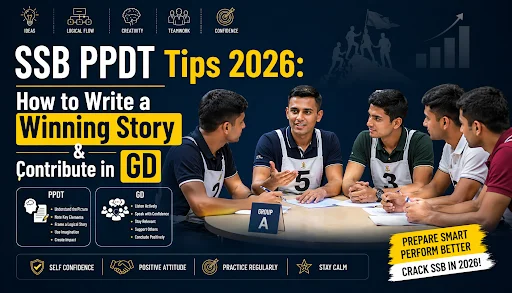
The PPDT, or Picture Perception and Discussion Test, is the second part of Stage 1 and plays a decisive role in screening. While OIR tests your intelligence, PPDT evaluates your personality, communication skills, and ability to work in a group.
In this test, candidates are shown a blurred picture for a short duration. Based on that image, they are required to write a story and later discuss it with the group.
This process may sound simple, but it is designed to reveal multiple aspects of your personality, including how you think under pressure, how clearly you express your ideas, and how well you interact with others.
Complete PPDT Process Explained
The PPDT process is conducted in three stages, each of which is equally important.
First, the picture perception stage begins, where a hazy image is displayed for about 30 seconds. During this time, candidates must observe and note details like the number of characters, their age, mood, and the situation.
Next comes the story writing phase, where candidates are given around 4 minutes to write a story based on what they perceived. The story should have a clear structure with a logical beginning, middle, and conclusion.
Finally, each candidate narrates their story to the group, followed by a discussion aimed at reaching a shared story. This is where communication skills and teamwork are tested.
Key Elements of PPDT
How PPDT is Evaluated
In PPDT, assessors are not looking for perfect English or extraordinary stories. Instead, they focus on Officer-Like Qualities (OLQs). These include leadership, clarity of thought, confidence, and the ability to work in a team.
A good story is one that is simple, realistic, and solution-oriented. Overly dramatic or unrealistic stories can create a negative impression. Similarly, during discussion, candidates who either dominate aggressively or remain completely silent are often screened out.
Balanced participation, where you contribute meaningfully without interrupting others, is considered ideal.
Tips to Clear the OIR Test Effectively
To perform well in the OIR test, candidates need to focus on both speed and accuracy. Since time is limited, spending too long on a single question can reduce your overall score.
Regular practice of reasoning questions is the best way to improve performance. Start with basic questions and gradually move to more advanced ones. This helps build confidence and improves problem-solving speed.
It is also important to avoid random guessing. Accuracy matters more than attempting all questions. A well-balanced attempt with correct answers can fetch a better OIR grade.
Tips to Perform Well in PPDT
Success in PPDT depends on how clearly you think and communicate. While observing the picture, try to identify a central character and build your story around a positive outcome.
During narration, speak clearly and confidently. Your tone should reflect confidence but not arrogance. Maintaining eye contact with group members helps in creating a good impression.
In the discussion phase, the goal is not to win an argument but to reach a common understanding. Listening to others, adding value to the discussion, and supporting logical ideas are key to success.
Common Mistakes Candidates Make
Many candidates fail in Stage 1 not because they lack ability, but because they make avoidable mistakes. In the OIR test, poor time management and lack of practice often lead to low scores.
In PPDT, common mistakes include writing unrealistic stories, speaking too fast or too softly during narration, and either dominating or not participating in the discussion.
Being aware of these mistakes beforehand can help you avoid them during the actual test.
Preparation Strategy for SSB Stage 1
A well-planned preparation strategy can make a significant difference. Candidates should dedicate time daily to reasoning practice for OIR and storytelling practice for PPDT.
Practicing story writing based on random images can help improve imagination and structuring skills. Similarly, group discussions with friends can build confidence and improve communication skills.
Consistency is the key. Even one hour of focused preparation daily can bring noticeable improvement over time.
Daily Practice Plan
Improve Communication Skills
Practice speaking in front of a mirror or with friends.
Mock Practice
Simulate PPDT with a group to gain confidence.
Importance of Stage 1 in SSB
Stage 1 is the elimination round, and clearing it is essential to proceed further.
-
Only 30–40% candidates get screened in
-
Performance here sets the tone for further stages
Conclusion
The SSB Stage 1 Screening is a crucial gateway to becoming an officer in the Indian Armed Forces. By understanding the OIR Test and PPDT process, practicing regularly, and avoiding common mistakes, candidates can significantly improve their chances of clearing this stage.
Consistency, confidence, and clarity of thought are the key factors that can help you succeed in SSB screening.
FAQs on SSB Stage 1 Screening
What is SSB Stage 1 screening?
It is the first stage of the SSB interview, consisting of the OIR Test and PPDT.
How many candidates clear Stage 1?
Usually, around 30–40% candidates are screened in.
Is OIR Test difficult?
It is moderate and can be cleared with regular practice.
How to perform well in PPDT?
Focus on observation, clear narration, and active participation in discussion.
Can I clear SSB Stage 1 without coaching?
Yes, with proper practice and preparation strategy, it is possible.