SSB PPDT Tips 2026: Story Writing & GD Strategy
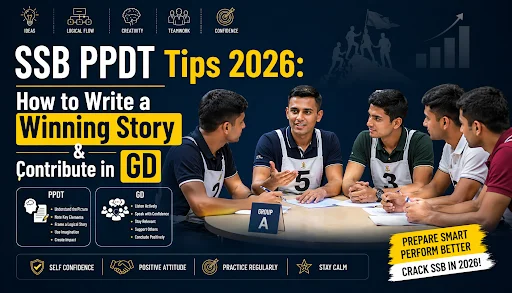
The PPDT in SSB is a crucial screening test that assesses observation, communication, and group behavior. Success depends on writing a simple, realistic story with a positive outcome and actively contributing in group discussion. Clarity, confidence, and teamwork play a key role in clearing this stage.
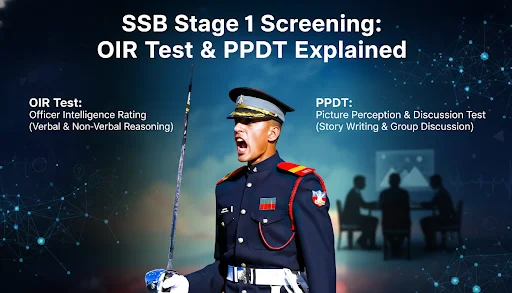
The Picture Perception and Discussion Test, commonly known as PPDT, is one of the most important parts of the SSB Stage 1 screening process. Many candidates fail to clear this stage not because they lack potential, but because they do not fully understand how PPDT works or how it is evaluated.
In the SSB interview, the PPDT is designed to assess your observation skills, clarity of thought, communication ability, and group behavior. It is not just about writing a good story but also about how effectively you present and defend your ideas in a group discussion.
If approached correctly, PPDT can become your strongest scoring area in screening. This guide will help you understand how to write a winning story and contribute effectively in group discussion.
What is PPDT in SSB?
PPDT stands for Picture Perception and Discussion Test. It is conducted on Day 1 of the SSB interview and plays a major role in deciding whether you get screened in or not.
The test consists of three stages: observing a picture, writing a story, and participating in a group discussion.
Each stage evaluates different aspects of your personality, and performance in all three stages is considered together.
Understanding the PPDT Process
The PPDT begins with a blurred image being shown to candidates for about 30 seconds. During this time, candidates must observe carefully and identify key elements such as the number of characters, their age, mood, and the situation.
After this, candidates are given around 4 minutes to write a story based on what they observed. The story should be logical, realistic, and should include a clear outcome.
Once the writing part is completed, candidates narrate their stories one by one. This is followed by a group discussion where all candidates try to arrive at a common story.
This entire process is designed to evaluate how you think individually and how you behave in a group.
How to Write a Winning PPDT Story
Writing a good story is the foundation of PPDT performance. A well-structured story reflects clarity of thought and problem-solving ability.
A strong PPDT story should have three main parts: introduction, development, and conclusion. The introduction should describe the situation, the development should explain the actions taken, and the conclusion should provide a logical outcome.
Instead of creating complicated plots, focus on simple and realistic situations. Your main character should take initiative, solve problems, and achieve a positive result.
Key Elements of a Good Story
Your story should reflect qualities like leadership, teamwork, responsibility, and decision-making.
Common Mistakes in Story Writing
Many candidates try to impress assessors by writing overly dramatic or unrealistic stories. This often backfires because assessors look for practicality, not creativity alone.
Another common mistake is writing incomplete stories due to poor time management. It is better to write a simple complete story than an incomplete complex one.
Avoid negative endings, confusion, or unclear situations in your story.
Tips to Improve Story Writing
Practice writing stories based on random images to improve speed and clarity. Focus on identifying a central character quickly and building your story around that character.
Keep your sentences short and clear. Avoid unnecessary details that consume time and reduce clarity.
Regular practice can help you develop a natural flow in writing.
Importance of Narration in PPDT
Narration is the bridge between your written story and group discussion. Even if your story is good, poor narration can affect your overall performance.
During narration, you need to present your story clearly and confidently in front of the group.
Speak at a moderate pace and ensure your voice is audible. Confidence and clarity are more important than perfect language.
How to Deliver a Strong Narration
While narrating your story, maintain eye contact with the group members. This shows confidence and helps in building connection.
Avoid reading directly from your paper. Instead, try to explain your story in your own words.
A structured narration that follows a logical sequence is always more effective than a rushed or confusing one.
Group Discussion in PPDT
The group discussion is often considered the most challenging part of PPDT. This is where many candidates get confused about how much to speak and when to speak.
The aim of the discussion is not to prove others wrong but to reach a common story as a group. Assessors observe how you behave in a team environment.
How to Contribute Effectively in GD
A good approach in GD is to listen carefully first and then contribute meaningfully. Jumping into the discussion without understanding others can create confusion.
When you speak, try to add value by combining ideas or suggesting a logical conclusion. Supporting others’ good points shows teamwork.
Balanced participation is the key to success.
Common Mistakes in GD
Some candidates dominate the discussion aggressively, which creates a negative impression. Others remain silent due to lack of confidence.
Both extremes can lead to rejection. The ideal candidate is someone who participates actively while maintaining respect for others.
Another mistake is focusing only on one’s own story instead of trying to build a common story.
Practical Strategy to Clear PPDT
To perform well in PPDT, candidates should follow a structured preparation strategy.
Start by practicing observation skills. Look at images and quickly identify key details. This improves your perception ability.
Next, practice writing short stories within a time limit. This helps in managing time during the actual test.
Finally, engage in group discussions with friends or peers. This builds confidence and improves communication skills.
Daily Practice Plan for PPDT
Consistency in practice can bring significant improvement.
Qualities Assessors Look for in PPDT
Assessors are not looking for perfection but for Officer-Like Qualities. These include:
-
Leadership ability
-
Confidence
-
Communication skills
-
Team spirit
-
Positive attitude
If your performance reflects these qualities, your chances of getting screened in increase significantly.
Conclusion
The SSB PPDT is not just a test of imagination but a complete assessment of your personality. From observation to discussion, every stage plays an important role in determining your performance.
By focusing on clarity, confidence, and teamwork, candidates can improve their chances of success. A simple, realistic story combined with effective participation in group discussion can help you stand out.
With regular practice and the right approach, clearing PPDT in 2026 becomes much more achievable.
FAQs on SSB PPDT Tips 2026
What is PPDT in SSB?
It is a screening test that includes picture perception, story writing, narration, and group discussion.
How to write a good PPDT story?
Keep it simple, realistic, and solution-oriented with a positive ending.
Is narration important in PPDT?
Yes, clear and confident narration is crucial for selection.
How to perform well in group discussion?
Listen actively, speak clearly, and contribute meaningfully.
Can I clear PPDT without coaching?
Yes, with regular practice and proper strategy, it is possible.