TAT Test in SSB: 12 Pictures, Story Format and Sample Answers
Learn about the TAT test in SSB with its 12-picture format, story structure, sample answers, common mistakes, and simple tips to write clear and effective TAT stories.
Most SSB aspirants spend months preparing for the interview stage but walk into the psychology round without a clear plan for the TAT test in SSB
.
That single gap costs more recommendations than any other mistake in the five-day process. This guide gives you the exact format, a proven story structure, annotated sample stories, and a concrete list of errors to eliminate before your Services Selection Board date. That's especially true when it comes to SSB TAT story format.
What Is the TAT Test in SSB?
The Thematic Apperception Test is a projective personality test conducted during SSB Day 2 as part of the psychology batch. Candidates are shown a series of ambiguous pictures and asked to write a short story about each one within a fixed time window. The same principle applies to SSB TAT story format.
The word "projective" matters here. Because the images are deliberately vague, candidates unconsciously project their own values, attitudes, and decision-making tendencies into the stories they create. Assessors then read those stories to identify Officer Like Qualities embedded in the hero's behaviour. Keep that in mind every time you sit down to practice TAT sample stories SSB.
The TAT is not a creative writing competition. Assessors are not looking for literary skill. They are mapping every sentence to a specific OLQ, checking whether your hero steps forward under pressure or waits for someone else to solve the problem. According to SSBCrack's complete TAT strategy guide, the test is designed to reveal the real personality behind polished interview answers. That context matters every time you think about how to write TAT story SSB interview.
TAT vs PPDT: Key Differences Every Aspirant Must Know
Confusion between TAT and PPDT is extremely common, particularly among first-time SSB candidates. Both involve a picture and a story, but the format, purpose, and timing are completely different. The same holds for how to write a TAT story SSB interview.
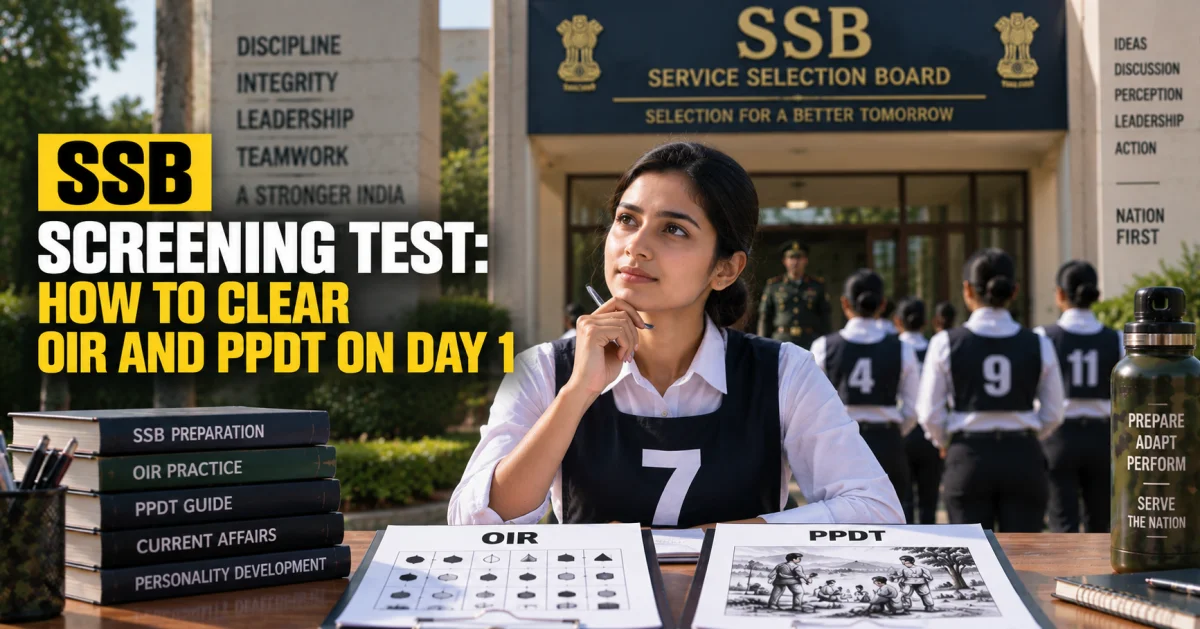
The PPDT, or picture perception test, happens on Day 1 as part of screening. Each candidate writes one story individually and then participates in a PPDT group discussion where the group narrates a common story. The TAT happens on Day 2, is entirely individual, and involves no group discussion at all. This distinction matters just as much for SSB psychological test preparation.
Here is a direct comparison across the two formats, particularly for TAT mistakes SSB candidates tend to repeat:
-
Day: PPDT is Day 1 (screening); TAT is Day 2 (psychology)
-
Number of pictures: PPDT uses one picture; TAT uses 12 pictures
-
Group element: PPDT includes a group discussion; TAT is entirely individual
-
Purpose: PPDT screens for basic OLQ potential; TAT assesses personality depth across multiple scenarios
-
Stories written: One in PPDT; 12 in TAT
As Dehradun Military Academy explains, treating TAT like a repeat of PPDT is one of the most common strategic errors candidates make. The two tests serve different functions in the OLQ assessment pipeline. That applies equally to avoiding TAT mistakes SSB candidates frequently overlook.
The 12-Picture Format: What to Expect
The TAT consists of 11 scene-based pictures and one blank slide, always shown last. Each picture is displayed for approximately 30 seconds. After it disappears, candidates have roughly 3.5 minutes to write their story in the TAT booklet provided.
The 11 scene pictures are intentionally ambiguous. A figure standing near a field could be a farmer, a student, a soldier, or a scientist, depending on how the candidate interprets it. That ambiguity is deliberate. The assessor wants to see what your mind does with an open canvas, not whether you identified the "correct" scene.
A few practical details candidates often miss:
-
Stories are handwritten, not typed. Legible handwriting matters for the assessor reading all booklets after the session.
-
Assessors retain the TAT booklets for scoring after the psychology batch concludes.
-
You cannot revise a previous story once the next picture appears. Each story is written and closed within that 3.5-minute window.
-
Story writing under time pressure is an inherent part of the test design. Candidates who freeze or overthink the picture lose writing time they cannot recover.
The optimal story length is 100 to 120 words across 8 to 12 sentences. Longer stories often run incomplete. Shorter ones leave the action phase underdeveloped, which hurts OLQ scores.
The IAR Story Structure: Introduction, Action, Result
The introduction action result TAT SSB formula is the most reliable structure for writing high-scoring stories consistently across all 12 pictures. Every sentence you write should belong to one of these three phases.
Introduction means establishing who your hero is and what situation they face. Two to three sentences maximum. Name the hero, state their role or context, and describe the problem or opportunity in front of them. Spending four sentences on background is a waste of time the assessor will notice. Reach the action phase quickly.
Action is the section assessors weight most heavily in their OLQ assessment. This is where the hero makes a decision, leads others, shows initiative, or resolves the conflict. Write four to five sentences here. The action must be specific and proactive. Vague sentences like "he tried his best" signal a weak candidate profile immediately.
Result closes the story with a positive outcome and, where appropriate, a brief line about the lesson learned or impact created. Two sentences are enough. Every single TAT story must end positively. There are no exceptions to this rule if you want to be recommended.
What SSB Assessors Actually Score: OLQs in Your Story
Assessors at the Services Selection Board use each TAT story to map hero behaviour to specific Officer Like Qualities. The 15 OLQs assessed across SSB tests include initiative, courage, sense of responsibility, social adaptability, speed of decision, and effective intelligence, among others.
In a TAT context, five OLQs appear most frequently in high-scoring stories:
-
Initiative: Hero acts without being told or waiting for permission
-
Courage: Hero faces risk or social pressure and proceeds anyway
-
Sense of responsibility: Hero takes ownership of the outcome
-
Social adaptability: Hero coordinates with others or adapts to an unfamiliar group
-
Speed of decision: Hero acts quickly when delay would worsen the situation
The hero theme story is central to assessor evaluation criteria. Your hero must drive the solution. If the hero endures a problem without resolving it, or if another character rescues your hero, the story fails its OLQ purpose regardless of how well it is written. Every action sentence should show the hero choosing, leading, or creating a positive change.
Sample TAT Stories With Strong Hero Theme and Positive Ending
Below are three model TAT sample stories SSB aspirants can use as templates. Each includes an OLQ annotation after the story.
Story 1: Flood Rescue (Disaster Theme)
Rahul, a final-year engineering student, saw flood waters rising rapidly in a village near his college. Without waiting for instructions, he organised 12 fellow students into rescue groups and located two boats from a nearby depot. He coordinated with local police over the phone while simultaneously directing volunteers to the most critical areas. Within three hours, 47 residents were moved to higher ground safely. Rahul's calm leadership under extreme pressure saved lives and earned the district administration's commendation.
OLQs demonstrated: Initiative (acted without waiting), courage (entered floodzone), sense of responsibility (took ownership), speed of decision (three-hour resolution), social adaptability (coordinated multiple groups).
Story 2: Academic Crisis (Professional Challenge Theme)
Priya, a school teacher in a remote village, discovered that 30 students had missed six weeks of syllabus due to a teacher shortage. She designed a condensed revision schedule, used evening sessions to cover lost content, and contacted an NGO for supplementary study materials. All 30 students appeared for their board exams and 26 passed with first division. Her approach became the model for three neighbouring schools.
OLQs demonstrated: Sense of responsibility, initiative, social adaptability (NGO coordination), positive ending story with measurable impact.
Story 3: Conflict Resolution (Social Problem Theme)
Vikram noticed tension building between two communities over a shared water source in his town. He arranged a joint meeting, presented factual data on water availability, and proposed a rotational usage schedule both groups found fair. Conflict resolution in TAT scenarios like this one scores highly because the hero uses reasoning rather than authority. Within a week, the arrangement was functioning smoothly and relations between the communities had improved.
OLQs demonstrated: Initiative, effective intelligence, social adaptability, sense of responsibility.
The Blank Picture: How to Handle Picture 12
The blank picture SSB assessors show last is not a trick. It is a deliberate opportunity. Because there is no image to interpret, every element of the story comes entirely from the candidate's own imagination. This makes it the purest projective moment in the entire TAT session.
Three rules apply to the blank slide:
-
Generate a vivid, realistic scenario from a setting you know well, such as a college campus, a rural community, or a professional workplace.
-
Pick a theme you have mentally rehearsed during preparation. Do not improvise a completely new scenario under time pressure on the final picture.
-
Avoid fantastical, war-combat, or cinematic rescue scenarios. Community service, professional challenge, and leadership in a familiar setting consistently score better because they feel authentic rather than performed.
A strong blank picture story follows the same introduction action result TAT SSB structure as every other story. The blank slide does not require a different format. Treat it as a gift: you control every detail, so make the hero's OLQs unmistakable.
8 Common TAT Mistakes That Get Candidates Rejected
Knowing what destroys a TAT score is as important as knowing the correct format. These eight errors appear consistently in rejected candidate booklets:
-
Negative or tragic endings: A hero who dies, fails, or gives up signals a personality profile incompatible with officer selection.
-
Hero as passive victim: If the hero only suffers and others solve the problem, no OLQ is demonstrated.
-
Repetitive themes across all 12 stories: Writing a flood rescue for every picture tells assessors you have one memorised story, not a genuine officer's range of thinking.
-
Unrealistic scenarios: Heroes who single-handedly stop terrorist attacks or save hundreds without any support read as fictional, not officer-like.
-
Exceeding the word limit: Stories running to 200 words routinely end mid-sentence when time is called. An incomplete result phase means a failed story.
-
Copying a memorised story verbatim: Assessors read thousands of booklets. Memorised stories have recognisable phrasing patterns and score poorly on authenticity.
-
Weak or vague action phase: Phrases like "he did his duty" or "she tried hard" carry no OLQ signal. Name the specific action and the decision behind it.
-
No clear resolution: A story that describes a problem and an effort but omits the outcome leaves the OLQ assessment incomplete.
Quick Tips to Write Winning TAT Stories Under Time Pressure
The 3.5-minute window feels generous during practice and brutal during the actual test. These habits close that gap:
-
Apply the 5-second rule: decide the hero's identity and the central conflict within the first five seconds of viewing the picture. Any longer and your writing time shrinks.
-
Write one conflict only. Candidates who introduce two problems rarely resolve either one cleanly within the word limit.
-
If you are pressed for time, write the action section first and then build the introduction and result around it. The action phase carries the highest OLQ weight.
-
Keep language simple and direct. Complex sentences take longer to write and longer for assessors to read. Short, active sentences communicate OLQs more clearly than elaborate prose.
-
Practice writing 100-word stories with a timer daily for at least three weeks before your SSB. Speed and structure must become automatic, not considered.
For a broader look at how the SSB evaluates candidates across all stages, including how psychological scores interact with GTO and interview scores, see our guide on Indian Army vs Navy career paths after 12th, which covers the full selection pipeline for both services.
FAQs
What is the TAT test in SSB and how many pictures are shown?
The TAT test in SSB refers to the Thematic Apperception Test, a projective personality test conducted on SSB Day 2. Candidates are shown 12 pictures in total: 11 scene-based slides and one blank slide. Each picture is visible for approximately 30 seconds, followed by roughly 3.5 minutes of writing time per story.
How should I structure a TAT story for SSB using introduction, action, and result?
The introduction action result TAT SSB formula means: two to three sentences establishing the hero and situation, four to five sentences showing the hero's specific decisions and actions, and two sentences describing the positive outcome. Aim for 100 to 120 words total.
What themes work best for TAT stories in SSB?
Community service, professional challenges, academic leadership, and disaster response themes consistently produce high OLQ scores. Avoid war-combat fantasies or supernatural scenarios. The hero theme story works best when it draws on realistic situations the candidate could plausibly face.
Can I show a negative ending in a TAT story?
No. A positive ending story is mandatory for every one of the 12 TAT pictures. Tragic or ambiguous endings signal a negative personality projection, which directly lowers the assessor's OLQ rating for that story.
How do SSB assessors score TAT stories and what are they looking for?
Assessors apply assessor evaluation criteria by mapping hero behaviour to specific Officer Like Qualities. They look for initiative, speed of decision, courage, social adaptability, and sense of responsibility. The hero must solve the problem proactively. Passivity, vague action, and incomplete resolutions all reduce the OLQ score.
What is the difference between TAT and PPDT in SSB?
The picture perception test, PPDT, happens on Day 1 and includes a PPDT group discussion after the individual story. TAT happens on Day 2, is fully individual, involves 12 pictures instead of one, and includes no group component. The two tests serve different stages of the SSB psychological test battery.