SSB Self Description (SD): Format, Five Paragraphs and Sample Answers
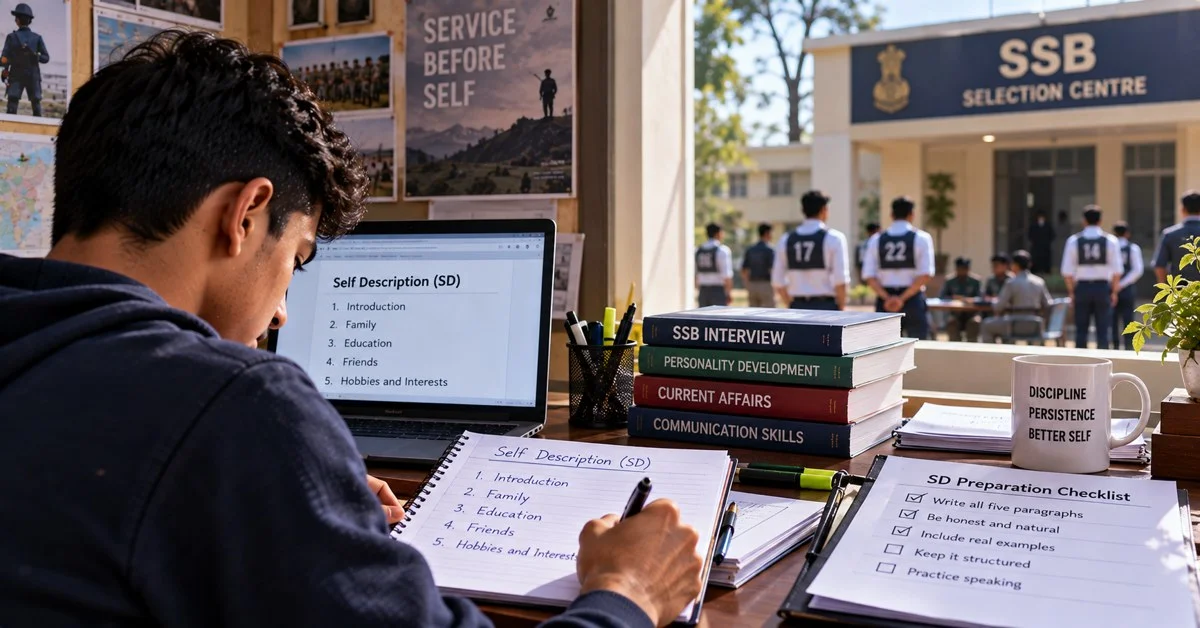
Self description in SSB is a key psychology test on Day 2. This guide explains the format, what each paragraph should cover, how psychologists judge it against TAT and WAT, common mistakes and sample answers.
Most candidates entering the Services Selection Board know the five-day process exists. Very few know exactly what happens on Day 2 when the psychologist hands them a blank sheet and asks them to describe themselves. The self description in SSB is not a casual exercise. It is a structured psychological tool, and the way you write it tells the assessor far more than the words on the page. That is a detail worth keeping in mind when studying SSB self description sample answers.
This guide covers the correct SSB self description format, what each of the five paragraphs must contain, how psychologists read your answers, and three annotated sample answers across different candidate profiles, particularly for self description in SSB.
What Is the Self Description Test in SSB?
The Self Description test is a written psychological assessment administered during SSB interview Day 2, alongside other SSB psychological tests such as the Thematic Apperception Test (TAT SSB) and the Word Association Test (WAT SSB). Together, these form the SSB written psychological tests block that the psychologist uses to build a personality profile of each candidate. The same principle applies to self description in SSB.
In the SD, candidates write approximately 150 to 200 words covering five specific areas of their personality. The goal is not creative writing. The psychologist assessment SSB is designed to reveal how accurately a candidate understands themselves, whether that self-image is consistent across different test instruments, and how closely their traits align with Officer Like Qualities. This matters directly when thinking about how to write self description SSB answers.
According to NDA Portal's explanation of the Self Description test, the SD is one of the few SSB tests where candidates explicitly talk about themselves rather than projecting onto characters or responding to prompts. That directness is precisely what makes it both valuable and risky for unprepared candidates. The same holds for OLQ in SSB interview.
The Services Selection Board uses the SD as a reference point throughout the five-day assessment. Anything you write here will be cross-checked against your behaviour in Group Tasks, your stories in TAT, and your responses during the personal interview. Inconsistency, not honesty, is what fails candidates. This applies equally to OLQ in SSB interview evaluation.
The Five-Paragraph Format: What Each Paragraph Must Cover
The SSB self description five paragraphs follow a fixed sequence. Deviating from this structure signals either poor preparation or low self-awareness, neither of which works in your favour during psychologist assessment SSB.
Here is what each paragraph must address:
-
Paragraph 1: How others see you. Write what your parents, teachers, or close friends say about you. This paragraph signals social awareness and the ability to receive feedback, qualities linked to the OLQ of social adaptability.
-
Paragraph 2: How you see yourself. Your own perception of your character. This tests self-awareness in SSB and your capacity for honest introspection, which connects to the OLQ of self-confidence grounded in reality.
-
Paragraph 3: Your qualities and strengths. Cite two or three genuine strengths with brief behavioural examples. Psychologists look for Officer Like Qualities such as initiative, courage, and effective intelligence here.
-
Paragraph 4: Your shortcomings. Mention one or two genuine weaknesses. This is the paragraph most candidates write badly. The assessor is specifically looking for self-honesty and the corrective action for weaknesses SSB expects to see alongside each flaw.
-
Paragraph 5: What you want to become. Your vision for self-improvement. This paragraph reveals goal orientation, responsibility, and whether you are already working on closing the gap between where you are and where you want to be.
The full SSB self description format, as detailed by SSBCrack's guide on writing the Self Description, positions these five paragraphs as a psychological arc from external perception inward, then outward again toward future intent.
How SSB Psychologists Evaluate Your Self Description
Understanding how to write self description SSB answers correctly requires knowing what the assessor is actually measuring. The psychologist does not read your SD in isolation. They place it beside your TAT stories, your WAT SSB responses, and notes from your Day 1 screening to look for a coherent personality picture.
The primary evaluation criteria are:
-
Internal consistency: Does your Para 2 self-image match the character who appears in your TAT narratives?
-
OLQ alignment: Do the strengths you mention in Para 3 correspond to Officer Like Qualities the board is mandated to assess?
-
Realistic self-appraisal: Is Para 4 honest, or does it list socially acceptable pseudo-weaknesses like "I work too hard"?
-
Growth orientation: Does Para 5 include a concrete plan, not just aspirational language?
The 15 Officer Like Qualities assessed across the SSB five-day process include effective intelligence, reasoning ability, initiative, self-confidence, speed of decision, and social adaptability. Each paragraph of your SD maps onto one or more of these OLQs in SSB interview evaluation. Psychologists are specifically trained to detect candidates who list OLQs as adjectives rather than demonstrating them through behavioural examples.
Personality assessment defence boards compare a candidate's SD against their Group Discussion conduct and GTO tasks. A candidate who writes "I am calm under pressure" in Para 3 but panics during the Command Task will have their SD flagged as inconsistent during the conference.
How Honest Should You Be? (The Weakness Paragraph Explained)
This is the question that generates the most anxiety among candidates preparing for NDA SSB interview preparation and CDS SSB interview rounds alike. The short answer is: be genuinely honest, and pair every weakness with a corrective action.
Include one or two genuine, non-disqualifying weaknesses and pair each with a concrete corrective action. Psychologists are trained to detect rehearsed or unrealistically positive responses, and a blank or suspiciously clean Para 4 raises an immediate red flag.
What counts as a non-disqualifying weakness? Something behavioural and improvable. Examples: impatience when a team works slowly, difficulty delegating tasks, or a tendency to over-prepare rather than acting quickly. These are honest, they are specific, and they have obvious corrective paths.
What you should avoid in Para 4: character flaws that directly contradict OLQs (claiming you lack courage or cannot lead), medical or physical issues, and vague admissions like "sometimes I make mistakes." That last example says nothing and signals evasion.
Assessors cross-reference SD responses against WAT, TAT, and the personal interview for consistency. If your TAT story hero solves every problem independently but your SD Para 4 says you struggle to trust your own judgment, that contradiction will surface. Recommended candidate SSB panels consistently confirm that a well-placed honest weakness, paired with visible progress on correcting it, actually strengthens the overall assessment rather than weakening it.
Common Mistakes Candidates Make in SSB Self Description
Based on patterns documented by SSBCrack's analysis of common mistakes in SSB psychological tests, the most frequent errors are:
-
Writing in third-person narrative style. The SD must be first-person. "He is a responsible person" reads as a reference letter, not a self-assessment.
-
Using abstract traits without behavioural examples. Writing "I am a leader" is meaningless. Writing "I led a 12-member school team to complete a community project within a three-day deadline" demonstrates the trait.
-
Overstating OLQs. Claiming every Officer Like Quality in Para 3 reads as either dishonest or poorly self-aware. Stick to two or three strengths you can actually evidence.
-
Ignoring the improvement plan in Para 5. Many candidates treat Para 5 as a career goal statement. It should describe a personal development plan, not an ambition to become a General.
-
Inconsistency with TAT and WAT stories. If your WAT SSB responses repeatedly signal introversion but your Para 1 claims your friends see you as the life of the group, the psychologist will note the contradiction.
-
Exceeding the recommended length. The SD should stay within 150 to 200 words. Longer responses often dilute focus and introduce inconsistencies.
Sample SSB Self Description Answers (Three Candidate Profiles)
The following SSB self description sample answers are annotated to show which OLQ each paragraph targets.
(a) NDA Fresher (Class 12 pass)
My parents describe me as sincere and responsible, while my teachers say I take initiative in group activities [Para 1: social adaptability]. I see myself as goal-driven with a calm temperament [Para 2: self-confidence]. My key strengths are perseverance and quick situational thinking, shown when I organised my school's annual event within 48 hours after the original coordinator fell ill [Para 3: initiative, effective intelligence]. I sometimes struggle with impatience when tasks move slowly; I am working on this by practising deliberate patience during team sport drills [Para 4: self-awareness, corrective action]. I want to develop stronger delegation skills so I can lead larger teams without feeling the need to control every outcome [Para 5: responsibility, growth orientation].
(b) CDS Graduate Candidate
My peers describe me as dependable and level-headed under pressure [Para 1]. I consider myself a practical thinker who values structured planning [Para 2]. My strengths include analytical reasoning and communication, demonstrated when I resolved a hostel committee dispute through mediated discussion [Para 3: effective intelligence, social adaptability]. I tend to over-analyse decisions; I counter this by setting firm time limits on problem-solving [Para 4: corrective action for weaknesses SSB]. My goal is to sharpen my ability to act decisively with incomplete information [Para 5].
(c) Re-attempt Candidate
My family sees me as determined and resilient [Para 1]. I view myself as more self-aware now than during my first SSB attempt [Para 2]. I have improved my physical stamina and team communication significantly over the past year [Para 3]. My earlier challenge was speaking up in group settings; I addressed this by joining a debate club for six months [Para 4: concrete corrective action]. I aim to combine assertiveness with active listening to become a more balanced team contributor [Para 5].
Before vs. After: Weak SD Rewritten
Weak version (generic):
"My friends say I am a good person. I think I am hardworking and honest. I am good at studies and sports. Sometimes I get angry but I am controlling it. I want to become a good officer and serve my country."
Problems: No behavioural evidence. Para 4 gives no corrective action. Para 5 is an aspiration, not a development plan. The language is vague throughout.
Rewritten version (assessor-aligned):
"My teachers describe me as methodical and dependable, and my friends say I stay calm when situations become unpredictable [Para 1]. I see myself as someone who prepares thoroughly before acting, which gives me confidence in unfamiliar settings [Para 2]. My strongest qualities are composure under pressure and problem-solving, shown when I managed a trekking group during sudden weather change and brought everyone back safely [Para 3]. I can be overly cautious before committing to a decision; I am addressing this by practising timed decision exercises during my SSB preparation [Para 4]. I want to develop faster situational judgment so I can lead effectively even when information is incomplete [Para 5]."
What changed: every paragraph now includes a specific example, Para 4 has a concrete corrective action, and Para 5 targets a developable skill rather than a career wish. The entire response stays within 160 words.
Quick Tips to Write an Honest, Impressive Self Description
-
Write in first person throughout. No exceptions.
-
Keep the total word count between 150 and 200 words.
-
Sync your Para 3 strengths with the themes appearing in your TAT SSB stories and WAT SSB responses to ensure assessor-facing consistency.
-
Avoid superlatives. "I am extremely disciplined" is weaker than "I maintained a 5 AM training routine for eight months."
-
Use specific behavioural examples over adjectives. One concrete incident is worth more than three personality labels.
-
Each weakness in Para 4 must come with an active corrective step you are already taking, not one you plan to start.
-
Read your completed SD against your WAT and TAT responses. If any theme contradicts, revise before the test.
-
Avoid listing Officer Like Qualities by name. Show the quality through an action.
For broader context on how the SD fits into the full SSB five-day process and how it compares with other assessment tasks, see our detailed comparison of career paths in the armed forces on the Indian Army vs Navy career guide.
FAQs
What is the five-paragraph format for SSB self description and what should each paragraph cover?
The SSB self description five paragraphs cover: (1) how others perceive you, (2) how you see yourself, (3) your strengths with examples, (4) your shortcomings with corrective actions, and (5) your self-improvement goal. Write in first person and keep the total to 150 to 200 words.
How do SSB psychologists evaluate the self description and which OLQs do they look for?
Psychologists compare your SD against your TAT, WAT, and personal interview responses. They map each paragraph to specific Officer Like Qualities: Para 3 signals initiative and effective intelligence, Para 4 signals self-awareness, and Para 5 signals responsibility and goal orientation. Consistency across all tests is the primary measure.
How honest should I be? Will mentioning weaknesses hurt my selection?
Mentioning real weaknesses will not hurt your selection if you pair each one with a concrete corrective action already in progress. What damages your assessment is either leaving Para 4 blank or listing implausible pseudo-weaknesses. Psychologists in the psychologist assessment SSB round are specifically trained to distinguish authentic self-reflection from rehearsed responses.
Can you share a sample SSB self description for an NDA or CDS fresher?
Yes. See the NDA fresher and CDS graduate samples in the section above. Each is annotated with the OLQ each paragraph addresses and stays within the 150 to 200 word limit recommended for the SD test.
What are the most common mistakes in SSB self description answers?
The most common errors are writing in third person, using adjectives without behavioural evidence, omitting the improvement plan from Para 5, and producing a Para 3 that contradicts the candidate's WAT SSB or TAT SSB story themes. Overstating OLQs and exceeding the word limit are also frequently flagged errors during the SSB written psychological tests review.