Rehearsed Answers in SSB: How Assessors Spot Them and What to Do

Quick summary
Memorised answers rarely survive the SSB. Learn how the Interviewing Officer, Psychologist and Group Testing Officer spot SSB rehearsed answers across the five-day process, and how to prepare genuine answers for 2027.
Every year, thousands of candidates walk into the SSB board with polished scripts memorised from coaching notes and online lists of Officer Like Qualities, and most of them fail for exactly that reason. The problem with SSB rehearsed answers is not that they sound too confident. It is that three assessors comparing notes across five days will find the gaps you never thought to prepare for.
This article explains precisely how the detection works, where scripted responses break down, and what genuinely spontaneous answers look like from the assessor's side of the table. If you are preparing for 2027, this is the fix you need before your next attempt.
Why SSB Assessors Are Trained to Detect Scripts, Not Just Weak Answers
Most candidates assume SSB assessors are scanning for wrong answers. That assumption is the root of the problem. The board is not looking for whether you know the definition of Officer Like Qualities; it is looking for whether your personality actually holds those qualities across five days of continuous observation.
Cross-verification refers to the process by which the Interviewing Officer, the Psychologist, and the Group Testing Officer independently record their observations, then compare notes to identify inconsistencies in a candidate's responses, behaviour, and stated values. A candidate relying on SSB rehearsed answers can survive one assessor's questioning. Surviving all three, across every task, is structurally near-impossible.
Understanding how SSB assessors detect scripted answers starts with recognising what triggers their attention:
OLQ vocabulary that does not match the candidate's natural speech pattern in group tasks
Personal incident examples that are vague, generic, or suspiciously polished
A mismatch between the qualities claimed in the personal interview and the behaviour observed by the GTO
SSB coaching harm enters precisely here. Coaching that installs a script rather than building self-awareness produces genuine SSB interview answers in neither setting, making the inconsistency visible to all three assessors simultaneously.
The Five Moments in SSB Where Scripted Answers Collapse
Most candidates entering SSB focus on perfecting individual answers. That is precisely the wrong unit of analysis. The board runs a three-assessor cross-verification system across all five days, meaning the Interviewing Officer, the Psychologist, and the Group Testing Officer share observations and compare notes. What triggers a flag is not a weak answer in isolation; it is the inconsistency between that answer and what you wrote in your TAT story or how you acted in an SRT situation.
There are five specific pressure points where scripted responses break down: the WAT's 15-second time limit, the TAT's requirement for narrative depth, the SRT's situational logic demands, the GTO group discussion's real-time unpredictability, and the Interviewing Officer probing techniques that follow every OLQ claim. Each stage tests candidate naturalness assessment in a different way.
Avoiding SSB interview preparation mistakes tied to memorised Officer Like Qualities is central to the SSB OLQ assessment 2027 challenge. Have you genuinely mapped your own experiences to those qualities, or are you borrowing someone else's story? Learn more about how assessors evaluate candidates at SSBCrack's assessor evaluation guide.
How the Interviewing Officer Identifies a Coached Response in Real Time
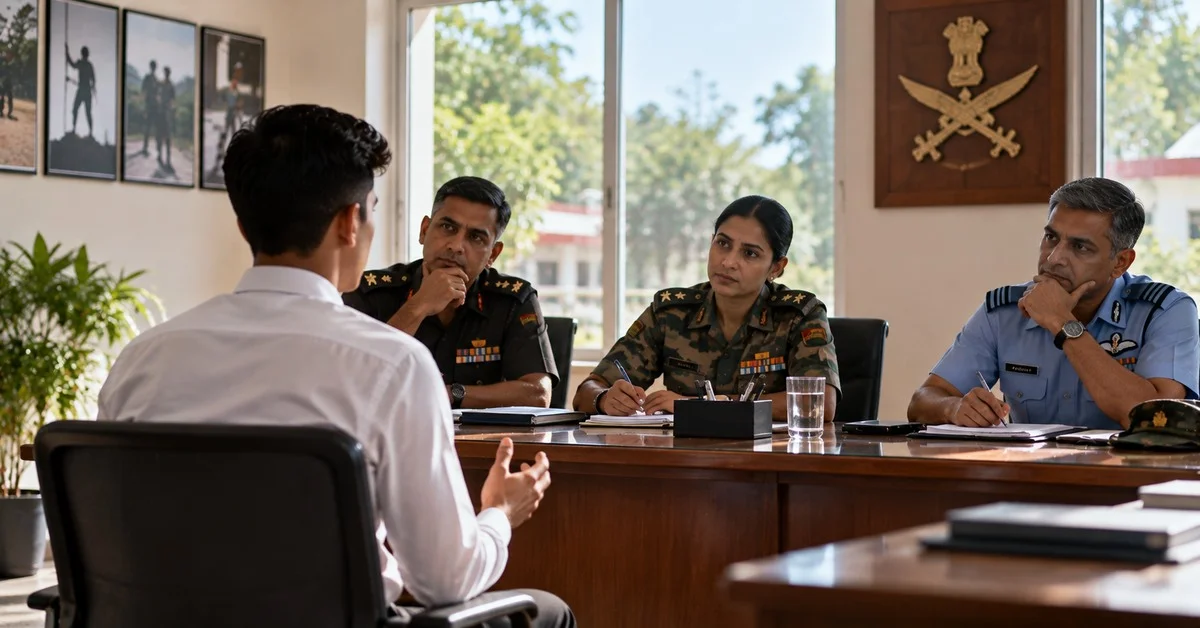
The Interviewing Officer's most effective tool is the follow-up question. When a candidate claims to possess a quality like courage or initiative, the IO immediately asks for a specific personal incident behind that claim. Coached candidates typically stall at this point because their memorised answer ended at the label, not the lived experience.
A practiced IO technique is to paraphrase your answer back to you slightly differently and watch whether you correct the paraphrase or simply agree. A candidate working from genuine memory will notice the discrepancy. One reciting a script usually will not.
Mid-answer topic shifts are another deliberate test. The IO may interrupt and ask something entirely unrelated, then return to the original thread minutes later. Genuine responses hold up under that kind of non-linear pressure. Scripted ones visibly restart.
The IO's notes are shared across the three-assessor board, meaning anything that sounds scripted in the personal interview is cross-checked against your SSB psychological tests results, including the self-description test SDT, across the full five-day SSB process.
What Genuine Spontaneous Answers Actually Sound Like: With Examples
Understanding how SSB assessors detect scripted answers becomes clearer when you compare two responses side by side. A coached candidate might say: "I displayed courage by leading my team through a crisis." An assessor hears that sentence and immediately asks for the specific incident behind it. The genuine version sounds different: "During a trek near Kasauli, our group leader twisted his ankle two kilometres from camp. I redistributed the load, set a pace everyone could hold, and got the group back before dark." Notice the sensory detail, the decision point, and the measurable outcome.
This is precisely why WAT TAT SRT SSB tips that focus on memorising OLQ vocabulary miss the point entirely. The narrative depth TAT demands comes from real memory, not constructed plots. The cross-verification board reviews your TAT themes against your personal interview answers, and SSB rehearsed answers collapse at that junction. Assessors note that the 15-second WAT window structurally prevents retrieval of memorised lines, making spontaneous word association the only viable strategy.
How to Rebuild Your Preparation If You've Been Relying on Memorised Answers
One of the most common SSB interview preparation mistakes is continuing with a flawed system simply because it feels productive. If your current notes are full of OLQ definitions and model answers, stop adding to them and start replacing them.
The 30-day reset works in four steps. First, journal at least one real personal incident daily, writing it in the sequence: specific memory, sensory detail, decision point, outcome. This structure trains your mind to retrieve experience rather than vocabulary. Second, practice WAT with a strict 15-second timer per word, which is the actual constraint designed to defeat memorised responses. Third, run mock SRT exercises without checking "correct" answers afterward; the goal is situational logic SRT builds naturally, not pattern matching. Fourth, map your genuine experiences directly to Officer Like Qualities instead of memorising quality labels.
The Group Testing Officer observes how you behave under pressure across multiple tasks. Genuine SSB interview answers rooted in real memory stay consistent across those tasks; rehearsed ones fracture.
What Stays Consistent in SSB Assessment in 2027 and What Has Shifted
The core OLQ framework governing SSB OLQ assessment 2027 remains unchanged from what the official Join Indian Army portal has described for years. Fifteen Officer Like Qualities, the same three-assessor board structure, and the same five-day process still define every Services Selection Board.
What has shifted is assessor focus. Candidate feedback from 2026 boards consistently points to tighter cross-verification between SSB psychological tests and the personal interview. Assessors are flagging personal interview inconsistency more precisely than before, matching a candidate's TAT narrative themes against statements made to the Interviewing Officer on day four or five.
Coaching that installs memorised OLQ vocabulary into a candidate's answers is now a liability in a way it wasn't five years ago. The detection is not sharper because assessors changed their criteria. It is sharper because more candidates arrive scripted, making genuine ones easier to identify by contrast.
FAQs
Can assessors always tell when an answer is rehearsed?
Not from a single answer. However, psychological consistency SSB assessors rely on cross-verification across all five days makes patterns visible. One polished answer rarely triggers a flag; contradictions between your Personal Interview, TAT story, and SRT responses do.
Does SSB coaching guarantee failure?
No. Coaching that builds self-awareness supports defence selection authenticity. Coaching that installs scripts works against it. The distinction matters more than the coaching itself.
What about WAT TAT SRT SSB tips I find online?
Use them to understand test structure, not to memorise responses. The WAT's 15-second limit is a structural design choice that makes memorised vocabulary physiologically difficult to deploy accurately.
What if I freeze without my prepared answers?
A brief pause followed by a real answer consistently outperforms a fluent scripted one. The core OLQ framework, confirmed on the official Join Indian Army portal, has remained unchanged; assessors are trained to value substance over delivery speed.
Tags
- SSB rehearsed answers
- Officer Like Qualities
- Group Testing Officer
- how SSB assessors detect scripted answers
- SSB interview preparation mistakes
- SSB psychological tests
- WAT TAT SRT SSB tips
- genuine SSB interview answers
- SSB OLQ assessment 2027
- Interviewing O