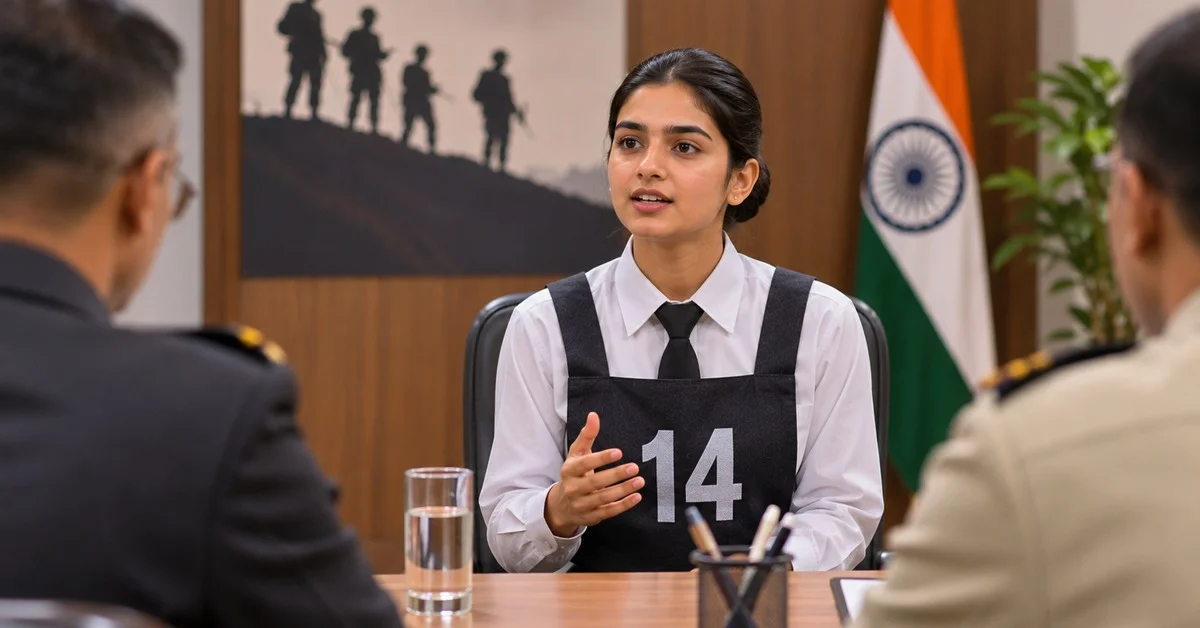
SSB Interview: How to Answer Why Do You Want to Join the Armed Forces?


Quick summary
Learn how to answer “Why do you want to join the armed forces?” at the SSB. Get a four-part framework, six sample answers for different backgrounds, the follow-up questions to expect and mistakes that make an answer sound rehearsed.
Answer it with your own story, not a slogan. Name the real moment your interest started and what you did about it. Then show what you know about the life you're choosing and why you suit it. Keep it to about a minute, keep it consistent with your PIQ, and expect follow-up questions on every claim.
The Interviewing Officer leans back, looks at your PIQ and asks the question you knew was coming. You start with "Sir, since childhood." and you can feel how flat it sounds even as you say it.
This guide breaks down the why do you want to join armed forces SSB question: what the IO is listening for, a framework for building your own answer, six sample answers for different backgrounds and the follow-ups that come next.
What the Interviewing Officer Is Really Checking
The IO is checking whether your reason is your own. Patriotism is taken for granted in everyone who reports to an SSB, so it doesn't count as an answer. What the IO wants to know is whether you've thought this choice through.
The personal interview usually runs 35 to 60 minutes and covers your background, studies and hobbies. Your answer to the why do you want to join armed forces SSB question gets tested against everything else you say. Here is what the IO is weighing:
- Is it genuine? A borrowed line shows in your tone and body language, however well you've memorised it.
- Does it match your PIQ? If you call sport your inspiration but list no sport anywhere on the form, the IO will notice.
- Do you know yourself? Can you explain what drew you in, and what you've done since?
- Does it fit the rest? The IO, GTO and psychologist compare notes at the conference, so your answer has to match how you behave in the other tests.
A strong why join army answer holds up under all four checks.
A Four-Part Framework to Build Your Own Answer
Build your answer from four parts, each backed by something real from your life. Write each part in one or two lines, then practise saying it aloud until it sounds like talking, not reciting.
- Spark: the specific moment your interest began. A cousin's passing-out parade, a flood relief convoy through your town, an NCC camp. Make it concrete enough that the IO can picture it.
- Proof: what you did about it. Fitness routines, NCC, sports captaincy, reading, earlier attempts. This is the part that shows you're serious.
- Knowledge: what you know of the life. Postings, time away from family, the role of a young officer. Show that you've looked past the uniform.
- Fit: why it suits you. Connect one or two of your traits to the job, with an example.
Write down every claim in your answer and check that your PIQ form backs each one. Like most SSB interview questions, this one leads straight into follow-ups, and anything you can't back up with an example will hurt you.
Weak vs Strong Answers
A weak answer could come from any candidate. A strong one could only come from you. When the IO asks "Why do you want to join the Indian Army?", the difference usually comes down to one specific detail.
| Weak line | Stronger version |
|---|---|
| "It's my childhood dream." | "I first thought about it at my uncle's passing-out parade in Class 8. Since then I've done NCC for three years and run every morning." |
| "I want to serve my nation." | "After the floods in our district, I watched an Army column clear the road in a day. I want to be the person who leads that kind of work." |
| "I like the uniform and the respect." | "I want a job where I'm responsible for a team from day one, and as captain of our college football side I found I enjoy that responsibility." |
| "It's a secure job." | "I want a career that keeps me physically and mentally tested, not one where I sit at a desk." |
Service to the nation isn't a wrong reason. It just shouldn't be your only one. Lead with the experience that made you choose the forces, and let the commitment to service come through it.
Sample Answers by Background
Use these as models, not scripts. Each one follows the four-part framework, so swap in your own moment, your own proof and your own traits before the SSB personal interview. If you can't say it naturally, change the words.
School student applying through NDA
"Sir, I first took it seriously in Class 10, when an NDA cadet from our school came back and spoke to us at assembly. I started running in the mornings and took up the house captaincy to see if I liked leading people, and I did. I know NDA means three years away from home, and the training is hard. That's part of why I want to start at 17 rather than later."
Why it works: it names a real moment and shows action taken, and it explains why this entry suits this age.
Graduate applying through CDS
"Sir, I thought about NDA in school but chose to finish my B.Com first. In college I ran our NSS blood donation drive for two years, and I liked handling people and logistics under pressure. Most of my batchmates are joining firms. I'd rather lead a platoon than manage a spreadsheet, and the CDS route lets me bring a degree and some maturity to that role."
Why it works: it answers the "why now" question before the IO asks it.
NCC cadet
"Sir, my first annual training camp was the first time I lived by a timetable I didn't set myself, and I found I did better that way. By the third year I was a sergeant, responsible for 30 cadets on a trek. That trek showed me I want this to be my job rather than a hobby."
Why it works: it turns an NCC certificate into proof of responsibility.
Working professional
"Sir, I've worked as a software tester for two years and I'm good at it. But I've noticed my best days are the ones when I'm leading the team through a release crunch, not the ones at my own screen. I was preparing for CDS alongside the job and kept up my fitness routine. I'm not running away from my job. I'm choosing work where leading people is the main task."
Why it works: it shows a pull towards the forces, not a push away from the job.
Candidate from a defence family
"Sir, my father served in the Signals, so I grew up on cantonment postings. I've seen the transfers and the long separations, so I know what I'm choosing. My father actually suggested engineering. Applying was my own decision, after I spent a summer helping at the station's youth sports camp."
Why it works: it shows the choice is the candidate's own, made with a realistic view of the life.
First in the family to apply
"Sir, no one in my family has served, so I had to find out about the life myself. I spoke to two officers from our district and read about how young officers spend their first postings. What kept me going was the idea of being responsible for people's safety and growth. My parents were worried at first, but they're with me now."
Why it works: it shows initiative, since the candidate went looking for information instead of relying on films.
Whatever your background, a good answer to the why do you want to join armed forces SSB question runs for about a minute of speaking.
Follow-Up Questions to Expect
Expect the IO to dig into anything you claim. A 2014 account from a candidate describes the IO firing 15 to 20 questions in one go and asking for answers in order. So prepare for the follow-ups as carefully as for the main question.
- "Why this service and not the others?" Give a reason tied to the work, such as leading soldiers on the ground, flying, or life at sea, not "it's the most famous."
- "Why should we select you?" Point to proof you've already mentioned, and don't claim new qualities you can't back up.
- "What will you do if you're not recommended?" Be honest. Say you'll work on what fell short and try again, and name a realistic backup.
- "What's your plan B?" Have a real answer. A plan B doesn't weaken your motivation, but claiming you have none sounds rehearsed.
- "Why leave your job?" For the why leave job and join army SSB question, talk about what draws you to the forces, not about what you dislike in your current job.
Mistakes That Make the Answer Sound Rehearsed
Most answers sound rehearsed because they were written for any candidate, not for you. Watch for these.
- Reciting a paragraph word for word: if you stumble on one word and lose the whole answer, you've memorised it. Learn the four points, not the sentences.
- Copying SSB interview sample answers: the IO has heard every popular line many times. The models above only help once your own details replace theirs.
- Contradicting your Self-Description Test: the SDT asks how your parents, teachers, friends and you yourself see you. If your interview story doesn't match what you wrote there, it shows at the conference.
- Glamour reasons: films, the uniform and status don't hold up once the IO asks what the job involves day to day.
- Overselling: calling yourself "fully prepared for any hardship" invites a test of that claim. Speak calmly and give an example instead.
Record yourself answering on your phone, then play it back. If it sounds like a speech, cut it down to the specific details.
FAQs
Is "childhood dream" a bad answer?
Only when it's the whole answer. If your interest really did start early, say when and why, then move quickly to what you've done about it since.
Can I mention salary or job security?
You can mention them as a secondary point if they're true. Lead with the work itself, though. Money as your main reason tells the IO you'd take any well-paid job.
How long should the answer be?
Keep it short, as suggested above, and stop once you've made your points. The IO will ask more if they want it.
Can I answer in Hindi?
If you speak Hindi more fluently, ask the IO politely at the start whether you may use it. Being clear and genuine matters more than polished English.
Start preparing today. Write your four points, record a one-minute version, and check every claim against your PIQ. Then practise the psychology tests, starting with these SRT situations with sample responses, because the psychologist's view of you has to match the IO's. For more SSB Interview guides and alerts, join Defence Study's community channels on WhatsApp and Telegram.
Tags
- why do you want to join armed forces SSB
- conference
- psychologist
- why join army answer
- SSB interview questions
- SSB personal interview
- why leave job and join army SSB
- SSB interview sample answers
- interviewing officer
- PIQ form
- motivation
- GTO