SSB Lecturette Format: How to Structure 3 Minutes With Examples

Quick summary
SSB Lecturette Format: How to Structure 3 Minutes With ExamplesMost candidates who reach the Group Testing Officer round understand what an SSB lecturette is. The real problem is execution: three minutes feels endless when you are standing in front of assessors, and the one-minute preparation window
Most candidates who reach the Group Testing Officer round understand what an SSB lecturette is. The real problem is execution: three minutes feels endless when you are standing in front of assessors, and the one-minute preparation window vanishes faster than expected. A vague awareness of the format is not enough to perform well under that pressure.
This guide gives you a second-by-second time blueprint, a topic selection decision rule for your prep minute, spoken opening and closing templates you can practise aloud, a full timestamped sample script, and a breakdown of the Officer Like Qualities the GTO is mapping to your delivery. Work through each section in order and you will walk into the room with a repeatable framework, not just good intentions.
What Is the SSB Lecturette and Where Does It Fit in GTO?
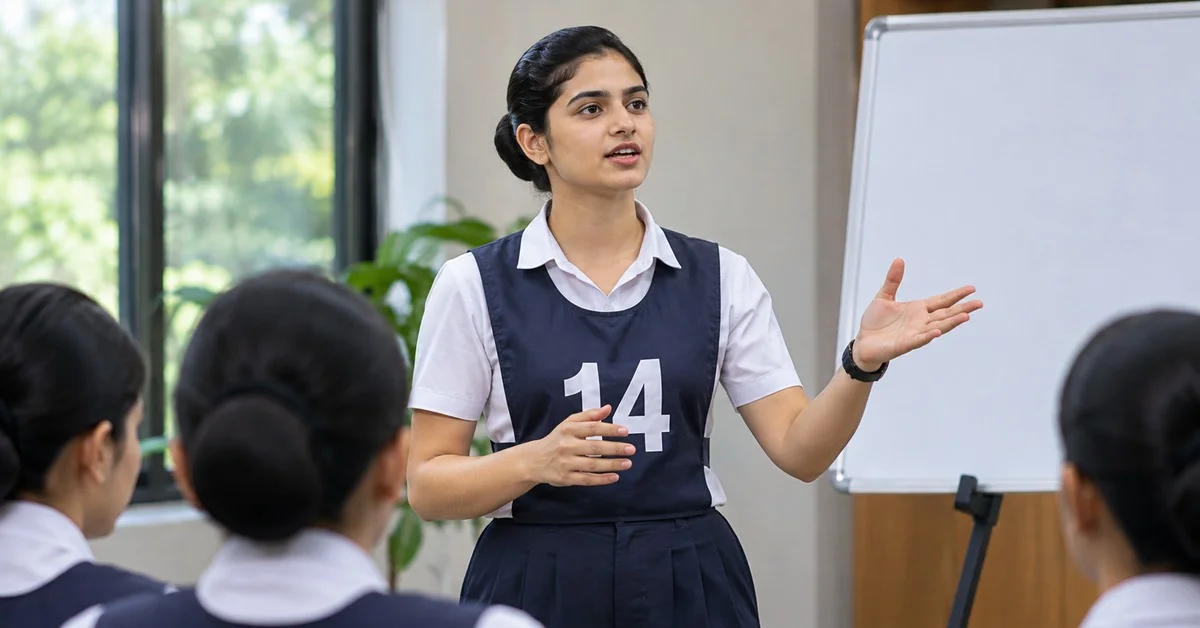
The SSB lecturette refers to a structured, individual speaking task where a candidate delivers a 3-minute talk to their group on a chosen topic, with exactly 1 minute of preparation time beforehand. It is one of the core lecturette GTO SSB activities conducted by the Group Testing Officer on Day 4 of the SSB interview.
Understanding the SSB lecturette format is essential for any serious defence interview preparation, because this task is not evaluated casually. The GTO observes how you think, organise, and communicate under time pressure.
The Lecturette round typically involves:
- A group of 8 to 12 candidates taking turns to speak
- Four topic cards presented to each candidate, from which one is selected
- A strict 3-minute delivery window after 1 minute of silent preparation
According to SSBCrack's detailed GTO breakdown, the SSB lecturette sits within a full day of group tasks, making it one of the few moments where individual performance is isolated and directly observed.
The 3-Minute Time Blueprint (Second-by-Second Breakdown)
Most candidates understand the basic rules of the Lecturette, yet still struggle with pacing when they stand up to speak. The real problem is not knowledge , it is time management. Without a fixed internal clock, even a well-prepared aspirant burns 90 seconds on the introduction and has nothing left for analysis or a proper close.
The blueprint below converts 3 minutes into four distinct phases. Commit these splits to memory before you practise a single SSB lecturette sample script, because structure must become automatic before content can flow.
- 0:00 , 0:30 (Introduction): State your topic, define its scope, and deliver a single compelling hook. Thirty seconds only.
- 0:30 , 2:00 (Body , 3 points): Cover exactly three sub-points, roughly 30 seconds each. Each point needs one fact or example to anchor it.
- 2:00 , 2:45 (Analysis / Impact): Connect your points to a broader implication. This is where Officer Like Qualities such as effective intelligence become visible to the Group Testing Officer.
- 2:45 , 3:00 (Conclusion): One crisp closing statement. No new information.
How many aspirants actually rehearse with a stopwatch before arriving at one of the most evaluated SSB interview rounds? Very few , and that gap is precisely where SSB lecturette mistakes like overrunning time or skipping the conclusion originate. According to SSBCrack's complete guide on the Lecturette, candidates who treat each phase as a non-negotiable time block consistently deliver more coherent and confident talks than those who wing the pacing.
How to Use Your 1-Minute Prep Time: Topic Selection Strategy
One minute sounds short, but it is enough to build a reliable skeleton for your entire talk. The decision that matters most in those 60 seconds is which topic to pick. Candidates who understand how to give SSB lecturette effectively follow one rule: choose the topic you know most about, not the one that sounds most impressive to the Group Testing Officer.
Once you have selected your topic, write only one anchor word per point on the prep card. Aim to note exactly 3 body points, because your available speaking time between the 0:30 and 2:00 marks leaves no room for a fourth. Prioritise current affairs and defence topics first, then science, then social issues.
Strong OLQ assessment scores often begin here, because structured prep directly improves logical sequencing in delivery. Confident body language in speaking flows naturally when you already know where each point is going before you stand up. SSBCrack's complete Lecturette guide reinforces this point consistently.
How to Open and Close Your Lecturette: With Spoken Examples
The first 15 seconds of your SSB lecturette decide whether the Group Testing Officer registers you as a confident communicator or another nervous candidate. Your SSB lecturette opening lines must do one job: grip attention immediately.
Three proven opening templates work consistently:
- Startling fact: "India's ISRO achieved its 100th successful launch milestone, yet fewer than 3% of our youth can name a single Indian astronaut programme."
- Rhetorical question: "If India can land a rover on the Moon's south pole, why are we still importing critical defence components?"
- Direct assertion: "Space exploration is no longer a scientific ambition. For India, it is a strategic necessity."
For your close, avoid trailing off. A future-outlook close signals power of expression and genuine thinking: "The decisions India makes in this decade will determine whether we lead the next era or follow it."
Practise using current affairs for SSB topics to build a ready bank of strong opening facts before your interview day.
Full Sample Script: "India's Role in Space Exploration" (3 Minutes)
This script demonstrates the SSB lecturette format in action, with timestamps you can use to self-monitor during practice. The topic falls under science and technology, a category that consistently rewards candidates who can connect facts to national impact.
[0:00] Introduction
India became only the fourth country in the world to soft-land on the Moon when Chandrayaan-3 touched down near the lunar south pole in 2023. That single achievement redefined what a developing nation can accomplish in deep space on a budget that was a fraction of comparable missions. Today I will speak on India's growing role in space exploration and why it matters for our future.
[0:30] Body , Point 1: ISRO's Cost Efficiency
ISRO has built a reputation for delivering missions at costs that larger agencies find difficult to match. The Mars Orbiter Mission, Mangalyaan, cost approximately 74 million dollars, making it the least expensive interplanetary mission ever completed at the time of its launch. This reflects the effective intelligence embedded in our engineering culture: solve complex problems with constrained resources and still lead the world.
[0:55] Body , Point 2: Commercial and Strategic Expansion
India now offers satellite launch services to foreign governments and private clients through ISRO's commercial arm. This positions the country not just as a scientific participant but as a strategic space power. The lecturette GTO SSB assessment rewards candidates who demonstrate awareness of such geopolitical dimensions, not just technical facts.
[1:20] Body , Point 3: The Human Spaceflight Programme
The Gaganyaan mission marks India's entry into crewed spaceflight. Four astronaut-designates have completed training. A successful crewed mission will place India among an elite group of nations capable of independently sending humans to orbit, strengthening both national prestige and defence-linked space capabilities.
[2:00] Analysis and Impact
Space is no longer purely a scientific frontier. Satellite surveillance, communication networks, and navigation systems are now core components of national security. India's advances in space directly enhance military readiness, disaster response, and economic planning. Ignoring this connection would mean missing the strategic heart of the subject entirely.
[2:45] Conclusion
Conclusion techniques matter as much as your opening. Two options work well here. A call-to-awareness close: "As a nation and as future officers, we must understand that space superiority will define the next generation of defence strategy." A future-outlook close: "With Gaganyaan on the horizon and private space startups growing rapidly in India, the question is no longer whether India belongs in space , it is how far we intend to go." Either close reinforces your SSB lecturette delivery with purpose and leaves the group with a clear final impression.
What the GTO Is Actually Evaluating: OLQ Indicators in Lecturette
The Group Testing Officer scores your Lecturette against Officer Like Qualities, not presentation polish. Every behaviour during those 3 minutes maps to a specific OLQ, which is why reviewing an SSB lecturette sample script with timestamps helps you practise the right signals, not just the words.
- Eye contact across the group signals power of expression. Candidates who fix their gaze on one person or stare at the card consistently underperform on this indicator.
- Logical sequencing of 3 distinct points reflects effective intelligence. Jumping between ideas without transitions is one of the most penalised SSB lecturette mistakes.
- A confident delivery maintained from start to finish demonstrates social adaptability, specifically your ability to hold a group's attention under pressure.
GTOs observe all 8 to 12 candidates simultaneously, so clarity and structure matter far more than vocabulary.
7 Common SSB Lecturette Mistakes (and How to Fix Each)
Understanding how to give SSB lecturette confidently means knowing exactly what trips candidates up during GTO tasks Day 4. These seven errors are the most frequently observed, each with a direct fix.
- Reading from the prep card: The card is a memory prompt, not a script. Glance, then speak.
- Monotone delivery: Vary pitch at each new point to hold the group's attention.
- Overrunning the 3-minute limit: Practice timed runs until stopping at 2:50 feels natural.
- Skipping the conclusion: Without a closing line, your talk simply stops. Always end deliberately.
- Filler words ("umm", "like", "basically"): Replace each filler with a deliberate pause.
- Choosing an impressive-sounding topic over a familiar one: Depth beats novelty every time.
- No eye contact with peers: Scan the group in a slow arc rather than fixing on one person.
FAQs
- How do I structure a 3-minute SSB lecturette?
-
Use the time-split blueprint: 0:00 to 0:30 for introduction, 0:30 to 2:00 for three body points, 2:00 to 2:45 for analysis, and 2:45 to 3:00 for your conclusion.
- What are the best SSB lecturette opening lines?
-
Start with a startling fact, a rhetorical question, or a direct assertion. Strong SSB lecturette opening lines signal confidence before you say your second sentence.
- How should I use the one-minute prep card?
-
Write one keyword per point, not full sentences. Three to four anchor words on your one-minute prep card are enough to guide a fluent delivery.
- What mistakes does the GTO penalise most?
-
Reading verbatim from the card, using filler words like "umm", and skipping the conclusion are the three most penalised errors. Each destroys the impression of effective intelligence the GTO is measuring.
- Can I speak on current affairs topics?
-
Yes. Pick a topic where you can offer analysis, not just facts. Frame it around impact and India's role wherever possible.
Your next step is to record yourself delivering a full 3-minute lecturette on two different topics: one from defence and one from current affairs. Time each attempt, review your eye contact and pacing, and refine your opening line until it sounds natural rather than rehearsed. Consistent practice with the time-split structure is what separates a confident delivery from a forgettable one.
Tags
- SSB lecturette
- effective intelligence
- SSB lecturette opening lines
- Officer Like Qualities
- SSB lecturette format
- SSB lecturette sample script
- how to give SSB lecturette
- lecturette GTO SSB
- SSB lecturette mistakes
- power of expression
- lecturette preparation time
- OLQ assessment
- social adaptability
- GTO tasks in SSB