India-Japan Hypersonic Missile Cooperation Gains Ground After Tokyo 2+2 Talks

Quick summary
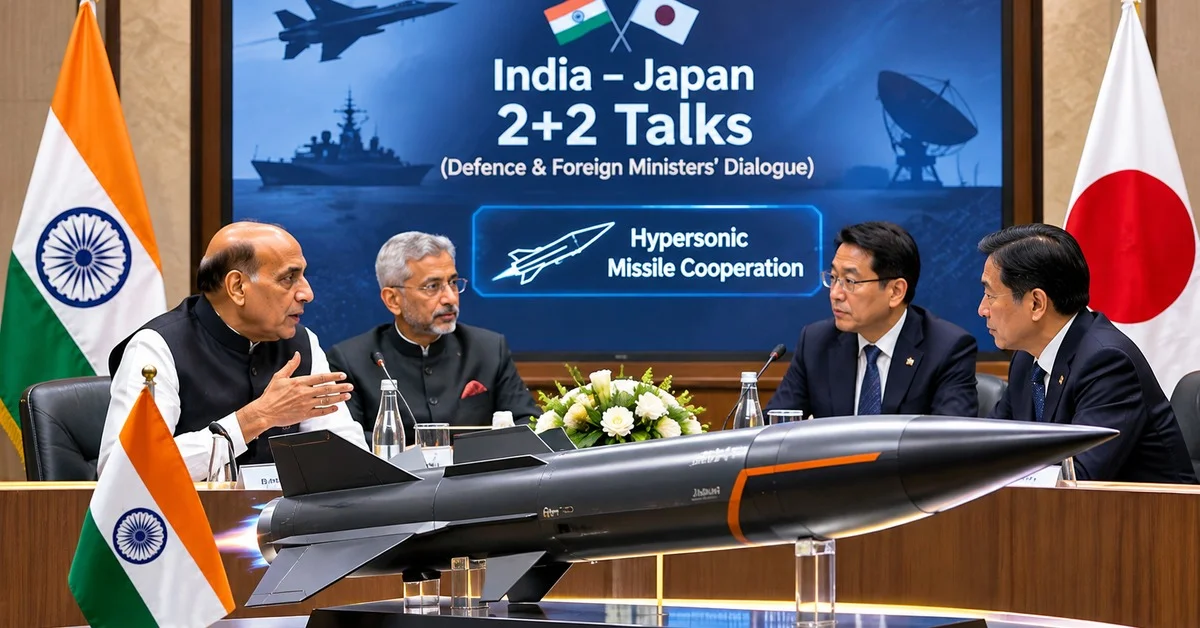
India and Japan are exploring closer cooperation in hypersonic and other missile technologies after their 2+2 talks in Tokyo. A Letter of Intent on Indian firing ranges also opens the way for Japanese live-fire training in India.
India and Japan are looking to take their defence relationship into more advanced territory, with missile technology and hypersonic weapons emerging as possible areas of cooperation. The push follows the fourth India-Japan 2+2 Foreign and Defence Ministerial Meeting, held in Tokyo on November 19, 2026.
The two sides are examining how they can share technical expertise and work together on future missile systems. No formal joint hypersonic weapon programme has been announced so far.
Firing Range Pact Marks a Key Step
A major outcome of the visit was a Letter of Intent (LoI) on the use of Indian firing ranges. It paves the way for Japan's Self-Defense Forces to conduct live-fire training in India for the first time, including drills with surface-to-ship missiles.
The partnership also has a research side. India's Defence Research and Development Organisation (DRDO) and Japan's Acquisition, Technology and Logistics Agency (ATLA) are set to begin joint research on missiles and other advanced defence technologies.
Chandipur Test Range Draws Attention
According to reports, India is prepared to open DRDO's Integrated Test Range (ITR) at Chandipur in Odisha to Japan. Two upcoming testing facilities in West Bengal and Andhra Pradesh could also be made available.
Chandipur is central to India's missile testing network. Its radars, telemetry stations, electro-optical tracking systems and mission control facilities help scientists monitor trials and assess how missiles perform.
Why Japan Is Looking at Indian Missile Ranges
Space is a major reason. Japan has limited room at home for long-range missile training, especially when drills need large stretches of sea to be kept clear. India's eastern coast and established test infrastructure offer a useful option.
A Japanese team visited India in October 2026 to check whether local ranges could support training with anti-ship missiles and smaller attack drones. One system in focus is Japan's Type-25 surface-to-ship missile, which has a range of roughly 1,000 km.
Japan's Changing Defence Strategy
Japan is going through one of its biggest military shifts since the Second World War. Tokyo is building longer-range strike capability, expanding its defence industry and taking on a larger security role in the Indo-Pacific.
China's growing military activity and North Korea's advancing missile programme are driving much of this effort. Japan is developing new missiles to strengthen deterrence.
It is also planning a layered coastal defence network built around large numbers of relatively low-cost unmanned systems. These aerial, surface and underwater platforms are expected to handle reconnaissance and strike missions alongside stand-off weapons, which can hit targets from a safer distance.
Naval Shipbuilding and Maritime Technology
Missiles are only one part of the discussion. The two countries are also exploring closer ties in warship building and maritime technology.
Officials have indicated that the focus is on technical know-how, design expertise and industrial cooperation. The talks are not centred on directly building Japan's Mogami-class stealth frigates in India.
India has offered its shipyards and defence public sector undertakings as partners for Japanese programmes. This could include production for Japan's own needs and for export, with manufacturing in India potentially offering large cost savings.
UNICORN Antenna Project
The Unified Complex Radio Antenna, known as UNICORN, is also part of the discussions. It combines several communication antennas in a single mast structure. Plans under discussion go beyond Indian Navy requirements and include possible export opportunities for Japan.
The effort fits the wider "Design with Japan, Make in India" approach to industrial cooperation.
What It Means for India-Japan Defence Ties
The relationship is moving beyond joint exercises and interoperability towards research, technology and industry. For now, the firing range LoI and missile research are the clearer areas of progress. Hypersonic cooperation could become a significant next step if both governments turn their interest into a defined project.
Tags
- India-Japan Hypersonic Missile Cooperation
- India-Japan 2+2 Foreign and Defence Ministerial Meeting
- Tokyo 2+2 talks
- hypersonic weapons
- Indian firing ranges
- DRDO
- ATLA
- Integrated Test Range
- Chandipur test range
- Type-25 surface-to-ship missile
- Japan Self-Defense Forces
- Mogami-class stealth frigates
- UNICORN antenna
- Design with Japan Make in India
- Indo-Pacific