Indian Army Underground Facilities: 19 Projects to Protect Troops and Weapons Along China and Pakistan Borders
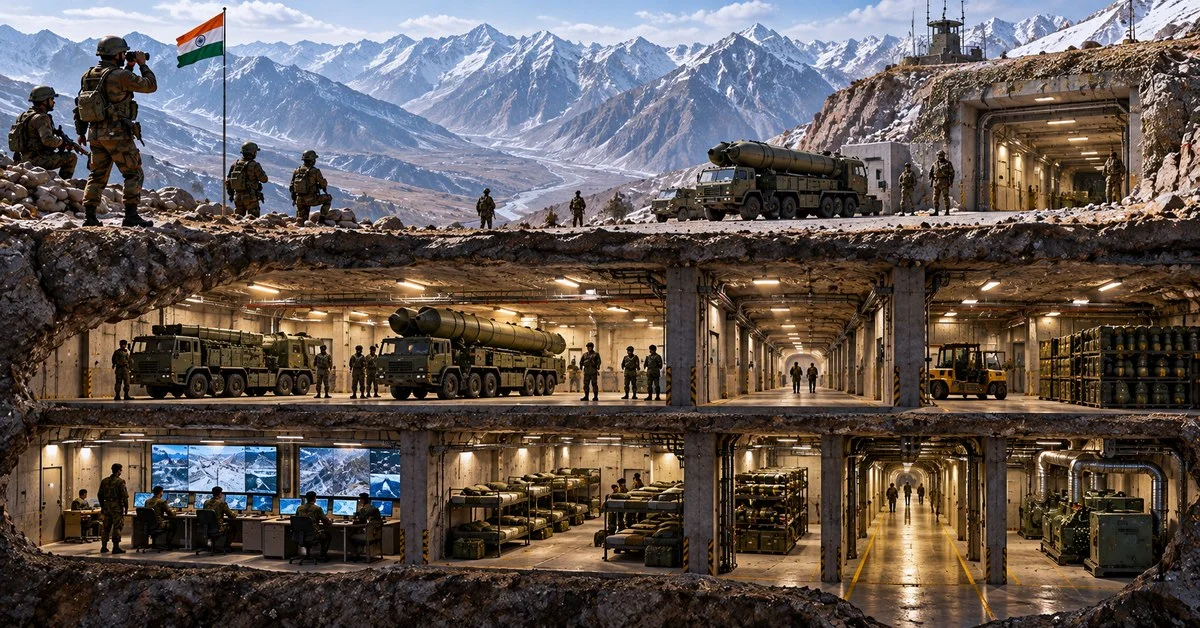
Indian Army underground facilities are being built along the China and Pakistan borders to protect troops, ammunition and equipment from missiles and drones, with 19 projects in the north and similar work planned for the Siliguri Corridor.
The Indian Army is building a network of underground shelters and storage sites along its borders with China and Pakistan. The aim is to keep soldiers, ammunition and key equipment safe from enemy missiles, drones and air strikes. The Army calls this a “force-preservation” plan. It means protecting the Army’s own strength so it can keep fighting even under heavy attack.
19 projects in the north
The Army’s Northern Command, which looks after Jammu and Kashmir and Ladakh, has started 19 separate projects to build protected underground facilities across its area. Each site will be designed to suit the local ground conditions and the job it needs to do.
These facilities will be used for:
-
Storing military equipment: Keeping important weapons and assets safe from enemy fire.
-
Ammunition storage: Protecting stocks of ammunition from missile and drone attacks.
-
Training needs: Supporting training activities in a safer environment.
The Command issued tenders for these projects in August. Companies interested in the work can send in their bids until 7 November.
What the Army commander said
Lieutenant General Pratik Sharma, General Officer Commanding-in-Chief of the Northern Command, spoke about the plan at the annual session of the Society of Indian Defence Manufacturers (SIDM) on 9 October.
He said the buying process for these projects would be transparent and fair to all. He also said the Army wants more companies to take part, including micro, small and medium enterprises (MSMEs).
Why the Army is moving underground
Modern wars are changing fast. Long-range missiles and precision-guided weapons can now hit targets on the surface with great accuracy. This makes open bases, ammunition dumps and parked equipment easy targets.
Underground sites offer much better protection. They can help the Army keep working even when the enemy carries out long and heavy attacks. The new Indian Army underground facilities are meant to survive missile strikes, mortar fire and attacks from the air.
The Army has learnt lessons from recent wars in West Asia and from its own experience during Operation Sindoor. That was India’s military action in May 2025 against terror camps in Pakistan and Pakistan-occupied Kashmir, launched after the terror attack in Pahalgam. Planners have also studied Iran’s large network of underground tunnels and “missile cities”, which helped it protect its weapons during long air campaigns.
Building for the toughest attacks
The Army has worked out different designs for these shelters after talking to experts and studying the needs of the modern battlefield. The options include:
-
Prefabricated structures: Ready-made units that can be put in place quickly.
-
Underground facilities: Shelters built below the ground for storage and protection.
-
Ultra-deep caverns: Very deep spaces carved into rock that can survive the strongest attacks.
These structures are meant to withstand heavy bombing, artillery fire and even “bunker-buster” weapons. A bunker-buster is designed to dig deep into the ground before it explodes.
Work in the east too
A similar effort is under way in the east to protect the Siliguri Corridor. Often called the “Chicken’s Neck”, this narrow strip of land in West Bengal is only about 20 to 22 km wide at its narrowest point. It is the main land link between the rest of India and the northeastern states, which makes it one of the country’s most sensitive areas.
Underground facilities planned here could be used for command and control, logistics and protected storage. This would help the Army keep key operations running in the region even if it comes under attack.
BRO building drone bunkers
The Border Roads Organisation is also building underground bunkers at some forward locations. These bunkers will protect combat drones and other high-value equipment. Details of these sites have not been shared for security reasons.
A shift in how wars are fought
The move shows a larger change in military thinking. Armies today focus not only on attack but also on survival and protection. Well-built underground sites can reduce exposure to enemy fire, protect fighting power and help troops keep going for longer.
India has long and difficult borders in both the north and the east. This new network of underground shelters could play a key role in keeping its forces safe and ready in any future conflict.