Colombia in Talks to Buy India’s BEL Anti-Drone System to Counter Drug Cartel Drone Attacks
Colombia is in talks to buy an anti-drone system from India’s Bharat Electronics Limited to counter drone attacks by drug cartels. Its ambassador says BEL’s offer is highly competitive against European rivals, though no contract has been signed yet
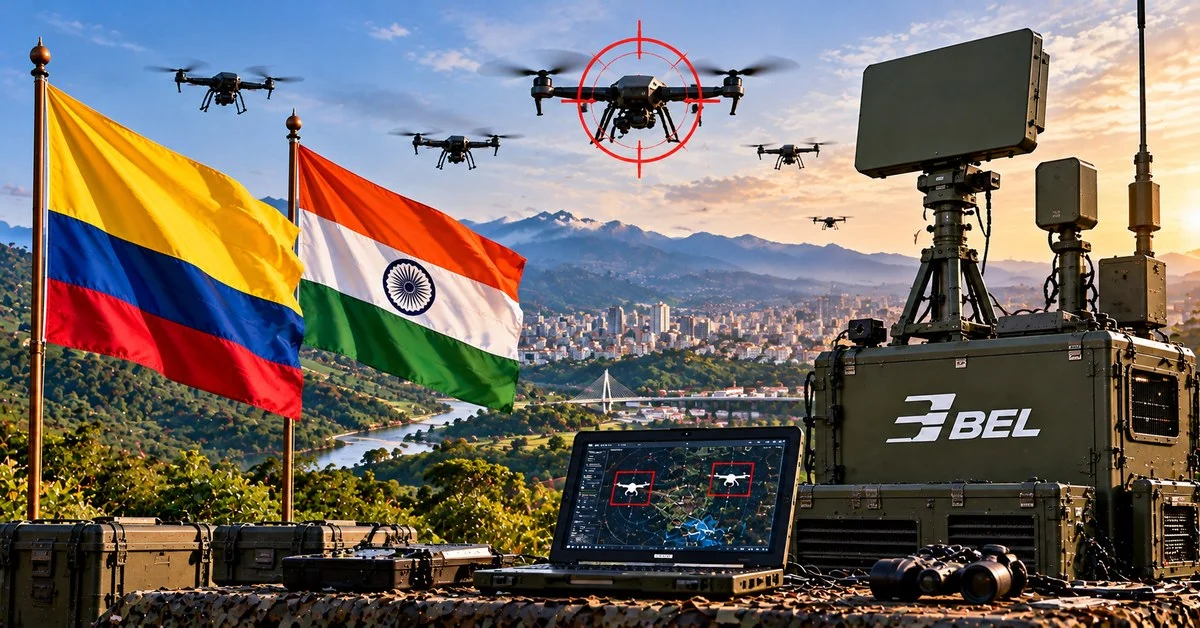
Colombia is in talks with India to buy an anti-drone system from Bharat Electronics Limited (BEL), the government-owned defence company. The South American country wants this technology to deal with the growing use of drones by drug cartels and armed groups.
Colombia’s Ambassador to India, Victor Hugo Echeverri Jaramillo, confirmed this month that negotiations are under way. He said BEL’s offer is “highly competitive” when compared with options presented by European defence companies.
No contract has been signed yet. Colombia is still studying which equipment and setup it needs.
Why Colombia needs anti-drone systems
Criminal gangs and rebel groups in Colombia are using more and more drones. These are mostly commercial drones that anyone can buy, which the groups change to suit their needs:
-
Attacks: Some drones are fitted with explosives and used to strike security forces.
-
Spying: Others are used to keep watch on police and army movements.
The threat is hardest to tackle in Colombia’s thick jungles and remote areas, where small drones are difficult to spot. To deal with it, Colombia started a large National Anti-Drone Shield programme earlier this year, worth several trillion Colombian pesos.
Colombian team visited BEL in March
The talks follow a visit to India earlier this year. On 27 March 2026, a Colombian defence team led by two Vice Ministers of Defence, Angélica Verbel Lopez and Angélica Marin Agudelo, visited BEL’s Ghaziabad unit and its Central Research Laboratory.
During the visit, BEL showed the team:
-
Anti-Drone Shield: BEL’s system for detecting and stopping hostile drones.
-
Drone swarm technology: AI-based systems that can control many drones together.
-
Drone cyber security: Tools to protect unmanned aircraft from cyber attacks.
-
Other facilities: BEL’s radar, antenna and command-and-control units.
How an anti-drone system works
A counter-drone system works in a few simple steps:
-
Detect: Radars and sensors spot a drone in the area.
-
Track and identify: The system follows the drone and checks whether it is a threat.
-
Stop: The drone is brought down either by jamming its signals or by physically destroying it.
BEL already supplies counter-drone technology to the Indian armed forces, which gives the company real field experience to offer foreign buyers.
About BEL
BEL is a Navratna public sector company under India’s Ministry of Defence, with its headquarters in Bengaluru. It makes radars, communication equipment, electronic warfare systems and missile systems for the Indian Army, Navy and Air Force. Over the past few years, the company has also been working to sell more of its products to friendly countries abroad.
Police cooperation also on the table
Apart from defence equipment, Colombia is also thinking of posting a police attaché at its embassy in New Delhi. This officer would help the two countries share intelligence and work together against international crime networks, including drug trafficking groups.
A boost for India’s defence exports
If the deal goes ahead, it would add to India’s growing list of defence exports. In recent years, Indian companies like BEL have been offering their products to countries that face non-traditional threats such as armed groups using drones. A sale to Colombia would also widen India’s defence presence in Latin America.
The Colombia anti-drone system talks are still at an early stage, and more details are expected once Colombia finalises what it wants to buy.