Operation Atlantic City: US Marines and NATO Allies Deploy to the Remote Arctic Island of Jan Mayen
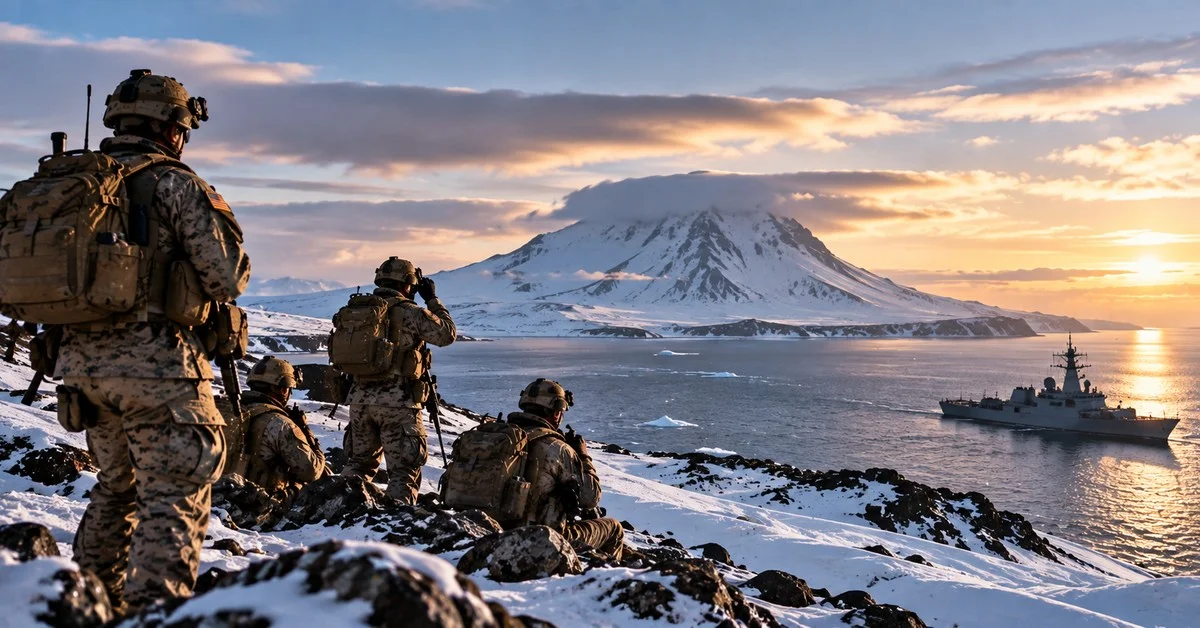
US Marines just made a rare, rapid deployment to one of the most remote islands on Earth. Here's what Operation Atlantic City actually involved, and why the Arctic is suddenly this contested.
Operation Atlantic City was a NATO exercise held from 26 August to 4 September 2026 on Jan Mayen, a remote Norwegian volcanic island roughly 620 miles (about 1,000 km) from mainland Norway. US Marine Corps units, alongside UK and Norwegian forces, with Australian personnel operating a coastal-defense missile system, carried out a first-of-its-kind rapid insertion of long-range fires and air-defense equipment onto the island. The exercise, run under NATO's Arctic Sentry initiative, was a direct response to rising Russian military activity in the High North and tested how quickly the Alliance could establish an expeditionary base and strike capability in genuinely remote Arctic terrain.
For readers tracking defence current affairs, this is the kind of story that shows up in CDS and AFCAT General Knowledge papers and SSB Lecturette topics on NATO, the Arctic, and great-power competition, not because of the island itself, but because of what the exercise signals about how NATO plans to contest territory most people assume is empty and irrelevant.
This piece covers what actually happened on Jan Mayen, which forces and equipment were involved, and why the Arctic has become a genuine flashpoint worth knowing about.
What Is Operation Atlantic City
Jan Mayen itself is a remote, largely uninhabited volcanic island, which is exactly what made this exercise notable. Getting combat-relevant equipment, personnel, and command systems onto Jan Mayen, a location that isolated, on short notice, is a genuinely different problem from exercising on a mainland NATO base.
Which Forces and Equipment Were Involved
United States: US Marine Corps Forces Europe and Africa (MARFOREUR/AF), II Marine Expeditionary Force, 1st Battalion of the 10th Marine Regiment, Marine Air Support Squadron 1, a High Mobility Artillery Rocket System (HIMARS) platoon from the 3-197th Field Artillery Regiment (New Hampshire Army National Guard), US Air Force Special Operations Command (MC-130 aircraft), US Air Forces Europe (C-130 and C-17 aircraft), and US Navy 6th Fleet and Task Force 68.
United Kingdom: LXX Squadron of the Royal Air Force (A400M transport aircraft), and Royal Marines from a Surveillance and Reconnaissance Squadron.
Norway: Royal Norwegian Navy personnel, the Norwegian Home Guard, Norwegian Joint Headquarters, and Joint Force Command Norfolk.
Australia: Personnel operating the Strikemaster coastal-defense system.
On the equipment side, the standout systems deployed during Operation Atlantic City were a Navy Containerized Launching System, a 40-foot container built around Lockheed Martin's Mk 70 platform holding four Mk 41 Vertical Launch System missile cells, and the Australian-developed Strikemaster system, which pairs dual Kongsberg Naval Strike Missile launchers on a Thales Bushmaster vehicle. Norway's own National Maneuver Air Defense System was also deployed, alongside Joint Light Tactical Vehicles and drones used for medical supply delivery.
Why the Arctic Matters Right Now
Jan Mayen sits north of the Greenland-Iceland-UK Gap, commonly called the GIUK Gap, a chokepoint that NATO has relied on since the Cold War to track and, if needed, block Russian naval movement between the Arctic and the open Atlantic. The Barents Sea, further east, functions as a key "bastion" for Russia's submarine fleet, including vessels capable of launching both conventional and nuclear-armed missiles.
Operation Atlantic City ran concurrently with the separate Northern Viking exercise, which focused on defending the GIUK Gap itself, and both fall under NATO's wider Arctic Sentry initiative, launched specifically in response to what the Alliance describes as Russia's increasing military activity in the High North.
Lt. Col. David Palacio, a fires officer with MARFOREUR/AF, said the deployment was built to ensure "the Alliance can instantly target and deny adversary freedom of maneuver in highly contested maritime terrain." Major General Daniel Shipley, commander of MARFOREUR/AF, framed it as proof of "ironclad relationships with Norwegian and British Allies" that shares "the burden of securing the High North... effectively across the Alliance." On the Norwegian side, Vice Admiral Rune Andersen said operating alongside allies demonstrates "capability and will to defend Norwegian territory and the High North," while Major General Øivind Gunnerud, chief of the Royal Norwegian Air Force, was blunt about the underlying driver: "Russia is the most important military factor shaping our planning in the High North."
Why This Matters for Defence Exam Aspirants
-
It's a live example of expeditionary basing. The concept of rapidly inserting fires and air-defense assets into a remote, undeveloped location is the same logic behind "expeditionary advanced base operations," a term that also shows up in discussions of Indo-Pacific and Taiwan-related defence analysis, useful for comparative GK questions.
-
The GIUK Gap is a recurring geography-meets-strategy term. Knowing what it is, and why a volcanic island near it matters, is the kind of specific, concrete fact that separates a strong SSB Lecturette answer from a vague one on "current global tensions."
-
It shows multinational interoperability in practice. A single exercise running US, UK, Norwegian, and Australian systems and personnel together is a good real-world reference point for any GK or interview question on NATO, coalition operations, or joint-force integration.
-
It connects to a broader Arctic competition theme. Russia's Arctic military posture, and NATO's response to it through initiatives like Arctic Sentry, is an increasingly common thread in current-affairs sections of CDS and AFCAT General Knowledge papers.
Want More Global Defence News Like This? Join the Defence Study community on WhatsApp, Telegram, or Instagram for global defence developments, current-affairs updates relevant to CDS, AFCAT, and SSB prep, and more as they're published. Stay Informed. Stay Prepared. Stay Ready.
Bringing It Together
Operation Atlantic City put US, UK, Norwegian, and Australian forces on one of the most remote islands in the Arctic to test whether NATO can rapidly establish real strike and air-defense capability far from any established base, and the exercise's own leadership was candid that Russia's growing Arctic activity is exactly why it happened.
For anyone preparing for a defence exam or an SSB interview, the specifics here, Jan Mayen, the GIUK Gap, Arctic Sentry, and the multinational force mix, are the kind of concrete current-affairs detail worth having ready rather than a vague sense that "there's tension in the Arctic."
Frequently Asked Questions
What was Operation Atlantic City? A NATO exercise held from 26 August to 4 September 2026 on Jan Mayen island, a remote Norwegian territory in the Arctic, where US, UK, and Norwegian forces, with Australian system operators, rapidly deployed long-range fires and air-defense equipment as a test of expeditionary basing capability.
Where is Jan Mayen Island? A volcanic, largely uninhabited Norwegian island roughly 620 miles (about 1,000 km) from mainland Norway, positioned north of the Greenland-Iceland-UK Gap.
Why did NATO conduct this exercise? It falls under NATO's Arctic Sentry initiative, launched in response to increasing Russian military activity in the High North, and ran alongside the separate Northern Viking exercise focused on the GIUK Gap.
Which countries and units were involved? The United States (US Marine Corps Forces Europe and Africa, II Marine Expeditionary Force, 10th Marine Regiment units, US Air Force, and US Navy), the United Kingdom (Royal Air Force and Royal Marines), Norway (Royal Norwegian Navy and Home Guard), and Australian personnel operating the Strikemaster coastal-defense system.
What is the GIUK Gap, and why does it matter here? The Greenland-Iceland-UK Gap is a strategic maritime chokepoint NATO has used since the Cold War to monitor and, if necessary, restrict Russian naval movement between the Arctic and the Atlantic, making Jan Mayen's position just north of it strategically significant.