50 Most Asked SSB Personal Interview Questions with Sample Answers (2026)
Most candidates who clear the NDA written exam or the Agniveer screening round assume the hard part is behind them. It is not. The Services Selection Board conference round, and in particular the personal interview, eliminates a significant share of otherwise capable aspirants every year. The reason is almost never a lack of patriotism or fitness. It is a lack of preparation for the specific SSB interview questions the Interviewing Officer uses to map your personality.
The same principle applies when it comes to SSB interview questions with answers.
This guide gives you 50 SSB interview questions with answers, IO annotations, and a preparation strategy built around what actually happens inside that room.
What Is the SSB Personal Interview and What Does the IO Look For?
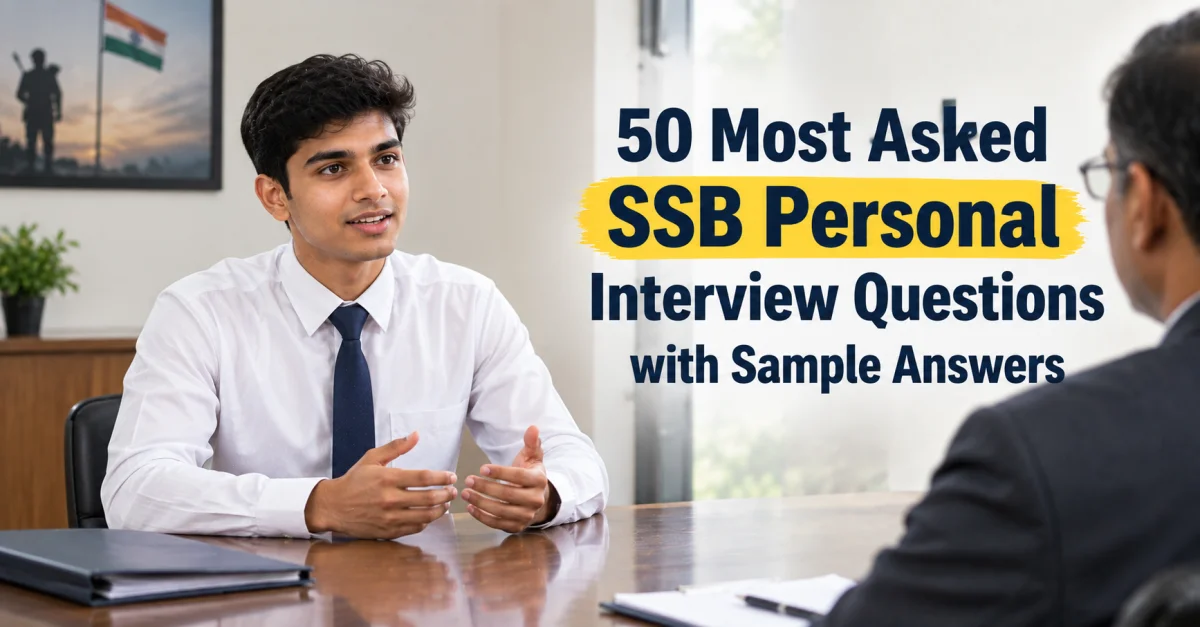
The personal interview is a one-on-one session with a trained Interviewing Officer that typically runs 20 to 30 minutes. It sits alongside the Psychological Tests and Group Testing Officer tasks as one pillar of the SSB five-day procedure. The IO does not grade you on correct answers. The assessment maps you against 15 Officer Like Qualities, including courage, initiative, social adaptability, responsibility, and cooperation. This matters a great deal when preparing your why do you want to join Indian Army SSB answer.
Before the interview begins, the IO studies your PIQ form SSB, which you fill out on Day 1. Every word on that form is fair game. Contradicting it verbally is one of the fastest ways to damage your OLQ assessment, so keep that in mind throughout your SSB interview preparation.
According to resources compiled at Indeed India and Centurion Defence Academy, the IO specifically looks for authenticity. Rehearsed scripts, memorised answers, and borrowed phrases from coaching institutes register immediately. What you say must sound like you, because it must actually be you. The same holds for Officer Like Qualities SSB evaluation across the board.
Self-Introduction and Background Questions (Q1 to Q10)
These questions occupy the first ten minutes of nearly every PI. The IO uses them to build a baseline picture of who you are before moving into harder territory. This baseline matters just as much in the conference round SSB.
-
Q1. Tell me about yourself. Model: "I am Arjun Mehta from Nagpur, currently in my second year of BSc Physics. I grew up in an Army cantonment because my father served for 22 years, which gave me a direct understanding of military life from a young age. Outside academics, I train in boxing and read military history." IO note: Reveals background, self-awareness, and a genuine link to service life.
-
Q2. Tell me about your hometown. Model: Describe one specific fact, a local industry, a geographical feature, or a historical event. Avoid generic lines about the city being beautiful.
-
Q3. What is your family background? Model: State occupations clearly, mention any service background, and show gratitude without over-dramatising hardship.
-
Q4. What are your hobbies? Model: Name two or three and be ready to go deep on one. The IO will follow up.
-
Q5. What are your strengths? Model: Choose strengths linked to Officer Like Qualities SSB assessors value, such as decisiveness or team orientation, and give a one-sentence example.
-
Q6. What are your weaknesses? Model: Name a real limitation you are actively addressing. Saying "I have no weaknesses" is a red flag.
-
Q7. Describe your school or college life.
-
Q8. Who is your role model and why?
-
Q9. What sports do you play?
-
Q10. How do your friends describe you?
The tell me about yourself SSB interview answer is the most important 90 seconds of your PI. Keep it under two minutes and end on something that naturally invites the next question.
Motivation and Career Choice Questions (Q11 to Q20)
This block tests whether your decision to serve is grounded in reality or in romanticised notions. The IO has heard every version of "I want to serve my country" and can immediately tell the difference between a felt conviction and a rehearsed line.
-
Q11. Why do you want to join the Indian Army? Model: "My father's service gave me a direct view of what the profession demands and what it gives back. I want a career where the outcome of my decisions carries real stakes, and where leadership is tested daily, not quarterly." IO note: Personal and specific, not generic. This is exactly what a strong why do you want to join Indian Army SSB answer sounds like.
-
Q12. Why not a civilian career? Model: Compare the professional growth structure and the nature of responsibility, not just the uniform.
-
Q13. Which service do you prefer and why?
-
Q14. What do you know about the Agnipath scheme? Model: Explain the Agnipath scheme SSB context accurately. The scheme recruits soldiers between 17.5 and 21 years of age for a four-year tenure, with 25 percent retained as permanent cadre.
-
Q15. Are you aware of what the NDA SSB interview process involves?
-
Q16. Have you appeared for SSB before?
-
Q17. What will you do if you are not selected?
-
Q18. Do your parents support your decision?
-
Q19. Why did you choose this particular entry?
-
Q20. What does service mean to you personally?
Leadership, Teamwork, and Situation-Based Questions (Q21 to Q30)
These SSB personal interview questions require structured answers. Use the situation, action, outcome format for every behavioural question. Briefly describe what happened, what you specifically did, and what the result was. Vague answers like "I motivated my team" carry no weight.
-
Q21. Describe a time you led a team. Model: "In college, our technical fest team lost two members three days before the event. I redistributed tasks based on individual strengths, ran a quick briefing each morning, and we delivered on schedule. Over 300 students attended."
-
Q22. How do you handle failure? Model: Give a real failure, name what you learned, and describe what changed in your behaviour afterward.
-
Q23. What would you do if a junior soldier disobeys an order?
-
Q24. Describe a conflict you resolved in a group.
-
Q25. Have you ever made a decision under pressure?
-
Q26. How do you motivate others?
-
Q27. Tell me about a time you failed as a leader.
-
Q28. How do you handle criticism?
-
Q29. What does teamwork mean to you?
-
Q30. Describe a situation where you had to take an unpopular decision.
Social adaptability is directly observable in how calmly and concretely you narrate these answers. Rambling or hedging signals low confidence to the IO, regardless of the content.
Academic, Current Affairs, and GK Questions (Q31 to Q40)
The IO expects any defense aspirant to stay current on national security and global affairs. The goal is not to sound like a news anchor but to show that you actually engage with the world around you.
-
Q31. Why did your marks drop in a particular year? Model: Be honest. Name the factor, what you did to address it, and the trajectory after. Never blame a teacher or institution.
-
Q32. What do you know about India's border situation?
-
Q33. Name India's most recent defense acquisition. Keep your current affairs defense 2026 knowledge current on indigenous platforms like the TEJAS Mk1A and the INS Surat.
-
Q34. What is the Line of Actual Control?
-
Q35. What do you know about Operation Sindoor?
-
Q36. Explain India's nuclear doctrine briefly.
-
Q37. What is the role of the Chief of Defence Staff?
-
Q38. Name three Indian defense PSUs.
-
Q39. How has the Agnipath scheme changed recruitment?
-
Q40. What is the significance of the Quad grouping?
Read one national newspaper and one defense-focused source daily for at least 30 days before your reporting date. Only present facts you can defend when the IO pushes further.
Tricky and Stress Questions (Q41 to Q45)
Stress interview tactics are not about cruelty. They test emotional stability, which is a core OLQ. The IO may suddenly raise his voice, challenge a factual claim you made, or ask something designed to catch you off balance. The correct response is always calm, factual, and unhurried.
-
Q41. You look too young for this. Are you sure you can handle command? Model: "I understand the concern, sir. At 19, I have already led teams in high-pressure environments. I know that command responsibility grows over years of service, and I intend to earn that progression."
-
Q42. Why were you rejected in your previous SSB? Model: Do not blame the system. Identify a specific gap you recognised and explain what you have done about it since.
-
Q43. What if you never get selected despite repeated attempts? Model: Express resolve without ignoring reality. Name an alternate plan, then return to your commitment.
-
Q44. Your academic record is poor. Why should we select you?
-
Q45. Do you think you are officer material?
Stay composed, answer factually, and never get defensive. The IO is watching your reaction at least as closely as your words.
SSB Personal Interview Questions for Female Aspirants (Q46 to Q50)
Female candidates face a specific set of SSB personal interview questions that test conviction about serving in a profession that has historically been male-dominated. Answers must be assertive and grounded in facts, not apologies.
-
Q46. Do you think women are physically capable of meeting military standards? Model: "Physical standards for each entry are defined and gender-adjusted where applicable, sir. I meet the required standards for this entry and continue to train. Capability is demonstrated through performance, not assumption."
-
Q47. How will you manage your family if posted to a remote location? Model: Explain that you have already had this conversation with your family, that they are supportive, and that male officers face the same postings.
-
Q48. Are you comfortable commanding male soldiers? Model: "Leadership is earned through competence and fairness, sir, not through gender. I have led mixed groups in college and found that clarity of communication and consistency build trust across any team."
-
Q49. What is your view on women in combat roles?
-
Q50. What unique perspective does a female officer bring to the armed forces?
The SSBCrack Exams female aspirant guide documents that these questions appear in virtually every female PI and reward composure and directness above all else.
5 Common Mistakes Candidates Make in SSB Personal Interviews
-
Giving vague answers. Answers like "I am hardworking and dedicated" tell the IO nothing. Every answer must carry a specific example or a concrete fact.
-
Contradicting the PIQ form. The IO has your PIQ form in front of him. If your verbal answer conflicts with anything you wrote on Day 1, your credibility collapses immediately.
-
Speaking negatively about past institutions or individuals. Criticising your school, college, coaching institute, or former employer signals poor social adaptability and a lack of professionalism.
-
Over-rehearsed responses. Candidates who have memorised answers often speak too quickly, pause unnaturally, or lose their thread when the IO deviates from the expected question order. Preparation should build understanding, not scripts.
-
Poor situational awareness in current affairs. Claiming to follow defense news and then failing a basic question on recent events is worse than admitting limited knowledge. Only speak about topics you can actually defend.
For a broader view of SSB interview preparation tips and how to develop OLQs systematically before your assessment, the Centurion Defence Academy SSB interview procedure guide covers the full five-day framework in useful detail.
FAQs
What is the duration of the SSB personal interview?
The personal interview typically runs 20 to 30 minutes. For candidates with complex PIQ forms or service backgrounds, it may extend slightly. The IO controls the pace entirely.
How should I answer "Tell me about yourself" in SSB?
Structure your tell me about yourself SSB interview answer around four elements: your name and location, your academic background, a personal fact that connects to military life or character, and a closing line that invites follow-up. Keep the total response under two minutes and speak naturally.
What OLQs does the Interviewing Officer assess?
The OLQ assessment covers 15 qualities including courage, initiative, social adaptability, sense of responsibility, cooperation, and effective intelligence. The IO does not tick a checklist. The assessment reflects the overall impression built across the entire conversation.
Can I mention failure or rejection in SSB interview answers?
Yes, and doing so well is actually a strength. The IO values self-awareness. Name what went wrong, what you understood from it, and what changed in your preparation or approach afterward. Candidates who claim never to have failed come across as either dishonest or unaware.
How do I prepare for current affairs questions in SSB PI?
Read one national newspaper daily and follow at least one credible defense publication. Focus on India's border situation, recent acquisitions, international partnerships, and domestic schemes like the Agnipath scheme. Engage with the material rather than memorising headlines, because the IO will push past the surface of any topic you choose to raise.