SSB WAT Questions: 60 Words with Sample Responses for Practice
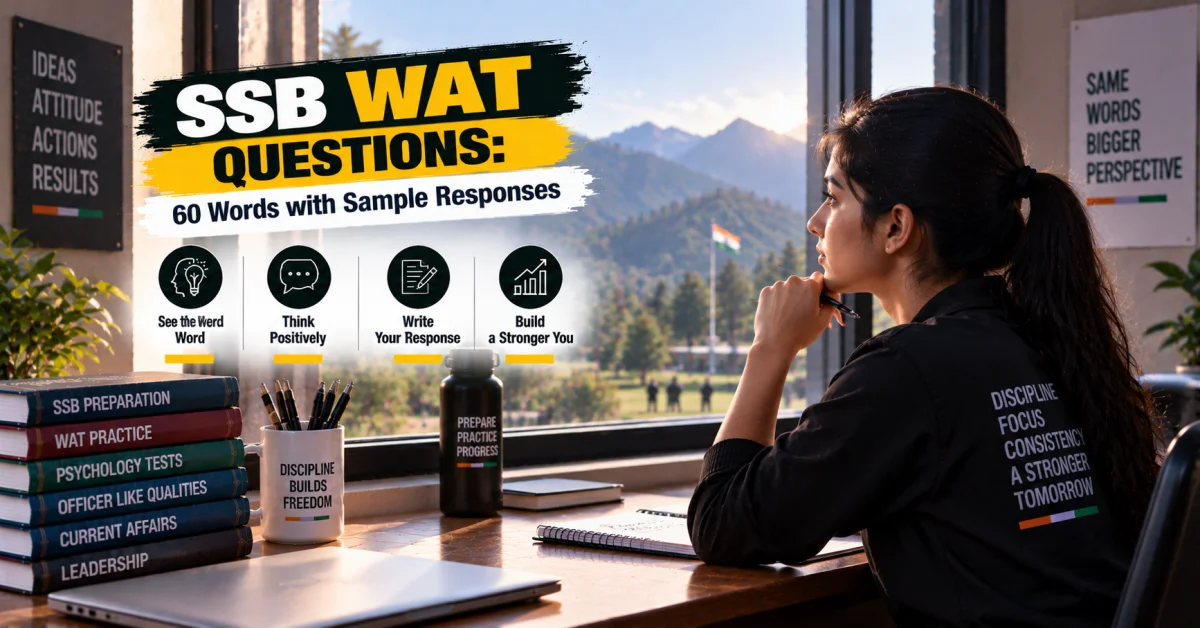
Prepare for the SSB WAT with 60 practice words and sample responses covering challenge, leadership, emotion, situational and abstract themes. Learn how to frame positive sentences within 15 seconds, avoid common mistakes and build consistent responses that reflect Officer Like Qualities.
Most candidates who sit for the word association test SSB already know the format. Sixty words, fifteen seconds each, one sentence per word. What they are not prepared for is the blank-mind panic that hits at word number eight when the clock is already running. This guide exists to fix that problem before you walk into the testing hall, and that's especially true when it comes to SSB WAT questions.
The SSB WAT questions covered here come with sample responses, OLQ signals, and correction notes so you can drill with purpose rather than just volume. Bookmark the word table, run the timed drill, and read the mistakes section before your next mock session. The same principle applies to how to form positive sentences in SSB WAT.
What Is the SSB Word Association Test (WAT)?
The word association test SSB is one of four psychological instruments used during the Services Selection Board interview process. Alongside the Thematic Apperception Test, the Situation Reaction Test, and the Self-Description Test, it forms the TAT SRT SDT battery that psychologist assessors use to build a picture of a candidate's personality across multiple data points, a detail worth keeping in mind for SSB WAT mistakes to avoid.
The format is simple and deliberately fast. A word appears on a projector screen for 15 seconds. During that window, you write one complete sentence that the word brings to mind. The test covers 60 words, making the total duration exactly 15 minutes. There are no multiple-choice options, no prompts, and no second chances once a word disappears. This matters just as much when thinking about OLQ in SSB interview.
The design is intentional. According to SSBCrack's WAT word list guide, the speed constraint is built in to prevent rehearsed or socially calculated responses. When you have only 15 seconds, your instinctive associations surface, and those associations reveal your habitual thinking patterns far more reliably than a considered answer would. The same holds for OLQ in SSB interview.
Services Selection Board psychology operates on the principle that personality is consistent across situations. The WAT is not testing your vocabulary or your grammar. It is testing whether the thoughts that come to you first tend to be constructive, action-oriented, and outward-looking, or whether they lean toward avoidance, self-doubt, and passivity. This applies equally to thematic word clusters.
Every sentence you write is treated as a sample of your natural thinking. Assessors look for patterns across all 60 responses, not just individual standout sentences. A single negative response will not sink your score, but a pattern of negative framing errors across multiple words absolutely will.
How SSB Psychologists Evaluate Your WAT Responses
Assessors are not reading your WAT responses for literary quality. They are mapping each sentence to the Officer Like Qualities framework, a set of 15 traits that the SSB uses to define the ideal officer personality. The most weighted OLQs in psychologist assessor scoring include Initiative, Courage, Perseverance, Social Adaptability, and Sense of Responsibility.
When a word like "failure" appears and you write "I analyse every failure to find what I can improve next time," the assessor records a signal for initiative and perseverance combined. When a candidate writes "Failure is hard to accept," the assessor records a neutral or slightly passive signal. Neither sentence is grammatically wrong, but only one advances your OLQ profile.
As explained in the SSBCrack guide on how psychologists evaluate WAT, TAT, and SRT responses, assessors look across the full 60-word response set for consistency. A candidate who signals Courage in ten different words, Perseverance in eight, and social adaptability trait in six is building a coherent personality picture. Fragmented or contradictory signals make the profile harder to read and often result in a lower score.
Scoring also accounts for whether a response is genuinely spontaneous or memorised. Assessors who have reviewed thousands of WAT sheets recognise stock phrases instantly. Writing "I lead my team with courage and dedication" for the word "leader" is a flag, not an asset. A specific, contextualised sentence, even a simple one, reads as far more authentic.
The SSB psychological tests are designed to be cross-validated. Your WAT responses are compared against your TAT stories, your SRT answers, and your self-description to check for consistency. A candidate who projects confidence in WAT but writes avoidant responses in SRT creates an inconsistency that assessors note.
How to Form a Strong WAT Sentence in 15 Seconds
The 15-second response drill becomes manageable once you internalise a three-step mental model and stop trying to write the perfect sentence.
Step 1: First thought wins. The word appears. Write the first action-oriented thought it triggers. Do not evaluate it, do not second-guess it, and do not scan for a "better" idea. The first instinct, if your practice has been positive and consistent, is your best response. Hesitation past the five-second mark is where candidates lose time and start writing incomplete fragments.
Step 2: Keep it positive and first-person or action-oriented. A positive first-person sentence keeps the OLQ signal clear. "I take initiative when my team is uncertain" scores better than "Initiative is important in a team." The first sentence places you in an active role. The second is an observation that could come from anyone.
Step 3: Write a grammatically complete sentence, no fragments. "Courage. Always." is not a response. "I face difficult situations with courage and a clear head" is. The psychologist assessor scoring system requires a full sentence to map an OLQ. Fragments cannot be assessed and are typically treated as non-responses.
How to form positive sentences in SSB WAT consistently comes down to daily practice with a timer. Set a stopwatch for 15 seconds per word. Write one sentence. Stop. Move to the next word. After 20 words, review your responses and identify any that use negative framing,
self-doubt language, or passive constructions. Replace them with action-oriented alternatives. Repeat the sequence the following day with a fresh set of words.
Avoid adjective-heavy sentences that describe a trait without situating it. "I am brave and disciplined" tells the assessor nothing concrete. "I kept my section calm and moving during a difficult night exercise" tells a story and signals multiple OLQs at once.
60 SSB WAT Words with Sample Responses
The table below organises 60 SSB WAT words with sample sentences into five thematic clusters for focused practice. Each entry shows the word, a model response, and the primary OLQ it signals. Use this as your core SSB WAT practice words list. For additional curated sentence examples, see the Centurion Defence Academy WAT practice guide.
Challenge Words
-
Obstacle , I find a way around every obstacle my team encounters. | Perseverance
-
Failure , I analyse every failure and return stronger the next time. | Initiative
-
Risk , I calculate risk carefully and act with confidence. | Courage
-
Danger , I stay calm in danger and guide my team to safety. | Courage
-
Crisis , I take charge immediately when a crisis demands quick action. | Initiative
-
Problem , I break every problem into steps and solve it methodically. | Perseverance
-
Defeat , I treat defeat as information and adjust my approach. | Perseverance
-
Pressure , I perform at my best when the pressure is highest. | Courage
-
Fear , I acknowledge fear and act in spite of it. | Courage
-
Struggle , Every struggle I face builds my capability for the next challenge. | Perseverance
-
Hardship , Hardship has shaped my discipline and strengthened my resolve. | Perseverance
-
Conflict , I resolve conflict by listening first and acting fairly. | Social Adaptability
Leadership Words
-
Command , I command with clarity and earn my team's trust through action. | Leadership
-
Responsibility , I never delegate a task I am not willing to do myself. | Sense of Responsibility
-
Decision , I make decisions quickly and own the outcomes completely. | Initiative
-
Authority , I use authority to enable my team, not to control it. | Leadership
-
Team , I build team cohesion by understanding each member's strengths. | Social Adaptability
-
Discipline , I maintain discipline by setting the standard myself first. | Sense of Responsibility
-
Mission , I keep every team member focused on the mission, even under stress. | Leadership
-
Order , I follow every order diligently and seek clarification when needed. | Sense of Responsibility
-
Victory , I celebrate team victory by recognising every individual contribution. | Leadership
-
Service , I joined the forces because service to my country is my highest purpose. | Sense of Responsibility
-
Duty , I complete my duty regardless of personal comfort or convenience. | Sense of Responsibility
-
Loyalty , My loyalty to my team and nation drives every decision I make. | Sense of Responsibility
Emotion Words
-
Anger , I channel anger into focused effort and constructive action. | Self-Control
-
Sadness , I support teammates through sadness and keep morale steady. | Social Adaptability
-
Anxiety , I manage anxiety through preparation and controlled breathing. | Perseverance
-
Loneliness , I use periods of loneliness to reflect and plan my next step. | Initiative
-
Hope , I give my team hope by reminding them of what we have already achieved. | Leadership
-
Confidence , I build my confidence through deliberate daily practice. | Perseverance
-
Courage , Courage to me means acting despite uncertainty, not in the absence of it. | Courage
-
Pride , I take pride in my unit's performance, not only my own. | Sense of Responsibility
-
Patience , I practise patience during long operations when results take time. | Perseverance
-
Trust , I earn trust by delivering on every commitment I make. | Social Adaptability
-
Respect , I treat every person with respect regardless of their rank. | Social Adaptability
-
Gratitude , I express gratitude to teammates who push me to improve. | Social Adaptability
Situational Words
-
Jungle , I navigate a jungle environment by reading terrain and keeping my team oriented. | Courage
-
Night , I train night movement drills until my team can execute them flawlessly. | Perseverance
-
Flood , During a flood, I organise rescue teams and direct evacuation systematically. | Initiative
-
Accident , When I see an accident, I secure the area and call for help immediately. | Initiative
-
War , I prepare rigorously in peacetime so my team is ready when war demands it. | Sense of Responsibility
-
Village , I connect with local villagers to build trust during operational deployment. | Social Adaptability
-
Border , Guarding the border is an honour I take with absolute seriousness. | Sense of Responsibility
-
Mountain , Mountain terrain demands physical fitness and mental adaptability, both of which I develop daily. | Perseverance
-
Ambush , In an ambush, I react immediately, control my team, and suppress the threat. | Courage
-
Rescue , I lead every rescue operation with a clear plan and constant communication. | Leadership
-
Uniform , Wearing a uniform means I represent values larger than myself at all times. | Sense of Responsibility
-
Camp , I ensure the camp is organised, the team is rested, and the mission plan is reviewed nightly. | Leadership
Abstract Words
-
Change , I adapt quickly to change and help my team see the opportunity within it. | Social Adaptability
-
Future , I build the future I want through deliberate choices today. | Initiative
-
Success , Success, to me, means completing the mission and bringing every member back safely. | Sense of Responsibility
-
Justice , I uphold justice even when it is personally inconvenient to do so. | Courage
-
Truth , I value truth and report facts accurately, even when the news is unfavourable. | Sense of Responsibility
-
Power , I use whatever power I am given to serve my team and mission, not myself. | Leadership
-
Time , I respect time as a resource and plan each day to use it purposefully. | Initiative
-
Nation , Defending my nation is not just my career, it is my calling. | Sense of Responsibility
-
Progress , I track my progress weekly and adjust my preparation plan accordingly. | Initiative
-
Freedom , I am willing to sacrifice personal comfort to protect the freedom others take for granted. | Courage
-
Spirit , I keep the team's spirit strong by acknowledging effort alongside results. | Social Adaptability
-
Sacrifice , Sacrifice is the foundation of service, and I accept it without hesitation. | Sense of Responsibility
Most Repeated SSB WAT Words: Practice These First
If SSB interview preparation 2026 time is limited, focus on the 15 words that appear most frequently across WAT batches. These words trigger the widest range of OLQ signals and are the ones most likely to catch unprepared candidates off-guard.
-
Failure , Tests Perseverance; most commonly answered with negative framing.
-
Courage , Tests Courage; generic responses score poorly.
-
Team , Tests Social Adaptability; self-centred responses are a red flag.
-
Decision , Tests Initiative; passive phrasing loses points.
-
Danger , Tests Courage; panic-framed sentences signal poor self-control.
-
Responsibility , Tests Sense of Responsibility; vague sentences are not scored.
-
Fear , Tests Courage and self-awareness; avoidance language is a disqualifier.
-
Victory , Tests Leadership; self-focused responses miss the mark.
-
Change , Tests Social Adaptability; resistance framing is common and costly.
-
Success , Tests multiple OLQs; overconfident or individualistic responses are flagged.
-
Conflict , Tests Social Adaptability; aggressive responses score negatively.
-
Sacrifice , Tests Sense of Responsibility; shallow or reluctant framing reads badly.
-
Mission , Tests Leadership and focus; vague responses are scored low.
-
Night , Tests Perseverance; avoidance or complaint-tone responses are flagged.
-
Anger , Tests Self-Control; any sentence that validates uncontrolled anger is scored negatively.
Drill these 15 words daily for one week before moving through the full SSB WAT practice words list. Each session should use a live timer set to 15 seconds per word.
Common WAT Mistakes That Lead to SSB Rejection
SSB WAT mistakes to avoid fall into five consistent categories that psychologist assessors flag across thousands of candidate scripts.
Negative framing errors are the most frequent disqualifier. Word: Fear. Bad response: "Fear stops me from making quick decisions." Corrected response: "I acknowledge fear and use it to sharpen my focus before acting." The first sentence confirms a limitation. The second demonstrates self-awareness and control.
Incomplete sentences and fragments cannot be scored. Word: Duty. Bad response: "Always my first priority." Corrected: "I treat duty as my first obligation and never compromise on it." A grammatically complete sentence is a non-negotiable requirement for OLQ mapping.
Generic responses are recognised immediately by experienced assessors. Word: Leader. Bad response: "A good leader is brave and kind." Corrected: "I lead by example and stay visible to my team when conditions are hardest." Specific, first-person language reads as authentic.
Self-doubt language in WAT directly contradicts the OLQ profile. Word: Failure. Bad response: "I am not sure I can recover from a major failure." Corrected: "I treat every failure as data and rebuild my approach immediately." Self-doubt language in WAT is one of the clearest signals that a candidate is not psychologically ready for command.
Overthinking delays produce rushed, incomplete, or off-topic sentences. The fix is not to think faster but to think less. The 15-second response drill works only if you commit to writing the first credible positive thought rather than hunting for the optimal one. Assessors who have reviewed WAT sheets note that overthought responses often contradict other parts of the psychological test battery because the candidate was performing rather than responding naturally.
FAQs
Can I get 60 SSB WAT words with sample responses to use for practice right now?
Yes. The full table in the section above contains 60 SSB WAT words with sample sentences organised into five thematic clusters: Challenge, Leadership, Emotion, Situational, and Abstract. Each entry includes the word, a model sentence, and the OLQ it signals. Start with the 15 high-frequency words listed in the "Practice These First" section if your time before the interview is short.
What mistakes do candidates commonly make in SSB WAT responses?
-
Negative framing that confirms a weakness rather than demonstrating how it is managed.
-
Writing fragments instead of a grammatically complete sentence, making OLQ mapping impossible.
-
Using self-doubt language in WAT responses, which signals that the candidate is not ready for command responsibility.
How do I write positive WAT sentences in 15 seconds without overthinking?
Use the three-step model. First, accept your first thought if it is action-oriented. Second, frame it as a positive first-person sentence with yourself in an active role. Third, write it as a complete sentence before the timer ends. Practice the 15-second response drill daily for at least two weeks before your SSB date to make this process automatic.
What are the most repeated SSB WAT words I should practise first?
The 15 highest-frequency words include Failure, Courage, Team, Decision, Danger, Responsibility, Fear, Victory, Change, Success, Conflict, Sacrifice, Mission, Night, and Anger. These words cover the broadest range of Officer Like Qualities and appear consistently across WAT batches. Drilling these first gives you maximum return on limited preparation time.
How do SSB psychologists score WAT responses?
Psychologist assessor scoring maps each response to the Officer Like Qualities framework. Assessors are not evaluating vocabulary or grammar beyond basic completeness. They track patterns across all 60 words, looking for consistent signals of Initiative, Courage, Perseverance, Social Adaptability, and Sense of Responsibility. A single weak response is not disqualifying; a pattern of passive, negative, or self-centred responses is. Your WAT profile is also cross-validated against your TAT, SRT, and SDT responses to check for personality consistency.