SSB TAT Questions: Important Picture Themes, Sample Stories and Writing Guide
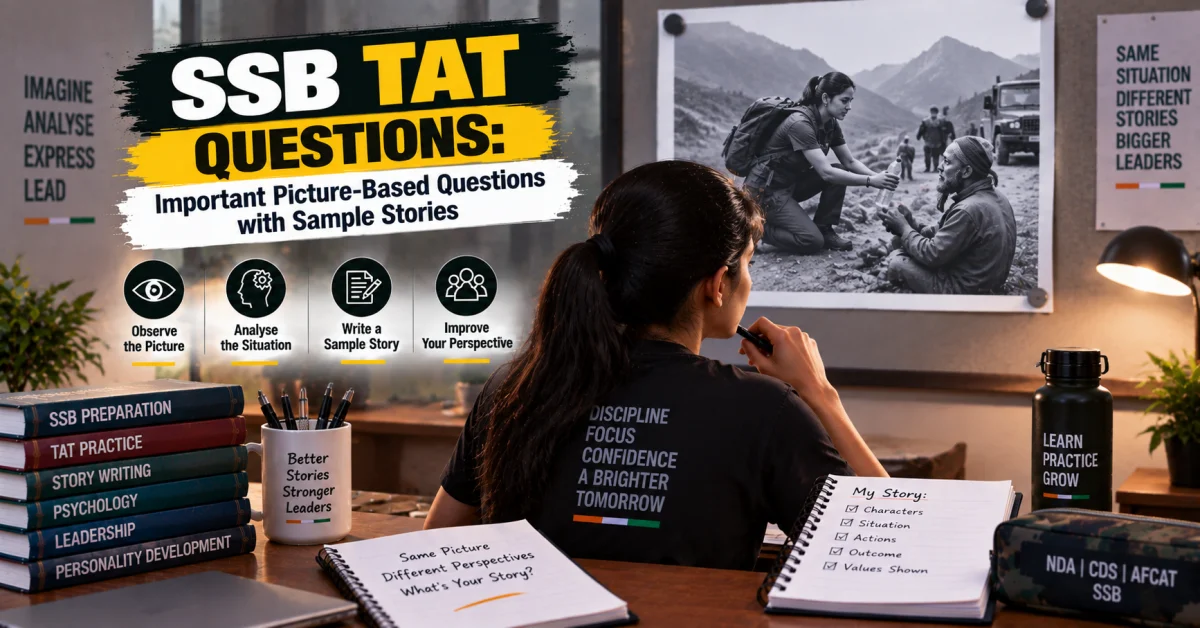
The SSB TAT tests candidates through ambiguous pictures to assess Officer Like Qualities such as initiative, responsibility, courage, decision-making, and social adaptability. Learn key picture themes, sample stories, common mistakes, and a practical 30-day preparation plan.
Most candidates walking into the Services Selection Board psychological test know the Thematic Apperception Test exists. Very few know exactly what the psychologist is looking for, sentence by sentence. This guide closes that gap. It covers the SSB TAT questions you will actually face, the Officer Like Qualities assessors track in every story, and a 30-day plan to get genuinely ready, not just familiar. That is especially true when it comes to SSB TAT sample stories.
What Is the SSB TAT and How Does It Work?
The Thematic Apperception Test is a projective SSB psychological test in which candidates are shown a series of pictures and asked to write a story about each one. The test works on the principle that people project their own values, instincts, and personality onto ambiguous images, revealing qualities a structured interview might never surface. The same principle applies to common TAT pictures in SSB interviews.
The format is fixed. Candidates receive 12 pictures in total: 11 scene-based images and one blank slide. Each picture is displayed for 30 seconds for observation, followed by 4 minutes of writing time. The complete test runs for approximately 60 minutes, a detail worth keeping in mind for the SSB psychological test overall.
The psychologist reading your response is not grading grammar or literary style. According to SSBCrack's detailed explanation of TAT in SSB interviews, assessors scan each story for evidence of Officer Like Qualities projected through the protagonist's choices and actions. A beautifully written story with a passive hero scores lower than a simply written story where the protagonist takes charge, accepts responsibility, and drives a positive outcome. Keep this in mind when thinking about common mistakes in SSB TAT stories.
The SSB TAT questions are deliberately ambiguous. A picture of a man near a river could suggest a flood rescue, a moment of personal crisis, or a training exercise. There is no single correct interpretation. What matters is whether your response reveals the temperament of someone fit to lead under pressure, and the same holds for demonstrating initiative in a TAT story.
Common SSB TAT Picture Themes You Must Prepare For
Across hundreds of documented SSB TAT sessions, common TAT pictures SSB interview candidates encounter tend to cluster into six recognisable categories. Preparing one strong story framework per category means you are never caught off guard by what appears on screen.
-
Solo challenge: One individual facing a physical or professional obstacle alone. Prep cue: show self-reliance and initiative, not paralysis.
-
Group conflict or leadership: A crowd, a team disagreement, or a mob situation. Prep cue: your hero mediates, organises, and leads without being authoritarian.
-
Disaster or rescue scenario: Floods, fires, accidents, collapsed buildings. Prep cue: focus on decisive action in the first 30 seconds of the story's timeline.
-
Family or emotional dilemma: A domestic conflict, a grieving figure, or a parent-child tension. Prep cue: show emotional intelligence and a sense of responsibility without melodrama.
-
Academic or career dilemma: A student at a crossroads, someone facing failure or a difficult choice. Prep cue: demonstrate decision-making under pressure and a growth mindset.
-
Blank slide: No image at all. Prep cue: create an original, positive scenario from scratch. Assessors specifically look for imagination and initiative here.
According to Centurion Defence Academy's TAT theme guide, candidates who prepare only for dramatic disaster pictures are caught off guard by quiet domestic or academic images, which appear frequently and are just as important to score well on.
How SSB Psychologists Actually Evaluate Your TAT Story
The psychologist assessment SSB process is structured around 15 Officer Like Qualities defined by the Services Selection Board. Every story a candidate writes is read against this framework, not against a literary rubric.
Five OLQs appear most consistently in high-scoring TAT responses: initiative, sense of responsibility, courage, decision-making under pressure, and social adaptability, which SSB assessors track through the hero's interactions with others. Each well-constructed story should surface two to three of these qualities naturally. Forcing all five into one story makes the narrative feel mechanical and unconvincing.
The psychologist reads for three things in sequence. First, does the protagonist notice the problem and act on it without being told? That signals initiative. Second, does the hero stay accountable for the outcome even when things go wrong? That signals sense of responsibility. Third, does the story resolve positively because of the hero's specific decision, not luck or someone else's intervention? That signals effective leadership potential.
According to SSBCrack's insider guide on psychologist evaluation, assessors also note consistency across all 12 stories. A candidate who writes one strong story and eleven passive ones does not score as a recommended candidate, which SSB selection demands. The OLQ in TAT stories must appear across the entire set, not just in the best response.
The Winning TAT Story Structure (Plot Blueprint)
A reliable TAT story writing framework that SSB coaches and recommended candidates consistently share involves a three-part formula. Understanding it prevents the two most common structural failures: stories that have no action, and stories that have no resolution.
Part 1: Situation. In one or two sentences, establish what is happening and why it matters. Introduce the hero protagonist in TAT immediately. Avoid lengthy backstory, since the picture context already provides it.
Part 2: Action. This is the core of the story and should take up the most space. The hero decides, acts, coordinates, or communicates. The action must be specific. "He helped" is weak. "He organised the villagers into two groups, one to reinforce the embankment and one to evacuate elderly residents" is strong.
Part 3: Outcome. Close with a positive story resolution the hero directly caused. The outcome should be concrete, not vague. "The situation was resolved" is insufficient. "All twelve trapped workers were evacuated before the tunnel collapsed completely" is the standard to aim for.
The hero protagonist in TAT can be any profession: a teacher, an engineer, a farmer, a student, or a doctor. There is no requirement for a military protagonist. What matters is that the character demonstrates the temperament of an officer through their choices, not their job title. This is one of the most underused TAT story writing tips that SSB preparation guides tend to overlook.
5 Sample SSB TAT Questions with Model Stories (Annotated)
The following SSB TAT sample stories cover one story per major theme category. Each is followed by a brief annotation identifying the OLQ demonstrated.
Picture theme: Solo challenge (a man standing at the edge of a flooded road)
Rajan, a schoolteacher, finds the bridge submerged after heavy rains. Children are stranded on the other side. He ties rope between two trees, creates a makeshift guide line, and leads each child across the shallow edge one by one. Every child reaches safety before dark.
Annotation: initiative (acts without waiting for external help), sense of responsibility (stays until the last child is safe).
Picture theme: Group conflict (a heated argument among workers at a construction site)
Priya, a site engineer, sees two teams fighting over equipment access, halting the entire project. She calls a five-minute stand-down, allocates equipment in shifts using a written roster, and resumes work. The site meets its daily target.
Annotation: social adaptability SSB quality (calm under hostility), decision-making under pressure.
Picture theme: Disaster (a collapsed building, people gathered outside)
Vikram hears a child crying from under debris. He organises bystanders into a human chain to pass rubble outward, calls the emergency number himself, and guides paramedics to the exact location when they arrive. The child is rescued within 40 minutes.
Annotation: courage, initiative.
Picture theme: Academic dilemma (a student staring at an exam result)
Arjun fails his engineering entrance exam by 12 marks. Rather than deferring a year, he analyses his weak subjects, joins a structured revision programme, and clears the exam in the next attempt with a merit rank.
Annotation: decision-making under pressure, sense of responsibility toward personal goals.
Blank slide TAT strategy
For the blank slide, create a self-contained scenario. Example: a young doctor posted in a remote village identifies a dengue cluster, organises a community awareness drive, and prevents an outbreak. This demonstrates imagination and initiative simultaneously.
SSB TAT Mistakes That Get Candidates Screened Out
Understanding mistakes in SSB TAT stories is as important as learning the correct structure. Seven errors consistently reduce scores.
-
Negative endings: Any story where the hero fails, dies, or gives up signals a pessimistic outlook. Positive story resolution is non-negotiable.
-
Passive hero: A protagonist who watches others act, waits for orders, or is rescued rather than rescuing projects the opposite of Officer Like Qualities.
-
Copying a classmate's story theme: Psychologists read dozens of responses from the same batch. Identical story structures are immediately flagged.
-
Military-only protagonist bias: Restricting every hero to a soldier or officer limits story variety and signals a lack of imagination. Civilians with officer temperament score equally well.
-
Ignoring the blank slide: Leaving the blank slide TAT strategy unpractised is a critical oversight. Many candidates freeze and waste the 4-minute window.
-
Writing beyond the time limit: An incomplete but decisive story is better than a lengthy story that trails off mid-sentence because time was called.
-
Story without a decision point: Every strong TAT story contains one moment where the hero chooses a specific course of action. Stories that describe events without a clear decision reveal a lack of the decision-making under pressure quality assessors need to see.
How to Prepare for SSB TAT in 30 Days
SSB interview preparation for the TAT requires structured repetition across four weeks, not last-minute cramming.
Week 1: Theme recognition drills. Collect 30 to 40 TAT practice pictures from verified sources. For each image, spend 30 seconds identifying the dominant emotion or action, then write a single sentence naming the theme category. Do not write full stories yet. Build the habit of rapid picture reading first.
Week 2: Timed writing practice. Write one complete story per picture using the three-part formula. Set a strict 4-minute timer for every attempt. Focus on getting a decision point and a positive resolution within the time limit. Quantity matters here: aim for at least 20 stories across the week
.
Week 3: OLQ self-audit. Re-read your Week 2 stories and tag each paragraph with the OLQ it demonstrates. If a story tags the same OLQ in every paragraph, rewrite it to show two or three different qualities. If a story has no tagged OLQ at all, it needs a new action paragraph. This is the OLQ in TAT stories audit that most candidates skip entirely.
Week 4: Mock TAT under exam conditions. Sit for a full 12-picture session with a timer. No pauses, no corrections after time is called. Review for blank slides handled, decision points present, and positive resolutions achieved. Repeat twice before your SSB date.
Pairing TAT preparation with WAT SRT SSB tests practice in the same sessions builds psychological endurance, since all three tests run on the same day and fatigue affects story quality in the later slides.
FAQs
Can the hero in a TAT story be a civilian?
Yes. The Services Selection Board assesses Officer Like Qualities through the hero's behaviour, not their profession. A farmer who organises flood relief and a soldier who does the same both demonstrate initiative and sense of responsibility equally. Varying your protagonist across stories also shows range and imagination.
What should I write for the blank TAT slide?
Use your blank slide TAT strategy to create an original, positive scenario from scratch. Choose a setting you can describe confidently, introduce a problem within the first sentence, and resolve it through the protagonist's direct action. Assessors specifically use this slide to measure creativity and initiative, making it one of the highest-value pictures in the set.
How many OLQs should one story show?
Aim for two to three OLQs per story, woven naturally through the action and outcome paragraphs. Attempting to demonstrate all 15 Officer Like Qualities in a single four-minute story produces an unconvincing, crowded narrative. Consistency across all 12 stories matters far more than density in any single one.
What if I cannot understand the picture in 30 seconds?
Focus on the dominant emotion or action visible in the image, whether it is urgency, grief, effort, or conflict, and build from that. Do not leave the answer sheet blank. A story grounded in the dominant feeling of a picture is always preferable to an empty page, which scores zero and signals anxiety to the psychologist.
Do TAT stories need to relate to military situations?
No. Everyday civilian situations with decisive, responsible protagonists score very well in the psychologist assessment SSB process. A doctor managing a rural health crisis, a student organising disaster relief, or an engineer preventing an industrial accident all provide strong platforms for demonstrating the same qualities SSB boards look for in a recommended candidate. If you are also comparing career paths in the defence forces, the Indian Army vs Navy career guide on Defence Study covers service-specific expectations in detail.
For further reading, see TAT in SSB Interview: Thematic Apperception Test Explained and SSB TAT Pictures: Types of Themes and Story Writing Guide.