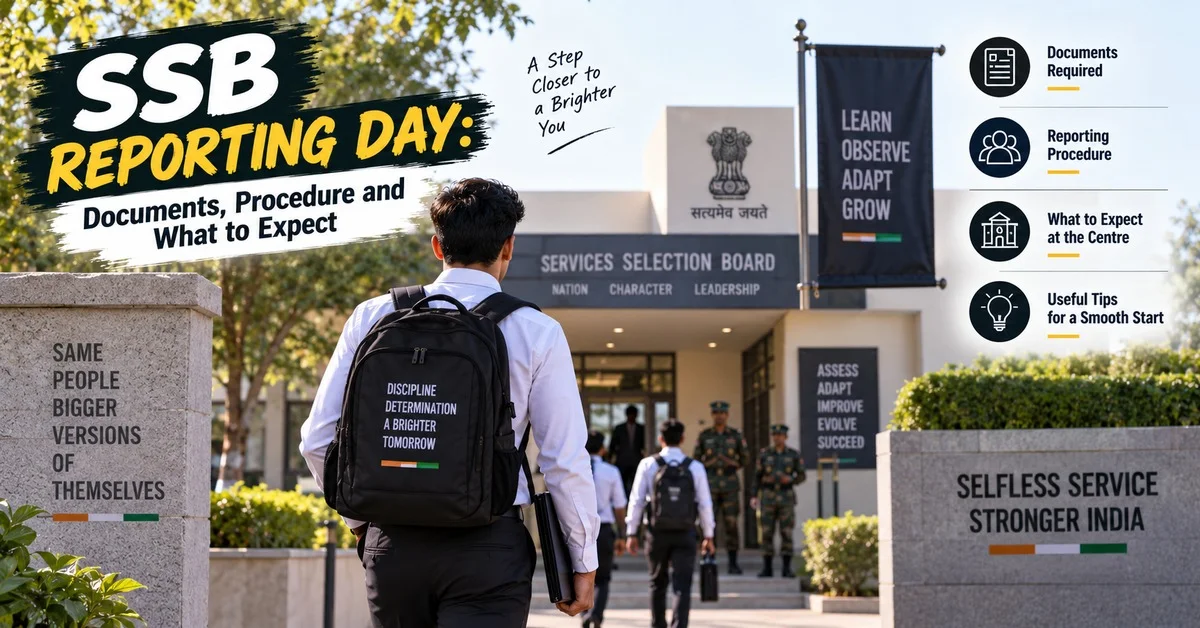
SSB Reporting Day: Documents, Procedure and What to Expect

Quick summary
SSB Reporting Day is more than a document check. Here's exactly what happens, in what order, and what changes depending on when you report.
SSB Reporting Day is the first day of the 5-day SSB process, when candidates arrive at the centre, get their documents verified, receive a chest number, and fill out the PIQ (Personal Information Questionnaire). What happens next depends entirely on your reporting time. Candidates reporting early morning are often screened the same day, while afternoon reporters usually begin screening the next morning. Knowing this in advance changes how you plan the rest of your day.
If you're an aspirant searching for this, you likely want one of three things: the exact sequence of events, the documents you need in hand, or whether the screening test happens immediately.
This guide covers what happens on SSB Reporting Day, in the exact order it happens.
Why SSB Reporting Day Sets the Tone for the Rest of the Assessment
Reporting day looks procedural on the surface, but assessors form early impressions from how a candidate handles it.
Punctuality, how documents are organized, and how carefully the PIQ is filled all feed into the picture an assessor builds before the Personal Interview even begins.
That's the real reason this stage deserves preparation, not just paperwork.
What Actually Happens on SSB Reporting Day: Step-by-Step
Across reporting-day accounts, the sequence is fairly consistent. Here's what to expect, in order.
Arrival at the designated reporting point: usually a railway station, bus stand, or airport named on your call-up letter, at the specific time mentioned in it.
Reception and transport to the SSB centre: board representatives or liaison staff receive candidates and arrange transport, often by bus, to the assessment centre.
Opening briefing: an officer welcomes the batch and explains the schedule for the day and the days ahead.
Document verification: originals and photocopies of your call-up letter, photo ID, educational certificates, and photographs are checked against your application.
Chest number allotment: you're assigned a chest number, a unique identifier used instead of your name for every test through the process.
PIQ completion: you fill out the Personal Information Questionnaire in detail, covering your background, education, family, interests, and self-assessment.
Accommodation and mess allotment: rooms and meal arrangements are assigned for the duration of your stay.
Rules briefing: staff explain restrictions on mobile phone use, dress codes, and general conduct expected at the centre.
This entire sequence, minus screening itself, is often referred to informally as "Day 0," since it happens before the actual testing begins.
Morning Reporting vs Afternoon Reporting: Why Timing Changes Everything
This is the part most first-time candidates overlook, and it directly affects how the rest of your day unfolds.
Your call letter states the exact reporting time. Checking it in advance helps you plan return travel and avoid assuming screening is guaranteed on day one.
Documents You Must Carry for Reporting Day
SSB reporting day documents start with the basics: your original call-up letter, a valid photo ID, educational certificates, recent passport-size photographs, and photocopies of each, organized and ready for inspection.
A missing or disorganized document at this stage causes avoidable delays right when you want to make a calm first impression.
If you want the complete, situation-by-situation list, including NCC certificates, sports certificates, and affidavits for name or age discrepancies, our dedicated SSB Documents Required checklist covers it in full.
What Is the PIQ and Why It Matters Beyond Reporting Day
PIQ stands for Personal Information Questionnaire, a detailed form covering your education, family background, hobbies, achievements, and self-description.
It's usually completed during the reporting sequence, and its importance goes far beyond that afternoon. Everything you write in it becomes the basis for questions in your Personal Interview later in the process.
Fill it carefully, honestly, and specifically. Vague or inconsistent entries here tend to resurface as uncomfortable follow-up questions days later.
What Happens After Reporting: The Screening Test
Once document checks, chest number allotment, and PIQ are done, the next stage is Screening, widely regarded as the most consequential part of SSB day 1 screening for most candidates.
Screening has two parts:
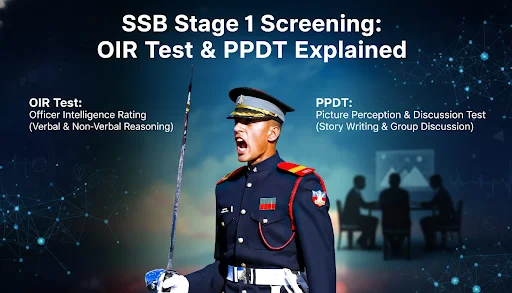
OIR (Officer Intelligence Rating) Test: two papers, one verbal and one non-verbal, each with around 40 questions to be solved in a tight time limit. It tests speed and accuracy under pressure, not just knowledge.
PPDT (Picture Perception and Description Test): you view a blurred image for about 30 seconds, then individually write a short story around it in a few minutes. Afterward, a group of candidates discusses the picture together and builds a shared narrative, while assessors observe initiative, communication, and how each person interacts in the group.
A significant share of candidates are screened out at this stage, according to several SSB coaching resources, though the exact proportion varies by batch and board. That's precisely why preparing for OIR and PPDT beforehand matters as much as preparing your documents.
Common Mistakes Candidates Make on Reporting Day
Carrying incomplete documents: missing even one certificate or photocopy set can cause delays or complications during verification.
Filling the PIQ carelessly: rushed or vague answers create inconsistencies that surface later in the interview.
Arriving late: tardiness at the reporting point creates a poor first impression before any test has begun.
Turning up in an unkempt or overly casual appearance: first impressions form well before the Personal Interview.
Not checking the exact reporting time on the call letter: this leads to confusion about whether screening happens the same day.
Being discourteous to liaison staff or fellow candidates: assessors and support staff both notice conduct from the very first hour.
How to Prepare for SSB Reporting Day
Reconfirm your exact reporting point and time from the call-up letter a day in advance.
Organize all originals and photocopies in a labeled folder, in the order they're likely to be checked.
Pack neat, presentable clothing for reporting day and the days that follow.
Practice OIR-style verbal and non-verbal reasoning questions beforehand, since time pressure is the real challenge, not difficulty.
Think through your background, achievements, and interests in advance, so the PIQ doesn't feel rushed when you sit down to fill it.
Get proper rest the night before, since reporting day can run long and screening may follow immediately.
Quick Pre-Reporting Day Checklist
Original call-up letter, plus photocopies
Valid photo ID (Aadhaar, PAN, passport, or similar)
Educational certificates from the qualifying exam onward
Recent passport-size photographs, as specified in your call letter
Any category-specific certificate (NCC, sports, NOC, or similar), if applicable
A pen, small notebook, and basic stationery
Comfortable, presentable clothing for multiple days
Confirmation of your exact reporting time and point
Want Reporting-Day Updates and SSB Prep Delivered Directly to You? Join the Defence Study community on WhatsApp, Telegram, or Instagram for SSB updates, screening tips, and exam notifications as they happen. Stay Informed. Stay Prepared. Stay Ready.
Bringing It Together
Reporting day isn't just a formality before the "real" testing starts. Document checks, chest number allotment, and the PIQ all set up everything that follows, including a Personal Interview that draws directly from what you wrote that first day.
Knowing your reporting time, carrying the right documents, and treating the PIQ seriously is what separates a smooth start from an avoidable stumble.
Frequently Asked Questions
What time should I report for SSB? Your call-up letter specifies the exact time and place. Early morning reporters, often around 0600 to 0700 hrs, may be screened the same day, while afternoon reporters, typically around 1400 to 1500 hrs, usually begin screening the next morning.
What is PIQ and when do I fill it? PIQ stands for Personal Information Questionnaire. It's filled during the reporting sequence and covers your education, family, interests, and self-assessment. It becomes the reference point for questions in your later Personal Interview.
Does screening happen on SSB reporting day itself? It depends on your reporting time. Early morning reporters may be screened the same day, while afternoon reporters usually undergo document checks, chest number allotment, and PIQ on day one, with screening the next morning.
What if I reach late on SSB reporting day? Try to reach well before your specified time. Reporting late can delay document verification for you and others, and it creates an avoidable poor first impression before testing even begins.
What documents are checked during SSB reporting day procedure? Your original call-up letter, photo ID, educational certificates, and photographs are verified against your application, along with photocopies of each.
What is screened out at the OIR and PPDT stage? The OIR test measures verbal and non-verbal reasoning under time pressure, while the PPDT assesses picture perception, storytelling, and group discussion skills. Together, they filter which candidates proceed to the remaining SSB stages.
Tags
- SSB Reporting Day
- SSB reporting day documents
- SSB reporting day procedure
- what happens on SSB reporting day
- SSB day 1 screening
- OIR Test
- PPDT