SSB Repeater vs Fresher: Key Differences and Preparation Tips
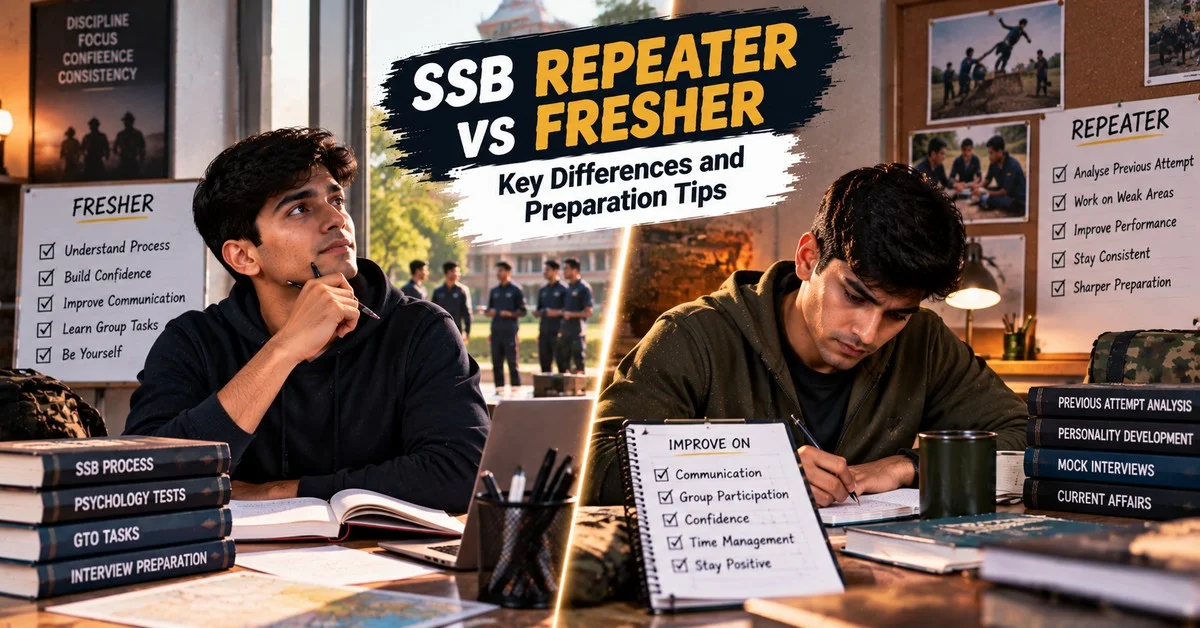
Attending SSB for the first time or trying again? Learn the key SSB repeater vs fresher differences, the myths that hold candidates back, the questions repeaters face, and practical preparation tips for your next SSB.
In the SSB Repeater vs Fresher comparison, there is no separate standard or penalty for repeaters. Every candidate is assessed on the same Officer Like Qualities (OLQs). A fresher's main challenge is the unfamiliar process, while a repeater's challenge is to avoid rehearsed answers and show genuine improvement since the last attempt. Freshers should focus on understanding the process and staying natural; repeaters should honestly review past attempts, work on weak areas and be ready to explain what they have done since.
Who Is a Fresher and Who Is a Repeater?
A fresher is a candidate attending the SSB for the first time. A repeater is a candidate who has attended the SSB before and was either screened out on Day 1 or not recommended after the conference.
The Personal Information Questionnaire (PIQ) form you fill at the selection centre asks about your previous SSB attempts. So the board knows whether you are a fresher or a repeater. That is nothing to worry about, as long as you answer honestly and can show how you have grown since your last visit. Knowing which group you belong to is the first step in the SSB Repeater vs Fresher comparison.
SSB Repeater vs Fresher: Key Differences at a Glance
Here is a quick SSB Repeater vs Fresher comparison across the main areas of the selection process:
Does the SSB Treat Repeaters Differently?
This is the most common worry in the SSB Repeater vs Fresher debate. The honest answer is: the standard is the same for everyone.
The assessors, the Psychologist, the Group Testing Officer (GTO) and the Interviewing Officer (IO), look for the same Officer Like Qualities in every candidate. These include:
-
Effective intelligence and reasoning
-
Sense of responsibility
-
Initiative and self-confidence
-
Cooperation and group influence
-
Courage, determination and stamina
-
Social adaptability and ability to express yourself
No extra marks are cut because you are a repeater, and no extra marks are given to freshers. Many officers were recommended on their second, third or later attempts.
What does change for repeaters is the context. The board may be curious about what you have done since your last attempt. In the interview, you may be asked about it directly. That is not a trap; it is an opportunity to show maturity and growth.
The Fresher's Experience
Let's look at each side of the SSB Repeater vs Fresher picture, starting with freshers.
Strengths of Freshers
-
Natural responses: Freshers often write psychology tests and speak in the interview in a genuine way, without trying to fit a "model answer".
-
Open mind: They have no bad memories of past results to carry.
-
Energy and curiosity: Everything is new, which keeps them alert and interested.
Challenges for Freshers
-
Unfamiliar schedule: Not knowing what comes next can cause anxiety.
-
Time pressure: The speed of the OIR test, TAT, WAT and SRT can come as a surprise.
-
Overthinking: Some freshers read too much online and try to "act" like an ideal candidate.
-
Group tasks: Outdoor GTO tasks can feel confusing without prior understanding of the rules.
The Repeater's Experience
On the other side of the SSB Repeater vs Fresher picture are candidates who have been through the process before.
Strengths of Repeaters
-
Familiarity: Repeaters know the schedule, the tests and the environment.
-
Calmer mind: They are usually less nervous on Day 1.
-
Clear feedback from experience: They often have a sense of which stages felt weak.
Challenges for Repeaters
-
Rehearsed answers: Repeated practice can make responses sound mechanical or "coached".
-
Pressure of expectations: Family, friends or the candidate's own mind may add stress.
-
Repeating the same approach: Going in with the same habits often leads to the same result.
-
Negative self-talk: Thinking "I'm always rejected" can affect confidence and performance.
Common SSB Repeater vs Fresher Myths
Myth 1: "Repeaters are rejected automatically after a few attempts."
Not true. There is no rule that rejects candidates because of previous attempts. What matters is your performance in the current SSB.
Myth 2: "Freshers get an easier assessment."
No. Everyone is assessed on the same qualities by the same assessors.
Myth 3: "Repeaters should change their personality to get recommended."
This is one of the biggest mistakes. The board wants to see the real you. Improvement should come from genuine growth, not from pretending to be someone else.
Myth 4: "If you were screened out once, you will always be screened out."
Screening depends on your OIR test and PP&DT performance on that day. Both can be improved with the right practice.
Myth 5: "Memorising good answers will help."
Assessors see thousands of candidates. Copied or memorised responses are usually easy to spot and rarely help.
SSB Fresher Tips: How to Prepare for Your First SSB
These SSB fresher tips focus on understanding the process and staying natural:
-
Understand the five-day process. Know what happens on each day: screening (OIR and PP&DT) on Day 1, psychology tests, GTO tasks, the personal interview and the conference.
-
Practise the OIR test and PP&DT. Timed reasoning practice and short story-writing with group discussion will help you on Day 1.
-
Learn the format of psychology tests. Practise TAT, WAT, SRT and the Self-Description (SD) within the time limits, but keep your responses genuine.
-
Read the newspaper daily. It helps with the group discussion, the lecturette and the interview.
-
Know your PIQ well. Your interview is largely based on it. Be ready to talk about your family, education, hobbies, achievements and hometown.
-
Build physical fitness. Regular running and basic exercises help in GTO outdoor tasks.
-
Don't try to be perfect. Assessors are not looking for a flawless performance. They want to see how you think, act and work with others.
-
Rest well before reporting. Arrive at the selection centre fresh, with your documents in order.
SSB Repeater Tips: How to Prepare for Your Next Attempt
These SSB repeater tips focus on honest review and real improvement:
-
Write down your last experience. As soon as possible after each SSB, note what happened at every stage: what you wrote, said and did. This record is extremely useful for your next attempt.
-
Find your weak stage. Were you screened out? Did you feel weak in the psychology tests, GTO tasks or the interview? Focus most of your effort there.
-
Avoid ready-made answers. Stop using the same stories or sentences in every attempt. Practise with new pictures and words so your thinking stays fresh.
-
Do something meaningful between attempts. Learn a new skill, take up a sport, join a club, volunteer, or take on responsibility at college or work. These real experiences give you better material and more confidence.
-
Prepare for "What changed?" questions. Be ready to explain calmly what you have learnt and done since your last SSB. Keep it honest and specific.
-
Keep your PIQ consistent. Fill your PIQ form truthfully, including your previous attempts. Make sure what you say in the interview matches what you wrote.
-
Work on your mindset. Treat each attempt as a new start. Past results do not decide your next one.
-
Get genuine feedback. Talk to recommended candidates or mentors who can observe your practice and point out patterns you may not notice.
SSB Interview for Repeaters: Questions You May Be Asked
In the SSB interview for repeaters, the IO may ask a few extra questions about your journey. Common examples include:
-
How many times have you attended the SSB, and where?
-
Why do you think you were not recommended last time?
-
What have you done to improve since your last attempt?
-
What did you learn from your previous SSB?
-
Why do you still want to join the Armed Forces?
-
If you are not recommended this time, what will you do?
How to answer: Be honest, calm and positive. Avoid blaming the board, other candidates or bad luck. Instead, talk about what you learnt and the specific steps you have taken to grow. For example, joining a sports team to improve teamwork or taking part in debates to build communication are real, clear examples.
Why Some Candidates Are Not Recommended
Understanding the reasons helps on both sides of the SSB Repeater vs Fresher divide. Some common patterns include:
-
Inconsistency: Responses in psychology tests, GTO tasks and the interview don't match each other.
-
Rehearsed behaviour: Candidates who "perform" rather than act naturally.
-
Low participation: Staying too quiet in group discussions and tasks.
-
Over-dominance: Trying too hard to lead and not letting others speak.
-
Weak self-awareness: Not being able to talk honestly about strengths and weaknesses.
-
Limited life experience: Not having real examples of responsibility, teamwork or initiative.
The good news is that almost all of these can be improved with time, reflection and genuine effort.
Mindset: The Real Difference Between Repeaters and Freshers
In the end, the biggest SSB Repeater vs Fresher difference is often mindset. Freshers need to stay calm in an unfamiliar setting. Repeaters need to stay fresh in a familiar one.
A few mindset tips for both:
-
Focus on the present attempt, not on past results or on what others might think.
-
Be yourself. The board is assessing your natural Officer Like Qualities.
-
Cooperate with others. The SSB is not a contest against your batchmates; it is an assessment of how you work with them.
-
Stay positive through the five days, even if one task doesn't go as planned. Assessors look at your overall performance.
-
Remember the purpose. The SSB is looking for people who can be trained as officers, not people who are already perfect.
SSB Repeater vs Fresher: A Simple Preparation Plan
Whichever side of the SSB Repeater vs Fresher line you are on, steady and honest preparation makes the biggest difference.
FAQs
What is the main SSB Repeater vs Fresher difference?
Freshers are new to the process and must manage nervousness, while repeaters know the process and must avoid rehearsed answers and show real improvement. The assessment standard is the same for both.
Is there any disadvantage in being an SSB repeater?
No. There is no penalty for previous attempts. All candidates are assessed on the same Officer Like Qualities.
Does the SSB board know if I am a repeater?
Yes. The PIQ form asks about previous SSB attempts, and you should always answer honestly.
Are freshers more likely to be recommended?
Not necessarily. Recommendation depends on your performance in the current SSB, not on the number of attempts.
What questions are asked in the SSB interview for repeaters?
Common questions include why you think you were not recommended earlier and what you have done to improve since your last attempt.
How should a repeater prepare differently?
The key SSB repeater tips are to review your previous attempts honestly, focus on your weak stage, avoid rehearsed answers and build real experiences between attempts.
What is the most important tip for a fresher?
Among all SSB fresher tips, the most important is to understand the five-day process and stay natural. The board wants to see the real you, not a perfect performance.