SSB Psychology Test: TAT, WAT, SRT and SD Explained
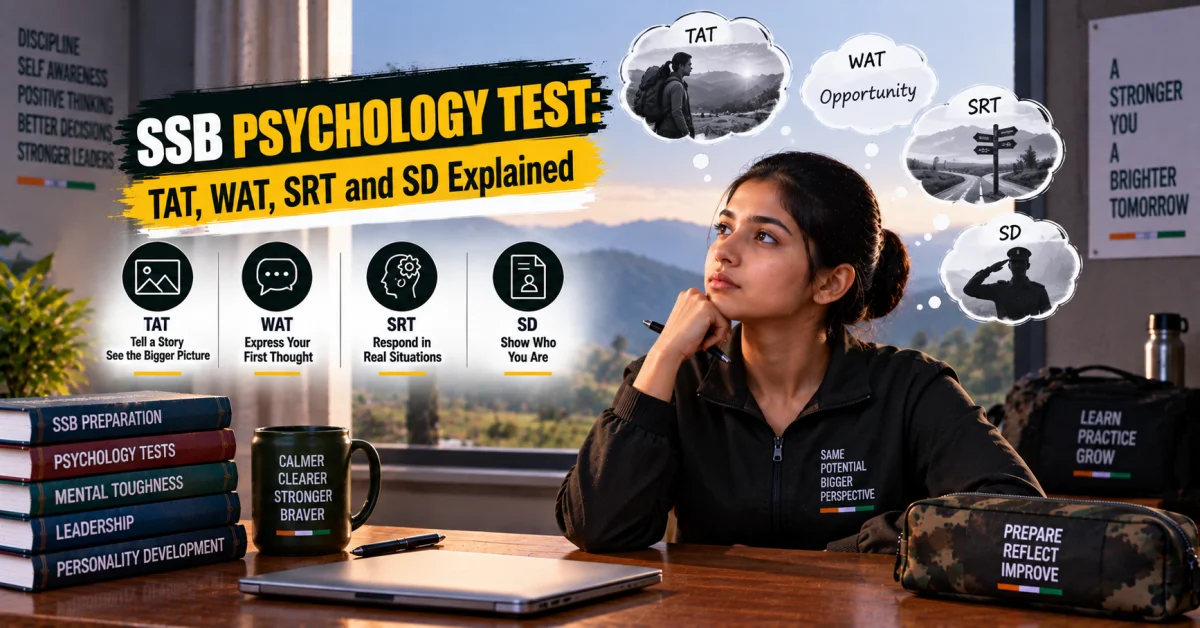
The SSB Psychology Test is conducted on Day 2 and includes TAT, WAT, SRT and Self Description. Understand what happens in each test, how psychologists assess responses, common mistakes that affect performance, and how to prepare effectively for the complete psychological assessment.
Most candidates who conference out of the SSB interview fail not at the physical tasks or the interview table. They fail on Day 2, in a quiet room, with a pen and a booklet. The SSB Psychology Test is where the military psychologist builds your personality profile, and unlike the GTO tasks, you cannot watch others and course-correct. Understanding exactly what happens during SSB Stage 2 psychological tests, and why each instrument is designed the way it is, gives you a structural advantage before you walk into that room. That applies directly to how you approach the SSB psychology test format and scoring.
What Is the SSB Psychology Test? (Format at a Glance)
The SSB Psychology Test is a battery of four written instruments administered on SSB interview Day 2. The complete battery covers TAT WAT SRT SD SSB, administered in that sequence, and runs for approximately 2.5 hours in total. A trained military psychologist conducts and evaluates the session, not a civilian HR assessor. That distinction matters, and it also shapes how to write TAT story for SSB.
The four components and their timings are as follows, and keeping them in mind is essential for SSB recommended candidate traits.
-
Thematic Apperception Test (TAT): 12 pictures plus 1 blank slide; 30 seconds to view each image, 4 minutes to write a story.
-
Word Association Test (WAT): 60 words flashed at 15 seconds each; one written response per word.
-
Situation Reaction Test (SRT): 60 situations answered in 30 minutes total.
-
Self Description (SD): Five written perspectives completed in 15 minutes.
Understanding SSB psychology test format and scoring starts with one core principle: no test is evaluated in isolation. The psychologist integrates your responses across all four instruments and then cross-references that profile with your GTO performance and Interview scores. A strong TAT cannot rescue a contradictory SD. The final merit board sees a unified picture, not individual test scores.
For a broader picture of how career choices shape your path to this selection process, see Indian Army vs Navy After 12th: Which Career Is Better in 2026?
Thematic Apperception Test (TAT): How to Write Stories That Reveal OLQs
Knowing how to write TAT story for SSB correctly separates recommended candidates from the majority. Each of the 12 pictures is projected for 30 seconds, followed by 4 minutes of writing time. The blank slide is your thirteenth story, written entirely from imagination. According to SSB Interview: Psychology Tests explained on SSBCrack, the psychologist is not evaluating creative writing. The focus is on Thematic Apperception Test scoring criteria: the hero of your story, the decisions the hero makes, how the problem is resolved, and whether the ending is positive.
A strong TAT story follows a clear arc. Consider this annotated example:
-
"Suresh noticed a fire near the fuel depot during night duty." , Demonstrates Alertness and situational awareness.
-
"He immediately alerted the sentry, called the fire team, and moved civilians to a safe zone." , Demonstrates Initiative and Effective Intelligence through sequenced, practical action.
-
"The fire was contained within 20 minutes; no casualties were reported." , This positive TAT story ending reflects composure and result-orientation, two key officer like qualities SSB assessors look for.
What to avoid is equally important. Avoid endings where the hero fails, dies, or requires rescue. Avoid stories where the central figure is passive, waits for orders, or panics. The psychologist reads your hero as a projection of how you would behave under pressure. Officer-like decision-making in every story reinforces your SSB personality profile across the full TAT sequence, not just in one standout response.
Word Association Test (WAT): What Your Responses Signal
The WAT presents 60 words at 15 seconds per word. Your task is to write the first sentence or phrase that comes to mind. The format sounds simple, which is precisely where most aspirants underestimate it. According to SSBCrackExams on psychological test formats, the psychologist tracks Word Association Test responses as a pattern, not as individual answers. Consistency across 60 responses builds or breaks your SSB personality profile.
Common SSB WAT mistakes to avoid include:
-
Writing a single noun with no context (word: "jungle"; response: "trees") , this reveals nothing about personality.
-
Negative or fearful associations (word: "battle"; response: "death and suffering") , signals poor composure.
-
Irrelevant or absurd responses (word: "leader"; response: "my uncle") , breaks the officer-like tone the psychologist expects.
Strong Word Association Test responses are action-oriented and positive. Word: "failure" , response: "teaches resilience and redirects effort." Word: "danger" , response: "demands calm assessment and quick action." Each response should reflect the same personality that your TAT hero embodied. The psychologist is not scoring individual words in isolation; the goal is OLQ consistency across tests. An aspirant who writes confident, action-driven TAT stories but produces fearful WAT responses creates a contradiction that flags inconsistency in the final evaluation.
Situation Reaction Test (SRT): Responding Like an Officer Under Pressure
The SRT presents 60 written situations. You have 30 minutes for the entire booklet, which averages 30 seconds per situation. Situation Reaction Test scenarios are designed to test practical judgment, initiative, and composure under time pressure, not problem-solving sophistication. The psychologist wants realistic, proportionate responses, not movie-style heroics.
Compare these three scenario types to see the difference between weak and strong responses:
-
Emergency at a public place:
Weak: "I would call the police and wait for them to arrive."
Strong: "I would secure the area, administer first aid if trained, alert emergency services, and guide bystanders away from danger." -
Conflict with a colleague:
Weak: "I would report them to my superior immediately."
Strong: "I would speak privately with them to understand the issue, then seek mediation if needed." -
Equipment failure during a task:
Weak: "I would stop the task until the equipment is repaired."
Strong: "I would improvise with available resources, inform the team, and complete the core objective."
Practical judgment in SRT means your solution must be executable by a real person in real time. Candidates who write elaborate rescue operations for minor situations signal poor judgment. The psychologist values proportionate, confident responses that reflect officer-like decision-making across all 60 scenarios consistently.
Self Description (SD) Test: What to Write in Each Perspective Section
The SD test requires you to write five perspectives in 15 minutes: how you see yourself, how your parents see you, how your teachers see you, how your friends see you, and how you would ideally like to be. These five perspectives in SD test are not independent paragraphs. The psychologist reads them as a coherent character assessment. Consistency across all five, and alignment with the personality your WAT and TAT revealed, determines whether your SD strengthens or contradicts your overall profile.
Section-by-section guidance for SSB Self Description test tips:
-
Self view: Acknowledge 2-3 genuine strengths and 1 honest, minor weakness. Never claim to have no weaknesses. A self-view that reads as flawless is flagged as dishonest.
-
Parents' view: Reflect warmth and responsibility. Parents typically see discipline, helpfulness, and family-orientation.
-
Teachers' view: Emphasise academic sincerity, respect for authority, and willingness to learn.
-
Friends' view: Include team spirit, loyalty, and a sense of humour. This perspective should sound the most natural and informal.
-
Ideal self: Describe growth areas directly linked to the weakness you admitted in your self-view. This creates a narrative arc that reads as self-aware and goal-oriented.
Keep each perspective to 3-4 sentences. Lengthy paragraphs dilute the signal. Short, clear, and consistent language across all five sections is what SSB recommended candidate profiles look like in this test.
How SSB Psychologists Evaluate All Four Tests: The OLQ Framework
The military psychologist evaluation is anchored to 15 Officer Like Qualities, grouped under four broad clusters: Planning and Organising, Social Adjustment, Social Effectiveness, and Dynamic qualities. No single test assesses all 15 OLQs. Each instrument is designed to surface specific qualities:
-
Effective Intelligence: TAT and SRT (story logic, situation handling)
-
Reasoning Ability: TAT and SRT (structured problem-solving)
-
Social Adaptability: WAT and SD (language tone, relational perspectives)
-
Cooperation: WAT and SD (team-oriented associations and descriptions)
-
Initiative: TAT and SRT (hero takes first action; candidate acts without prompting)
-
Stamina and Determination: TAT (hero persists through obstacles to a positive ending)
What the psychologist is specifically looking for is OLQ consistency across tests. A candidate who demonstrates Initiative strongly in TAT but writes passive WAT responses creates a mismatch the assessor will note. According to SSBCrack's complete OLQ guide, Stage 2 failure analysis consistently shows that candidates are not eliminated because one test was weak. They are eliminated because the four instruments together do not produce a coherent personality profile.
Most Common Mistakes That Lead to Stage 2 Failure
Stage 2 failure analysis from forum reports and candidate debriefs reveals five recurring patterns:
-
Inconsistency between SD and WAT: Writing positive, energetic WAT responses but a timid or overly humble SD creates a split profile the psychologist cannot reconcile.
-
Over-the-top SRT solutions: Claiming to single-handedly stop a flood or evacuate a building alone reads as fantasy, not officer-like decision-making.
-
Negative TAT endings: Any story where the hero fails, is injured, or the situation worsens is a direct negative signal on Thematic Apperception Test scoring criteria.
-
Borrowed TAT stories: Using stories memorised from SSB preparation books word-for-word. Military psychologists are familiar with these and flag them immediately.
-
Dishonest SD claims: Writing that you have no weaknesses, or listing weaknesses that are transparently disguised strengths ("I work too hard"), signals low self-awareness.
The psychologist is building your SSB personality profile across four instruments over 2.5 hours. Every response is a data point. One dramatic SRT answer will not save a pattern of passive, inconsistent responses across the other 59 situations.
A 4-Week SSB Psychology Test Preparation Plan
An effective SSB preparation schedule focuses on building genuine response habits, not memorising templates. Follow this week-by-week plan:
-
Week 1 (TAT): Write two TAT stories daily using any image from a newspaper or magazine. Focus on a positive ending and ensure your hero takes at least two concrete actions. Review each story for OLQ signals the next morning.
-
Week 2 (WAT): Practice 60 WAT words daily using a timer set to 15 seconds per word. After the session, review responses for negative or passive language and replace them. Build a personal vocabulary of action-oriented, positive associations.
-
Week 3 (SRT): Work through SRT booklets under timed conditions, 30 situations in 15 minutes per session. After each session, audit your responses for proportionality. Remove any solution that requires superhuman effort or ignores realistic constraints.
-
Week 4 (SD and consolidation): Write a full SD draft covering all five perspectives. Read it against your WAT and TAT responses from earlier weeks. Identify any inconsistencies and revise. In the final three days, run a full mock battery, TAT, WAT, SRT, and SD in sequence, to simulate Day 2 conditions.
Consistency built through daily practice is what separates SSB recommended candidate profiles from candidates who prepare only with information. Information is necessary. Habit is what scores.
FAQs
Can you explain the complete format of the SSB Psychology Test and how each section is scored?
The SSB Psychology Test involves four instruments on Day 2: TAT (12 pictures plus 1 blank, 4 minutes per story), WAT (60 words at 15 seconds each), SRT (60 situations in 30 minutes), and SD (5 perspectives in 15 minutes). There are no numerical marks per response. The psychologist builds a personality profile across all four instruments and evaluates it against 15 Officer Like Qualities.
What are the most common WAT and SRT mistakes that cause Stage 2 failure?
For WAT, the most damaging SSB WAT mistakes to avoid are negative associations, single-word responses with no meaning, and tone inconsistency across 60 words. For SRT, the key errors are disproportionate solutions, passive responses that defer action to others, and scenarios where the candidate plays no role.
How do psychologists evaluate TAT stories for Officer Like Qualities?
Thematic Apperception Test scoring focuses on the hero's qualities, not the story's literary merit. The psychologist checks: Does the hero take initiative? Is the decision-making logical and proportionate? Does the story end positively? Each of these elements maps to specific officer like qualities SSB assessors track across all 12 stories for consistency.
What exactly should I write in the SD test, and what should I never include?
Apply these SSB Self Description test tips: write 3-4 honest sentences per perspective, acknowledge one real weakness in your self-view, and ensure your ideal self directly addresses that weakness. Never claim to be without flaws, never list strengths disguised as weaknesses, and never use language that contradicts the personality your TAT and WAT responses established.
Is there a right or wrong answer in the SSB Psychology Test?
There are no correct answers in a factual sense, but there are revealing and unrevealing answers. The psychologist is not marking responses right or wrong. The assessment checks whether your responses, taken together across TAT WAT SRT SD SSB, form a coherent picture of an individual who possesses officer like qualities SSB selectors are looking for. Inconsistency, not a single poor response, is what typically leads to conference-out decisions.
For further reading, see SSB Interview: Psychology Tests , TAT, WAT, SRT, SD Explained and SSB Interview Stage 2: Psychological Tests Format and Marking.