SSB Progressive Group Task: Rules, Procedure and Tips
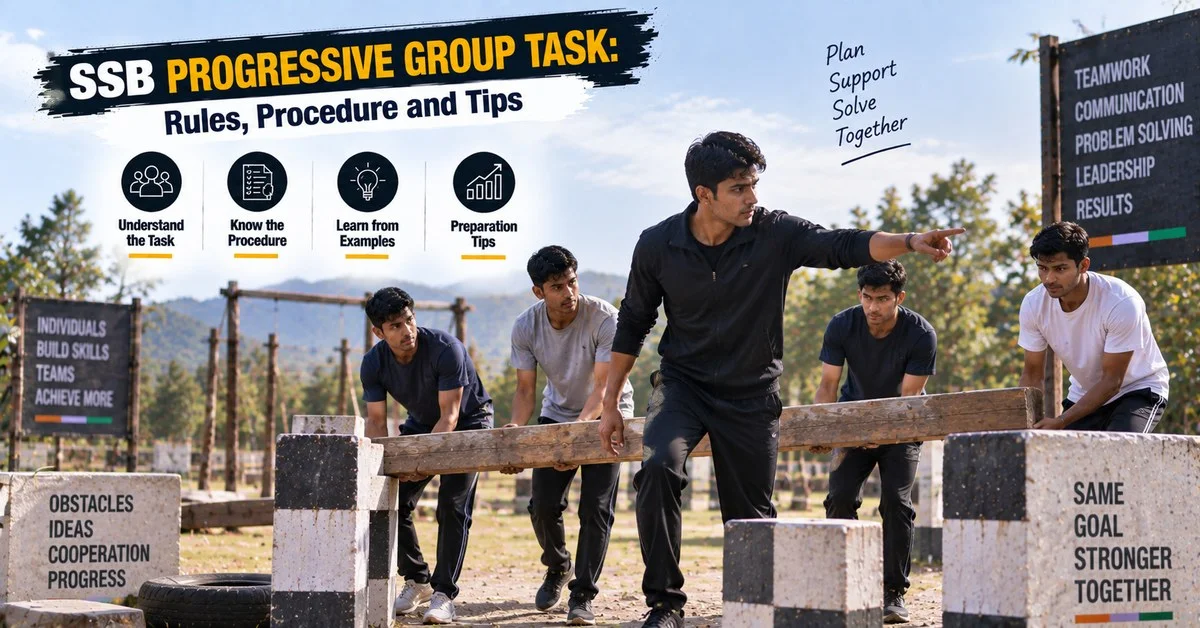
The SSB Progressive Group Task is a GTO group obstacle task where candidates work together, use helping materials and follow specific rules to cross progressively difficult obstacles. Learn the procedure, rules, common mistakes and practical PGT tips.
The SSB Progressive Group Task is one of the outdoor GTO tasks where your group has to cross a series of obstacles using limited helping material and following specific rules.
The difficulty increases as the group moves from one obstacle to the next. So the challenge is not simply physical strength. You have to understand the structure, plan with the group, use the material correctly and keep everyone moving together.
This guide explains what Progressive Group Task in SSB is, how the SSB PGT procedure works, the important rules, helping materials, common mistakes and practical SSB PGT tips for beginners.
What Is Progressive Group Task in SSB?
Progressive Group Task (PGT) is a GTO outdoor group task in the SSB. Candidates work together to cross a series of obstacles using helping materials such as a plank, wooden pole, rope and load. The obstacles become progressively more difficult, which is why the task is called the Progressive Group Task.
The important part is that the group has to solve the obstacle together.
You are not simply trying to cross an obstacle yourself. The group has to move the required helping material and load while following the restrictions given by the GTO.
That changes the way you should approach PGT.
A candidate who is physically strong but ignores the rules can create problems for the entire group. At the same time, someone who keeps giving ideas without actually helping with execution may not contribute much.
A better approach is:
Understand → Plan → Act → Help → Adapt
Why is it called Progressive Group Task?
The obstacles increase in difficulty as the group progresses through the task.
The first obstacle may require a relatively simple arrangement of the helping material. Later obstacles can require the group to combine different materials and coordinate their movements more carefully. Preparation sources commonly describe PGT as a series of progressively harder obstacles completed by the whole group.
The objective is not to finish by using brute force.
The group has to figure out how to use the available material within the rules.
How Does Progressive Group Task Work in SSB?
The broad SSB PGT procedure starts with a briefing from the GTO.
The group is told about the obstacle, the helping material and the rules that need to be followed. The candidates then plan and attempt to cross the obstacle together. Once an obstacle is completed, the group moves to the next one, which is more difficult.
Step 1: GTO Briefing
Before starting, pay attention to the instructions.
Understand:
-
Starting point
-
Finishing point
-
Obstacle structure
-
Helping material available
-
Colour restrictions
-
Other rules
-
What needs to reach the finish
Don't treat the briefing as something you can ignore because you will “figure it out” later.
A rule violation can affect the whole group's attempt.
Step 2: Understand the Obstacle
Before grabbing a plank or rope, look at the structure.
Ask:
-
Where is the safe area?
-
Where is the gap?
-
Where can the helping material be placed?
-
Where can candidates move?
-
How will the load be transported?
-
How will the last candidate cross?
That last question matters.
A solution isn't complete just because the first few people have crossed.
Step 3: Plan With the Group
Once you understand the obstacle, start discussing possible solutions.
Keep your suggestions short.
For example:
“Place the plank here, secure the balli there, then move the load across.”
A practical demonstration can be more useful than a long explanation.
Step 4: Execute the Plan
This is where planning becomes action.
Pick up the required material, help position it, support your teammates and move the load.
Don't stand at the side giving instructions while everyone else does the physical work.
Step 5: Move the Entire Group
The task is completed only when the required members, load and helping material have been taken through the obstacle according to the rules.
The group then moves to the next obstacle.
Step 6: Adapt to the Next Obstacle
Don't assume the solution that worked earlier will work again.
The next obstacle is designed differently.
Look at it again.
New obstacle = New problem.
SSB PGT Helping Materials
The exact material configuration can vary by setup, but preparation sources commonly describe the main helping materials as:
-
Plank
-
Balli or wooden pole
-
Rope
-
Load
The load is carried through the obstacle along with the group.
Each item has a different role.
Plank
A plank can be used to bridge a gap or create a stable path between permitted surfaces.
Don't assume that simply placing the plank somewhere makes the structure safe.
Check its position and support.
Balli
The balli is a longer wooden pole that can be used along with other helping material to solve more difficult structures.
Its usefulness depends on how the group positions and supports it.
Rope
The rope can help the group secure or move material, depending on the obstacle and the instructions provided.
Don't start tying everything together without understanding the task.
Load
The load adds another layer to the problem.
You aren't simply moving people across.
The group must also move the required load while completing the obstacle.
That means your solution has to account for people + material + load.
What Are the Rules of SSB PGT?
The exact wording and presentation of PGT rules can vary by selection centre and briefing. So candidates should follow the rules explained by their GTO on the day.
Preparation sources commonly describe restrictions involving the group, distance, colour-coded areas and use of helping materials.
1. Group Rule
The group has to move through the obstacle together.
You should not think of PGT as an individual race where one candidate reaches the finish and leaves the others behind.
The group, required helping material and load need to be taken through according to the instructions.
2. Distance Rule
Certain gaps are intended to be crossed using helping material rather than simply jumping across them.
The commonly described preparation rule is that a gap of 4 feet or more should be bridged rather than jumped.
Treat this as a rule to verify from the GTO briefing at your centre rather than assuming that every detail published online overrides the live instructions.
3. Colour Rule
Colour markings indicate which areas can be used by candidates and which can be used by helping material.
The commonly described system includes:
-
White: permitted area
-
Red: out of bounds
-
Blue: candidates may use it, but helping material/load restrictions apply
-
Yellow: helping-material placement area in some PGT setups
The exact colour-code briefing given by the GTO should always take priority.
4. Helping Material Rule
You cannot use the helping material however you want.
The material has to be used within the restrictions explained by the GTO.
Don't create a solution first and then try to justify it against the rules.
Check the rules before executing the solution.
5. Finish-Line Rule
The group must complete the obstacle before moving on.
Don't mentally finish the task when only two or three candidates have crossed.
Think about the last person, the load and the material.
SSB PGT Procedure: What Should You Do at Each Obstacle?
A simple process can make PGT easier.
Look
Spend a few seconds understanding the obstacle.
Think
Identify the safest and simplest possible route.
Suggest
Give one clear idea to the group.
Execute
Help physically with the material and movement.
Check
Make sure nobody is left behind and the load is accounted for.
Adapt
If the plan fails, don't waste time blaming someone.
Find the next workable solution.
This is much more useful than trying to act like the “leader” of the group.
What Does the GTO Observe During PGT?
There is a lot of advice online claiming that a specific PGT action directly equals a particular OLQ or that the GTO gives separate marks for individual behaviours.
Be careful with such claims.
The official SSB framework describes the assessment as holistic. The GTO is one part of the overall assessment, alongside the Interviewing Officer and Psychologist.
For preparation, focus on behaviours that are visible during the task:
-
Do you contribute ideas?
-
Can you understand a practical problem?
-
Do you help the group execute a plan?
-
Do you listen when someone offers a better solution?
-
Can you stay composed after a mistake?
-
Do you follow instructions?
-
Do you keep participating?
-
Do you help weaker or slower group members?
These are much more useful things to practise than trying to perform a particular “OLQ trick.”
SSB PGT Tips for Beginners
If you are attempting PGT for the first time, don't try to impress the GTO with dramatic behaviour.
Focus on being useful.
1. Understand Before Acting
Don't immediately grab every piece of material.
First look at the obstacle.
A few seconds of proper observation can save several minutes of failed attempts.
2. Give Short, Practical Suggestions
Avoid long speeches.
Instead of:
“Maybe if we consider the structure and then possibly use the plank…”
Say:
“Let's place the plank here and move the load first.”
Clear communication is easier for the group to follow.
3. Don't Only Give Ideas
If you suggest a solution, help execute it.
Pick up the plank.
Hold the balli.
Move the load.
Support your teammate.
PGT is a practical group task, not a classroom discussion.
4. Help Other Candidates
If someone is struggling to cross an obstacle, help them.
A simple hand, shoulder or positioning support can make the group movement smoother.
5. Don't Try to Control Everything
You don't need to decide every obstacle.
If another candidate has a better solution, support it.
Group effectiveness matters more than getting credit for every idea.
6. Keep Track of the Load
Don't treat the load as an afterthought.
The solution must account for it throughout the obstacle.
7. Follow the Rules
A clever solution that breaks a rule is not a clever solution.
Know the colour restrictions and other instructions before starting.
8. Stay Active
Avoid standing at the back and waiting for someone else to solve everything.
You don't need to be loud.
But you should contribute.
9. Don't Panic After a Mistake
If the group makes a mistake or has to restart, reset quickly.
Don't waste time arguing about who caused it.
The next attempt needs a solution.
10. Think About the Whole Group
The fastest candidate reaching the other side is not the whole task.
Think:
Can everyone cross? Can the load cross? Can the material cross?
Common Mistakes in SSB Progressive Group Task
Trying to Be the Leader
Some candidates think they have to command the group from beginning to end.
That's unnecessary.
Suggest, demonstrate and help.
Giving Too Many Instructions
Constant talking can slow the group down.
One useful idea is better than five unnecessary instructions.
Standing and Watching
A candidate who contributes nothing physically or verbally misses opportunities to show useful participation.
Ignoring the Load
Candidates sometimes focus so heavily on crossing themselves that they forget the load.
Don't.
Breaking Colour Rules
Always check where your feet, hands, load and helping material are allowed.
Using Brute Strength
PGT is not a weightlifting competition.
If your plan requires one person to carry everything or make an unsafe jump, rethink it.
Refusing Better Ideas
Your first solution doesn't have to be the final solution.
If another candidate finds a simpler approach, use it.
Blaming the Group After a Failure
If the first attempt fails, don't spend the remaining time discussing who made the mistake.
Identify what went wrong and try again.
Focusing Only on the GTO
You are working with your group.
Don't keep looking at the GTO for approval after every action.
Focus on the obstacle and your teammates.
How to Prepare for SSB Progressive Group Task
You don't need to memorise obstacle solutions.
You need to improve three things:
Observation + Problem Solving + Group Coordination
Practise Basic Obstacle Thinking
When you see a structure, ask:
-
Where is the start?
-
Where is the finish?
-
What is the gap?
-
What material is available?
-
What is the safest route?
-
How will the last person cross?
-
How will the load move?
Practise With Physical Materials
If you have access to a proper SSB practice ground, use it.
Working with an actual plank, rope and pole is different from watching videos about PGT.
If you don't have access to a ground, you can still practise the planning part using diagrams and hypothetical obstacles.
Practise Team Problem-Solving
Don't always solve problems alone.
Work with friends and give everyone the same obstacle.
Then compare:
-
Which solution was simplest?
-
Which used fewer movements?
-
Which was easier for the entire group?
-
Which solution stayed within the rules?
Improve Basic Fitness
You don't need to treat PGT as a bodybuilding event.
But basic fitness helps you:
-
Move comfortably on the ground
-
Carry and position helping material
-
Support teammates
-
Stay active through outdoor tasks
-
Maintain energy during the GTO series
Learn the Rules Before Your SSB
This is one area where preparation can prevent avoidable mistakes.
Understand the commonly used colour restrictions and material rules, but remember that the GTO's briefing at your selection centre is the instruction you should follow.
SSB PGT vs Other GTO Tasks
Knowing how PGT differs from other tasks can make the overall GTO series easier to understand.
The GTO series includes multiple group and individual tasks, so don't prepare for PGT in isolation. PGT is one part of the broader GTO assessment.
SSB PGT Do's and Don'ts
Do
-
Observe the obstacle first.
-
Give practical suggestions.
-
Help with the material.
-
Support other candidates.
-
Follow the rules.
-
Keep track of the load.
-
Accept useful ideas.
-
Stay active.
-
Recover quickly from mistakes.
Don't
-
Shout continuously.
-
Try to control every decision.
-
Ignore quieter candidates.
-
Leave the load behind.
-
Break colour restrictions.
-
Attempt unnecessary jumps.
-
Blame teammates.
-
Stand idle.
-
Focus more on the GTO than the task.
SSB PGT Practice: A Simple Exercise
You can practise the planning part even without an actual GTO ground.
Imagine this:
You have:
-
One plank
-
One wooden pole
-
One rope
-
One load
-
Six candidates
There is a gap between the starting platform and the finishing platform.
Before moving anything, answer:
1. Where can the material be placed?
2. Where can candidates step?
3. How will the plank be positioned?
4. How will the load move?
5. Who will stabilise the structure?
6. How will the last candidate cross?
Then change one condition.
For example:
The gap becomes longer and the plank alone is no longer enough.
Now the group has to rethink the solution.
This kind of practice teaches you to adapt instead of memorising.
Frequently Asked Questions About SSB PGT
What is Progressive Group Task in SSB?
Progressive Group Task is a GTO outdoor group task in which candidates work together to cross a series of progressively difficult obstacles using helping material and following the rules explained by the GTO.
How does Progressive Group Task work in SSB?
The GTO explains the obstacle and its rules. The group then plans and executes a solution using the available helping material. After completing one obstacle, the group progresses to the next, which is more difficult.
What is the procedure of SSB PGT?
The broad procedure involves a GTO briefing, understanding the obstacle, planning a solution, using helping material to cross it with the group and progressing through increasingly difficult obstacles. Exact operational details should be followed as explained by the GTO at the selection centre.
What are the rules of SSB PGT?
Commonly described PGT rules cover keeping the group and load together, observing distance restrictions, following colour-coded boundaries and using helping materials within the permitted conditions. The exact instructions given by the GTO take priority.
What helping materials are used in SSB PGT?
Preparation sources commonly mention a plank, balli or wooden pole, rope and load. The exact setup can depend on the obstacle and task arrangement.
What should beginners do in SSB PGT?
Beginners should focus on understanding the obstacle, giving short practical suggestions, helping with execution, following the rules, supporting teammates and adapting when a better solution is suggested.
Is physical strength the most important part of SSB PGT?
No. The task requires physical participation, but solving the obstacle also involves planning, coordination, communication and correct use of helping material. A group still needs to solve the structure within the rules.
What happens if a rule is broken in PGT?
The exact response depends on the instruction and task setup. Preparation sources describe restarts after rule violations. Candidates should follow the GTO's instruction rather than relying on an online description of the penalty.
Final Tips for SSB Progressive Group Task
Don't enter the PGT thinking you need to be the loudest candidate, the strongest candidate or the person who solves every obstacle.
Be useful.
Look at the obstacle carefully. Give a practical idea. Help execute it. Keep track of the load. Follow the rules. Support your teammates. And if the first plan fails, reset and try another.
The best preparation for SSB Progressive Group Task is not memorising a fixed solution.
It is learning how to look at an unfamiliar obstacle and think:
What do we have? → What are we allowed to do? → What is the simplest solution? → How does the whole group cross?
That mindset will help you handle different PGT obstacles without depending on a memorised answer