SSB PIQ Form Questions: 50 Questions You Must Prepare (With Assessor Logic)
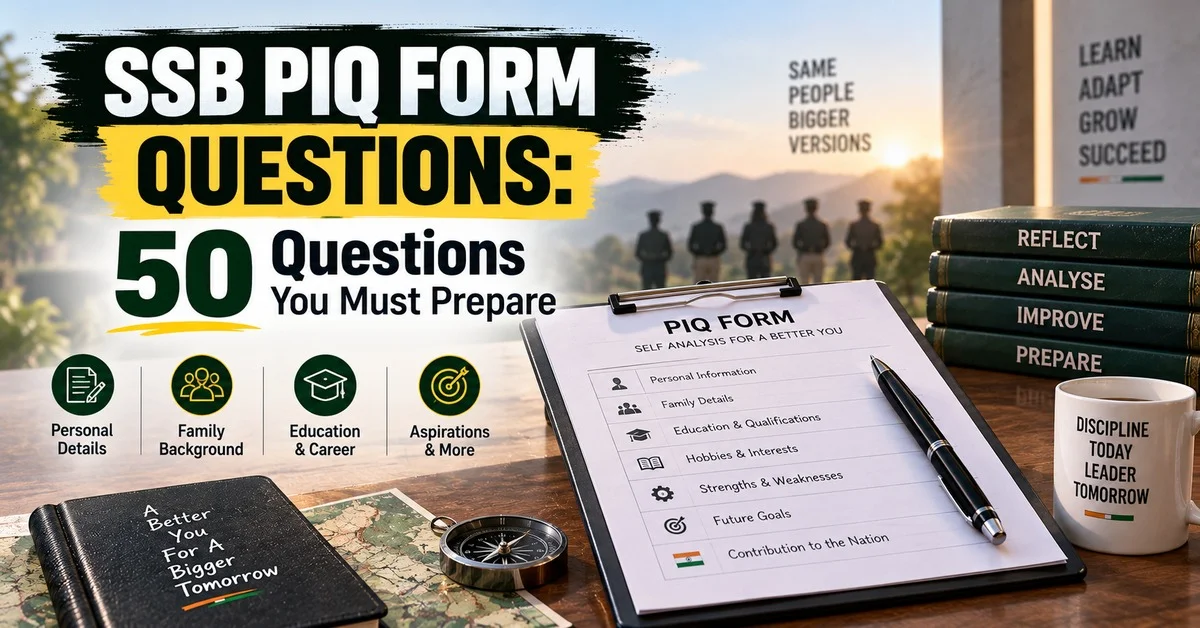
SSB PIQ Form Questions cover personal details, family, education, hobbies, sports, achievements and self-assessment. Learn what to prepare, how to fill the form and avoid common mistakes.
Most candidates who receive their SSB call letter spend weeks rehearsing Group Discussion scenarios and practising physical tasks. Very few give the same disciplined attention to the one document that shapes every subsequent day of assessment: the PIQ form. The SSB PIQ form questions you answer on Day 1 become the primary source material for your Personal Interview, and they influence the themes your psychology tests probe. Getting this right is not optional, and that is especially true when it comes to how to fill PIQ form SSB.
This guide gives you the complete section-wise question list, the assessor's evaluation logic behind each section, a practical filling guide, and a phase-wise preparation strategy tailored to NDA, CDS, and AFCAT candidates. The same principle applies to SSB PIQ form preparation.
What Is the SSB PIQ Form and Why It Determines Your Interview Fate
The Personal Information Questionnaire, commonly called the PIQ form, is a structured biographical data sheet that every SSB candidate fills out on the morning of Day 1, before screening begins. According to SSBCrack's detailed overview of the PIQ form, the document is not an administrative formality. It is the foundation on which the entire five-day assessment is built, and keeping that in mind is central to any solid set of PIQ form SSB interview tips.
The Interviewing Officer (IO) reads your PIQ before calling you into the Personal Interview room. Every question about your schooling, your father's profession, your hobbies, and your achievements has already been read, flagged, and mapped to follow-up questions before you sit down. Assessors are not learning about you during the interview. They are verifying what you wrote. That reality should inform every PIQ form SSB interview tip you follow.
According to Centurion Defence Academy's complete PIQ guide, the form also feeds directly into the psychology tests. The Thematic Apperception Test (TAT) and Word Association Test (WAT) are administered after PIQ submission, and the psychology officer uses your stated interests, background, and self-description to probe narrative consistency throughout the batch. This applies equally to SSB PIQ form family background hobbies achievements sections.
Candidates who treat the PIQ casually, writing vague answers or omitting key details, create gaps that trained assessors exploit within minutes. A specific, honest, and well-considered PIQ sets the frame for a confident interview. A careless one signals poor self-awareness, which directly undermines the Officer Like Qualities (OLQs) the board is measuring. This matters just as much when it comes to SSB personal interview questions.
Structure of the PIQ Form: Sections at a Glance
The SSB PIQ form is divided into seven broad sections. Understanding the architecture before you answer anything helps you see why each question exists and what it is actually measuring, particularly on SSB Day 1 screening.
-
Personal Details: Name, date of birth, permanent address, contact information, service preference, and chest number.
-
Family Background: Father's and mother's names, occupations, educational qualifications, and number of siblings with their occupations.
-
Educational Background: Schools and colleges attended, board results, subjects studied, and any academic distinctions.
-
Hobbies and Interests: Indoor and outdoor activities you pursue regularly, along with duration and level of involvement.
-
Sports and Extracurriculars: Sports played at school, college, or district level, and positions of responsibility held in clubs or teams.
-
Achievements: Academic, sports, social service, NCC, or leadership accomplishments with year and level of recognition.
-
Self-Assessment: Your self-described strengths, weaknesses, and qualities, which connects directly to the self-description test the SSB psychology battery includes.
The PIQ is filled on Day 1 of SSB during the reporting and documentation phase, before the screening test begins. Once submitted, it cannot be revised. Assessors use it as a cross-reference blueprint throughout all five days of SSB assessor evaluation, including the psychology tests SSB administers.
All 50 SSB PIQ Form Questions You Must Prepare (Section-Wise)
The grouped list below covers the core SSB PIQ form questions across all sections. Preparing written answers for each before you report removes the panic of facing a blank form with a 30-minute clock running.
Personal Details (Q1-Q8): Full name, date of birth, permanent home address, nearest railway station, service choice (Army/Navy/Air Force), chest number preference, emergency contact name, and contact number.
Family Background (Q9-Q18): Father's full name, father's occupation and designation, father's educational qualification, mother's full name, mother's occupation, mother's educational qualification, number of brothers with their names and occupations, number of sisters with their names and occupations, family's annual income range, and whether any family member has served in the armed forces.
Education (Q19-Q26): Names of all schools attended with years, Class 10 board and percentage, Class 12 board, stream and percentage, graduation college and degree (if applicable), post-graduation details (if applicable), medium of instruction, subjects of strength, and subjects of weakness.
Hobbies and Interests (Q27-Q33): Primary hobby with duration, secondary hobby, indoor recreational activities, outdoor recreational activities, reading preferences including genre and titles, creative pursuits such as music or art, and social activities or community involvement.
Sports (Q34-Q38): Main sport played, highest level of competition, positions of captaincy or leadership held, other sports with frequency, and physical fitness routine.
Achievements (Q39-Q44): Academic prizes or scholarships, sports certificates and levels, NCC certification and grade, social service initiatives led, positions of responsibility held, and any published work or recognised project.
Self-Assessment (Q45-Q50): Three personal strengths with examples, two personal weaknesses and how you address them, the most significant life experience and its impact, your role model and the reason behind the choice, a situation where you led others, and your motivation for joining the armed forces.
What SSB Assessors Actually Evaluate in Your PIQ Form
SSB assessor evaluation does not treat the PIQ as a record. It treats it as evidence. Each section is mapped to one or more of the 15 Officer Like Qualities (OLQs) that assessors score across all five days.
The family background section tells assessors about your socioeconomic environment, your exposure to responsibility from an early age, and whether a defence background reflects genuine motivation or just a checkbox. An armed forces family does not automatically benefit a candidate unless the response shows conscious, personal commitment.
The hobbies and interests section probes initiative and social adaptability. A candidate who lists "reading" as a hobby but cannot name three books read in the past year loses credibility immediately. Specificity is what signals authenticity here.
Sports is the clearest proxy for physical energy, team orientation, and the ability to handle competitive pressure. Captaincy or team positions signal influence over peers, which connects directly to officer potential.
The achievements section maps to self-confidence and determination. Assessors look for a pattern of consistent effort, not one isolated event. Three modest but verified achievements across different domains read better than one inflated claim.
The self-assessment section connects directly to the self-description test SSB uses in the psychology battery. If your self-described strengths in the PIQ contradict your Word Association Test (WAT) responses, assessors flag the inconsistency. Narrative consistency SSB assessors expect across all instruments is built outward from the PIQ.
How to Fill the SSB PIQ Form Correctly: Do's, Don'ts, and Common Mistakes
Practical rules for how to fill PIQ form SSB correctly begin with the physical act of writing. Use a blue or black ballpoint pen, write clearly and legibly, and avoid correction fluid, strike-throughs, or pencil. Assessors read dozens of forms daily, and poor handwriting or overwriting raises immediate questions about attention to detail.
The five most damaging PIQ form mistakes SSB candidates make, along with why each one hurts:
-
Vague hobby entries ("reading, music, cricket"): These give assessors nothing to work with and signal a candidate who has not reflected on their own life. Write the genre you read, the instrument you play, and the level at which you play cricket.
-
Contradictions with submitted documents: If your marksheet shows 68 percent and your PIQ says "above 70 percent," the IO will catch it. Every number must match your certificates exactly.
-
Inflated achievements: Writing "district level chess player" when you attended one school tournament is a lie that unravels under a single follow-up question. Write what is true and verifiable.
-
Blank achievement fields: Leaving sections empty signals either low initiative or dishonesty about participation. A school-level event, a blood donation drive, or an NCC 'B' certificate each belongs here.
-
Generic motivation statement: "I want to serve the nation" is the weakest possible answer to why you want a commission. Name a specific incident, role model, or moment that shaped the decision.
PIQ Answers for Family Background, Hobbies, and Achievements: Section-by-Section Guide
The SSB PIQ form family background hobbies achievements sections consistently cause the most anxiety, so each deserves specific guidance.
Family Background: Write your father's designation accurately, not his employer's name. "Assistant Manager, State Bank of India" is more useful than "SBI employee." If your mother is a homemaker, write that plainly. If a sibling serves in the forces, include rank and unit. For NDA candidates who are school-leavers, assessors expect a simpler family picture. For CDS and AFCAT AFSB interview candidates, professional family context signals the social exposure expected of a graduate-level officer.
Hobbies: Follow the three-detail rule: name the hobby, state how long you have pursued it, and give one specific example. "Trekking for four years, completed Kedarkantha trek in 2023" is far stronger than "outdoor activities." This approach also protects you during the Situation Reaction Test (SRT), where assessors may design scenarios connected to interests you have declared.
Achievements: List achievements in reverse chronological order, with the year and level clearly stated, whether school, district, state, or national. NDA candidates often worry about having too little because they lack work experience. An NCC 'A' certificate, a house captain position, a state-level debate award, or a community event you organised each qualifies. CDS and AFCAT candidates should add internships, college leadership roles, or professional certifications as separate entries. Self-assessment in PIQ should reference at least one achievement as evidence of a stated strength.
How Your PIQ Form Shapes Psychology Tests and Personal Interview Questions
The assessor workflow at an SSB follows a deliberate sequence. The PIQ is collected first. The psychology officer reviews it before administering the Thematic Apperception Test (TAT), Word Association Test (WAT), Situation Reaction Test (SRT), and the self-description test SSB uses to build a psychological profile. This is not coincidental.
Write "mountaineering" as a hobby, and expect TAT story cards to be interpreted with that background in mind. Claim "leadership under pressure" as a strength, and your SRT responses will be read against that claim. According to SSBCrack's analysis of PIQ's influence on psychology tests, candidates who maintain narrative consistency SSB requires across PIQ entries and psychology responses score measurably higher on psychologist ratings.
The Personal Interview follows the same logic. The IO begins with questions drawn directly from your PIQ, covering family background, education, and hobbies, before moving to defence knowledge and situational questions. Every PIQ entry is a potential question. If you wrote it, be ready to discuss it for five minutes with specific examples.
For the NDA SSB interview process, where candidates are typically 17 to 19 years old, the IO focuses more on school achievements, family values, and sports. For the CDS SSB interview process and AFCAT AFSB interview, the IO expects graduate-level articulation and deeper self-awareness in the self-description section.
PIQ Form Preparation Strategy for NDA, CDS, and AFCAT Candidates
Effective SSB PIQ form preparation starts two to four weeks before your reporting date, not on the morning of Day 1.
Weeks 3-4 before reporting: Write a raw draft of every section from memory, without consulting your documents. This exercise reveals gaps in your own self-knowledge that must be addressed before the interview.
Week 2: Cross-check every entry against your actual certificates, marksheets, and records. Reconcile every number and date. Practise explaining each hobby, achievement, and self-assessment point in spoken answers of 90 seconds or less.
Week 1: Identify which SSB personal interview questions your PIQ entries will generate. For each hobby, prepare a two-minute spoken explanation. For each achievement, prepare the context, your specific contribution, and the result. Review current affairs connected to your stated service preference.
NDA-specific note: School-leavers with limited achievements should build the achievements section around NCC grades, school sports, academic distinctions, and social service. Quality and specificity matter more than volume. CDS and AFCAT candidates should ensure their graduate-level exposure appears clearly across the hobbies, achievements, and self-assessment sections.
FAQs
What is the SSB PIQ form and when is it filled?
The SSB PIQ form, or Personal Information Questionnaire, is a biographical data form that candidates fill out on Day 1 of the SSB interview, before the screening test. It covers personal details, family background, education, hobbies, sports, achievements, and self-assessment, and becomes the primary reference document for the Interviewing Officer and psychology officer throughout the five-day assessment.
Can I make changes to the PIQ form after submission?
No. Once the PIQ is submitted to the documentation staff, it cannot be altered. Any error or omission remains on record. Preparing a draft at home and cross-checking it against your certificates before you report is essential practice, not optional.
How do PIQ answers affect psychology tests in SSB?
The psychology officer reviews your PIQ before administering the TAT, WAT, SRT, and self-description test. Themes drawn from your stated hobbies and interests appear in the psychology tests. Your self-assessment in PIQ is directly compared against your self-description test response, and inconsistencies between the two reduce your psychologist rating score.
What should NDA candidates write in the achievements section if they have no work experience?
NDA candidates should list school-level achievements such as academic prizes, NCC certificates (A or B grade), sports positions, debate or quiz wins, house captain or prefect roles, and any community service initiative they organised or participated in. The NDA SSB interview process accounts for the candidate's age, and assessors do not expect professional-level accomplishments from a 17-year-old.
What do SSB assessors look for in the hobbies and extracurriculars section?
Assessors look for specificity, duration, and genuine engagement. A hobby listed without detail signals that the candidate included it to appear well-rounded rather than from real interest. They map hobbies to Officer Like Qualities (OLQs) such as initiative, social adaptability, and physical energy. A candidate who lists a team sport with a verifiable competitive level signals considerably more than one who writes "outdoor activities."
What are the most common PIQ form mistakes that lead to rejection?
The most common PIQ form mistakes SSB candidates make include writing vague hobby entries, inflating achievements beyond what certificates support, leaving sections blank, providing data that contradicts submitted documents, and writing a generic motivation statement. Each of these creates a credibility gap that trained assessors are specifically looking for during the Personal Interview and psychology evaluation stages.
For further reading, see PIQ Form in SSB Interview: What It Is and Why It Matters and SSB Interview PIQ Form: Complete Guide for Candidates.