SSB Personal Interview Questions: 60 Most Asked Questions with Model Answers
Master the SSB Word Association Test with 60 practice words, model sentences, OLQ-focused guidance, and practical tips for writing confident responses undGV
Most candidates who clear the psychological testing round still stumble at the Personal Interview because they walk in with generic answers instead of structured ones. The SSB Personal Interview Questions you face are not random. They follow predictable categories, and the Interviewing Officer is not simply listening to what you say. He is watching how you think, how honestly you know yourself, and whether your personality reflects the 15 Officer-Like Qualities the Services Selection Board uses to assess every candidate. The same principle applies to SSB PI questions with answers.
This guide covers 60 of the most asked SSB PI questions with answers, organised by category, with a reusable answer framework you can adapt across every question you face. That is especially relevant when it comes to SSB Personal Interview Questions.
What Is the SSB Personal Interview and How Is It Evaluated?
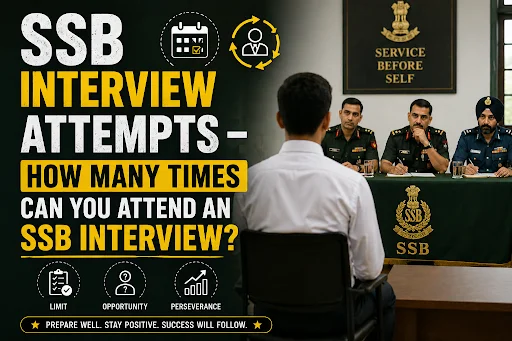
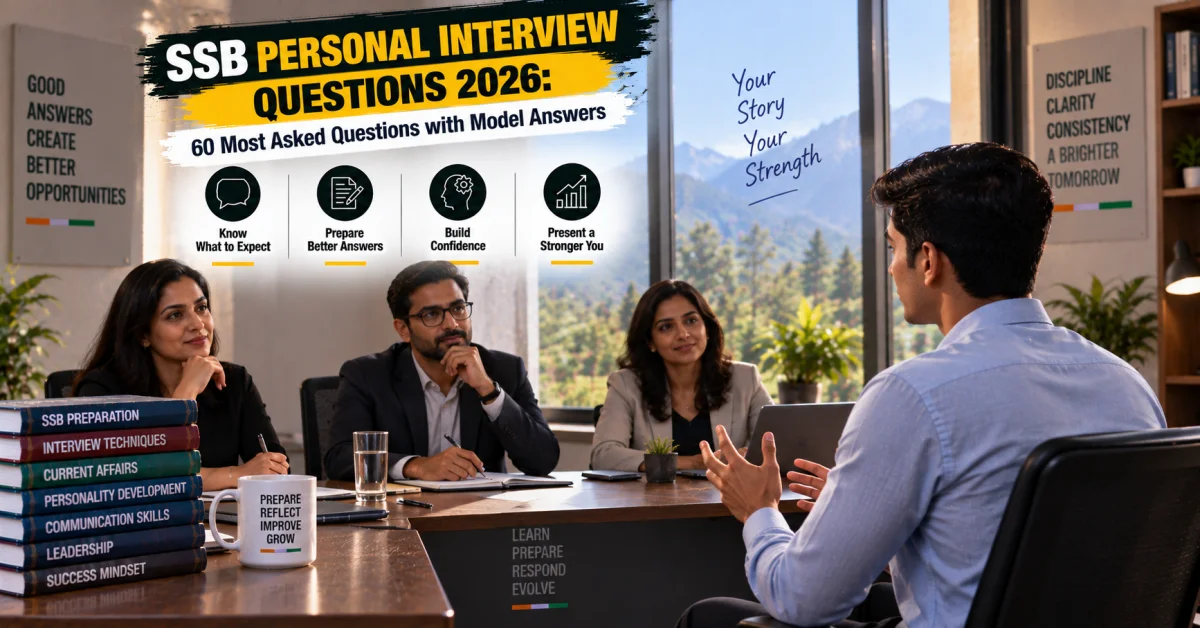
The Personal Interview is a one-on-one conversation between the candidate and the Interviewing Officer, typically lasting 30 to 60 minutes. It is one of three core assessment pillars at the Services Selection Board, alongside psychological tests and the Group Testing Officer tasks. Keep this in mind when working through SSB interview model answers 2026.
The IO does not evaluate your answers like a quiz. His role involves scoring you on 15 Officer-Like Qualities such as effective intelligence, reasoning ability, social adaptability, courage, and stamina. Content matters, but consistency, self-awareness in SSB, and authenticity matter more. A well-rehearsed but hollow answer will drop your OLQ assessment score faster than an imperfect but genuine one. Do not overlook this when thinking about SSB interview model answers 2026.
The IO also cross-references everything you say against your PIQ form, the Personal Information Questionnaire you fill out on Day 1. Any mismatch between your written answers and spoken responses is a red flag. According to SSBCrack's comprehensive PI questions guide, candidates who contradict their PIQ form details are among the most commonly rejected profiles in this round. The same holds true for the tell me about yourself SSB interview question.
How to Structure Any SSB PI Answer (The 4-Point Framework)
Before going through all 60 questions, understand one reusable structure. Every strong SSB PI answer can follow four steps: Context, Core Point, Example, Forward Link. This matters just as much for SSB interview mistakes to avoid.
-
Context: Set the scene briefly. One sentence on background or the situation.
-
Core Point: State your direct answer clearly. No hedging.
-
Example: Cite one real incident, achievement, or observation from your own life.
-
Forward Link: Connect it to your ambition, the role, or the armed forces.
Applied to "Tell me about yourself SSB interview": "I am from Pune, where I completed my schooling at Kendriya Vidyalaya (Context). I am a focused, team-oriented individual who has represented my school in district-level athletics (Core Point). During a relay race where our anchor runner was injured, I reorganised positions under pressure and we still placed second (Example). That experience confirmed that I work best in structured, high-stakes environments, which is exactly what the Army offers (Forward Link)." This framework is equally useful across all SSB PI preparation.
Use this structure across every question below. It ensures your answers feel real, not rehearsed. Oliveboard's SSB PI questions guide also notes that answers under 90 seconds with a clear structure score better on the IO's fluency rating than longer, wandering responses. The same principle applies to defence aspirant preparation.
Self-Introduction and Personal Background Questions
These questions open the interview and set the IO's first impression. They are drawn directly from your PIQ form, so every answer must match what you wrote.
Sample questions in this category: Tell me about yourself. Tell me about your family. Where are you from? Describe your school years. What are your hobbies? What is your biggest achievement so far?
Tell me about yourself.
IO looks for: Clarity of thought, confidence, self-awareness.
Model answer: "I am Aryan Singh from Lucknow. I completed my 12th with science and have been preparing for NDA for the past year. I am an active reader, a district-level swimmer, and the former head boy of my school. My family has an Army background, which shaped my decision early."
Avoid saying: "I am a simple boy who loves his country." This is vague and signals no real self-reflection.
What are your hobbies and how do they make you a better officer?
IO looks for: Genuine interests, ability to connect personal traits to military relevance.
Model answer: "I read military history and practise long-distance running. Reading has sharpened my analytical thinking, and running has built my physical discipline. Both directly support what life in uniform demands."
Avoid saying: Listing hobbies you cannot speak about in detail. The IO will probe.
Motivation and Why Defence Questions
This category tests the depth and sincerity of your motivation. The IO wants a specific reason, not a patriotic slogan. Entry-type framing matters here: an NDA SSB interview candidate is typically 16 to 19 years old with family or school-driven inspiration, while a CDS SSB interview candidate is a graduate who should articulate a more deliberate career choice. Agniveer candidates should link motivation to skill-building and national service within the four-year tour framing.
Why do you want to join the Army and not a civilian job?
IO looks for: Specific pull factors, not push factors like job scarcity.
Model answer: "I want structured leadership responsibility at 22, which very few careers offer. The Army gives me that, along with purpose and the physical lifestyle I thrive in."
Avoid saying: "Because I couldn't get into engineering." Negative framing ends your interview early.
Who is your role model and why?
IO looks for: Quality of reasoning, not the fame of the name chosen.
Model answer: "Field Marshal Sam Manekshaw, for his combination of battlefield courage and political clarity. He never confused his role with the politician's role, which is exactly the balance an officer must maintain."
For detailed motivation-framing strategies, SSBCrack's motivation and goals answer guide breaks down how the IO distinguishes genuine drive from scripted enthusiasm.
Strengths, Weaknesses, and Self-Awareness Questions
This is where most candidates fail. Saying "I am a perfectionist" as a weakness is so overused that it now signals a lack of self-awareness in SSB assessments. The IO has heard it thousands of times. A real weakness answer shows you have identified a gap, taken action, and can measure progress.
What is your greatest strength?
IO looks for: Relevance to Officer-Like Qualities, backed by an example.
Model answer: "My ability to stay calm under uncertainty. During our school trekking camp, the group leader twisted his ankle two hours from base. I reorganised the group, rationed water, and we reached safely before dark."
What is your greatest weakness?
IO looks for: Honest identification plus corrective action. This is the OLQ assessment's self-awareness test.
Model answer: "I tend to take on tasks myself rather than delegate when time is short. I recognised this during NCC camp when my section fell behind. I am actively practising task assignment with accountability checks to fix this."
Avoid saying: Any weakness that sounds like a disguised strength, or a weakness with no corrective step mentioned.
Academic Background and Career Goal Questions
These questions appear frequently for Technical Entry and CDS candidates who have academic records the IO can probe. If you have a gap year, explain it with facts, not apologies.
Why did you choose your graduation subject?
IO looks for: Intentionality, not random subject selection.
Model answer: "I chose mechanical engineering because it develops systems thinking, which aligns with the technical officer role I am targeting in the Corps of Engineers."
What will you do if you are not selected this time?
IO looks for: Resilience, not desperation or a plan to abandon the defence goal.
Model answer: "I will identify specifically what I lacked in this attempt, work on those gaps through coaching and physical training, and apply again. This is not my only attempt, but it is my most prepared one so far."
Avoid saying: "I will take up a government job." The IO sees this as low commitment.
For technical entry candidates, expect questions on your engineering subjects. Prepare at least three core topics from your degree at a conceptual explanation level, not formula recitation.
Current Affairs and Defence Knowledge Questions
SSB interview current affairs 2026 preparation is non-negotiable. The IO expects candidates to know recent events, especially those involving the Indian Armed Forces. Blank answers on defence news are among the most cited rejection reasons.
What current affairs should I prepare for SSB interview 2026?
-
Operation Sindoor: Know the context, objectives, and significance of India's military response.
-
India's Defence Budget 2025-26: The allocation crossed 6.21 lakh crore rupees, the highest ever.
-
Chief of Defence Staff role: Understand the CDS's function in integrating the three services.
-
QUAD alliance: Members are India, USA, Australia, and Japan. Know its strategic focus on the Indo-Pacific.
-
Agni-V missile: India's intercontinental ballistic missile with a range over 5,000 kilometres, MIRV-capable.
-
Recent appointments of Army, Navy, and Air Force chiefs.
-
India's border situation with China along the LAC and the Galwan aftermath updates.
What is the QUAD alliance and why does it matter to India?
Model answer: "QUAD is a strategic grouping of India, the USA, Australia, and Japan focused on a free and open Indo-Pacific. For India, it provides defence cooperation, intelligence sharing, and a counterbalance to Chinese assertiveness in the region without a formal treaty obligation."
Tell me about Operation Sindoor.
Model answer: "Operation Sindoor refers to India's targeted military strikes against terror infrastructure. It demonstrated India's doctrine of proportionate but decisive response, using precision assets to minimise collateral impact while sending a clear strategic signal."
Situation-Based and Rapid-Fire Questions
These questions test instinctive reasoning and value clarity. They arrive quickly and are designed to catch overcoached candidates off guard.
What would you do if a senior officer gives you an order you believe is unethical?
IO looks for: Understanding of military hierarchy balanced with moral courage.
Model answer: "I would follow the order if it falls within legal and ethical bounds, even if I disagree tactically. If I genuinely believe it violates law or service rules, I would raise it through the proper chain of command, not refuse publicly or unilaterally."
Name three qualities of a good officer.
Model answer: "Decisiveness under pressure, the ability to earn respect rather than demand it, and physical toughness that matches what he asks of his men."
What does discipline mean to you?
Model answer: "Discipline means consistent action aligned with a standard, maintained even when no one is watching. In the forces, it is what keeps a unit functional under stress when motivation alone is not enough."
7 SSB Personal Interview Mistakes That Get Candidates Rejected
Knowing the right answers is half the job. Knowing what destroys credibility is the other half. These are the seven most documented SSB interview mistakes to avoid, drawn from rejection analysis across multiple selection boards.
-
Memorised-sounding answers: The IO deliberately changes question phrasing mid-interview. If you have memorised exact lines, you will freeze or repeat verbatim, both of which signal inauthenticity.
-
Contradicting your PIQ form: If your form says you captained the cricket team but you cannot name a match situation when asked, the IO will note the inconsistency immediately.
-
Poor eye contact: Steady, natural eye contact signals confidence. Candidates who look at the floor or ceiling during answers are consistently rated lower on the social adaptability OLQ.
-
Vague motivation: Saying "I love my country" with no specific incident or decision point attached is the most common reason motivation answers fail.
-
Over-prepared weaknesses: A weakness that is clearly scripted, especially one with a polished fix that sounds rehearsed, signals low self-awareness rather than high self-awareness.
-
Silence on current affairs: Saying "I am not aware of that" to a question about India's defence budget or the Chief of Defence Staff role in 2026 is treated as lack of genuine interest.
-
Excessive humility: Deflecting credit for every achievement or refusing to name your strengths comes across as low self-worth, not modesty. Officers need to know their own capabilities.
A thorough breakdown of these failure patterns is available at SSBCrack's SSB interview mistakes guide.
FAQs
What is the SSB Personal Interview round and how long does it last?
The Personal Interview involves a one-on-one session between the candidate and the Interviewing Officer. It typically lasts between 30 and 60 minutes, depending on the IO and the depth of discussion each answer generates. It is scored on 15 Officer-Like Qualities, not on a right-or-wrong answer basis.
How should I answer "Tell me about yourself" in an SSB interview?
Use the Context, Core Point, Example, Forward Link structure. Open with your name, hometown, and academic background. State two or three genuine personal traits. Back them with one real incident. Close by linking those traits to why you suit the armed forces. Keep the full answer under 90 seconds.
What current affairs topics are important for SSB PI in 2026?
Focus on Operation Sindoor, India's defence budget, the Agni-V missile programme, the QUAD alliance, the Chief of Defence Staff's role, recent appointments of service chiefs, and the LAC border situation with China. Read one defence-focused news source daily for the 60 days before your SSB dates.
How do I answer "Why do you want to join the Indian Army?" convincingly?
Avoid generic patriotism. Cite a specific incident, person, or realisation that made you choose the Army over other career paths. Connect the lifestyle, leadership structure, or values of service life to something real in your own background. The IO is looking for sincerity, not poetry.
What common mistakes should I avoid in the SSB Personal Interview?
The seven most critical ones are listed in the section above. The top three in terms of rejection frequency are contradicting your PIQ form, memorised-sounding answers, and silence on basic SSB interview current affairs 2026 topics.
Can I use the same answers for NDA SSB and CDS SSB personal interviews?
The core framework is the same, but the framing should change. In an NDA SSB interview, your motivation is typically rooted in aspiration and family influence as a school leaver. In a CDS SSB interview, you are a graduate who made a deliberate career choice, and the IO expects proportionally more mature reasoning behind your decision. Adapt the same honest answer to match where you are in life, not which exam you cleared.
Strong SSB PI preparation comes down to three things done consistently: filling out your PIQ form honestly and studying it before the interview, practising answers aloud using the four-point framework rather than writing them out, and reading defence news daily so current affairs questions never catch you silent. If you are still deciding which service to target, the detailed comparison at Indian Army vs Navy After 12th: Which Career Is Better in 2026 will help you frame your motivation answers with much greater specificity.
For further reading, see SSB Interview Questions and Answers 2025 - 100+ Most Asked PI Questions and SSB PI Questions: 50 Most Asked Personal Interview Questions With Answers.