SSB OIR Sample Questions: Non-Verbal Reasoning (With Answers)
SSB OIR Test 2026 is the first intelligence screening stage candidates face on Day 1 of the SSB selection process. The test evaluates verbal and non-verbal reasoning through timed questions covering analogies, number series, coding-decoding, odd-one-out, figure series, pattern completion, and mirror images. This guide explains the OIR test format, sample questions with answers, scoring and grading, and practical preparation strategies for first-time candidates.
Most candidates who clear NDA or CDS walk into SSB Day 1 screening without a clear picture of what the OIR round actually tests. The SSB OIR test is the first filter you face, and understanding its structure before you sit in that examination hall separates composed candidates from rattled ones. That is especially true when it comes to SSB OIR test verbal reasoning.
This guide covers the full format, worked sample questions from both sections, the scoring logic assessors use, and a practical preparation plan for 2026 first-timers. The same principle applies to SSB OIR test verbal reasoning.
What Is the SSB OIR Test?
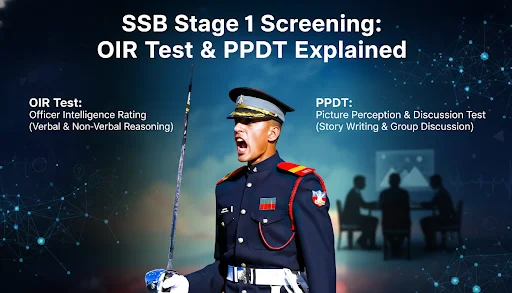
OIR stands for Officers Intelligence Rating. The test measures the general mental ability of a candidate to determine whether their reasoning capacity meets the baseline required for officer-level decision-making in the armed forces. Keep that in mind when thinking about SSB OIR test scoring.
According to the official Join Indian Army portal, the SSB OIR test is administered on Day 1 of the SSB interview process alongside the Picture Perception and Description Test (PPDT). Together, these two instruments form the complete SSB Day 1 screening stage. Candidates who do not clear both are screened out the same afternoon and sent home without proceeding to the five-day psychological and interview rounds. That detail matters when thinking about SSB OIR test scoring.
The test involves two separate intelligence test booklets, each administered under strict time limits, covering verbal and non-verbal reasoning respectively. The same applies to how to prepare for SSB OIR test
SSB OIR Test Format: Verbal and Non-Verbal Sections Explained
The SSB OIR test is divided into two booklets administered one after the other. Booklet 1 covers verbal reasoning and Booklet 2 covers non-verbal reasoning. Each booklet contains approximately 40 to 50 questions, and candidates typically receive 17 to 20 minutes per booklet. This matters just as much for coding decoding verbal.
Booklet 1 (Verbal) tests your ability to find word relationships, identify patterns in number sequences, apply coding-decoding verbal logic, and spot the odd-one-out verbal reasoning item in a group. These question types measure language-linked reasoning and sequential thinking.
Booklet 2 (Non-Verbal) shifts to visual and spatial reasoning. You will encounter figure series questions, pattern completion reasoning tasks, and mirror image questions where you must identify the correct reflected version of a shape.
As outlined on SSBCrack's SSB interview procedure page, both booklets are conducted under supervised, timed conditions with no option to carry over time from one section to another. Speed and accuracy together determine your raw score.
SSB OIR Sample Questions: Verbal Reasoning (With Answers)
The following OIR test sample questions represent the core verbal types you will face. Work through the reasoning, not just the answer.
1. Analogy: Book : Library :: Painting : ?
Answer: Gallery. A book is stored in a library; a painting is stored in a gallery. The relationship is object to its display or storage space.
2. Number series analogy: 3, 6, 12, 24, ?
Answer: 48. Each term doubles the previous one. Recognising the multiplication rule quickly is the skill being assessed.
3. Coding-decoding verbal: If CAT is coded as FDW, what is DOG coded as?
Answer: GRJ. Each letter shifts forward by 3 positions in the alphabet. C+3=F, A+3=D, T+3=W applies consistently.
4. Odd-one-out verbal reasoning: Rose, Lily, Mango, Jasmine
Answer: Mango. The first three are flowers; mango is a fruit. The category break identifies the outlier.
5. Number analogy: 4 : 16 :: 7 : ?
Answer: 49. Both follow the square relationship. Spotting the rule in under five seconds is the target pace.
6. Coding-decoding verbal: If FISH is coded as GJTI, what is BIRD coded as?
Answer: CJSE. Each letter advances by 1 position. B+1=C, I+1=J, R+1=S, D+1=E.
SSB OIR non-verbal reasoning demands that you process visual information rapidly. The following examples illustrate the reasoning rules behind each type.
1. Figure series questions: A sequence shows a triangle with 1 dot, then 2 dots, then 3 dots inside. The next figure should contain 4 dots inside a triangle. The rule is additive progression of internal elements.
2. Pattern completion reasoning: A 3x3 grid has shapes that rotate 90 degrees clockwise across each row. The missing bottom-right cell must show the shape rotated a further 90 degrees from the cell to its left.
3. Mirror image questions: A flag shape points right in the original. The correct mirror image points left with no vertical flip. A common error is choosing a version that is also flipped upward, which is rotation, not reflection.
4. Odd-one-out visual: Four shapes are shown, three with an even number of sides and one with an odd number. The triangle is the odd one out among a group of quadrilaterals.
5. Figure series questions: Circles decrease in size left to right while a square inside them grows. The rule involves inverse proportional sizing of inner and outer elements.
How the OIR Is Scored: Grades, Cutoffs and the Screening Decision
The OIR grading scale runs from Grade 1 to Grade 5, where Grade 1 represents the highest intelligence rating and Grade 5 the lowest. Most services require a candidate to achieve Grade 1, 2, or 3 to remain in contention for screening.
The screen-in screen-out decision on Day 1 is not based on OIR alone. Assessors combine your OIR grade with the observation recorded during the PPDT group task. A strong OIR grade can support an average PPDT performance, but a very poor OIR result is rarely rescued by PPDT alone.
Candidates who score in the upper half of the OIR grading scale, roughly Grade 1 to Grade 3, along with a reasonably coherent PPDT contribution, are typically screened in to the five-day SSB interview process. The exact cutoff is not published officially, but community data from the NDA CDS SSB stage consistently points to Grade 3 as the minimum viable score.
How to Prepare for the SSB OIR Test: Tips and Books for 2026
Knowing how to prepare for SSB OIR test effectively means building two habits: daily timed practice and deliberate error review.
-
Spend 30 minutes daily on verbal reasoning and 30 minutes on non-verbal reasoning. Maintain this for at least six weeks before your SSB date.
-
Use a timer for every practice set. Simulating the pressure of 17 to 20 minutes per booklet trains your pace, not just your knowledge.
-
Review every wrong answer. Most mistakes in the OIR come from misreading the rule in figure series or pattern completion rather than from not knowing the concept.
-
Avoid spending more than 45 seconds on any single question. Move on and return if time allows. This is the single most common mistake first-timers make.
Recommended SSB preparation books include "Verbal and Non-Verbal Reasoning" by R.S. Aggarwal, which covers all core OIR question types thoroughly. Pair this with published OIR test sample questions from SSBCrack's verbal reasoning question bank for variety and timed practice sets.
Frequently Asked Questions
What is the OIR test in SSB and why does it matter?
The OIR test, or Officers Intelligence Rating test, is the intelligence screening instrument used on SSB Day 1 screening. It directly determines whether you advance to the five-day SSB interview process. A poor result means immediate screen-out regardless of other qualities.
How many questions are in the SSB OIR test and what is the time limit?
Each booklet contains approximately 40 to 50 questions. Candidates receive around 17 to 20 minutes per booklet, which makes average speed roughly one question every 25 seconds.
What types of non-verbal reasoning questions appear in the OIR test?
SSB OIR non-verbal reasoning covers figure series questions, pattern completion reasoning, mirror image questions, and odd-one-out visual sets. Visual pattern rules such as rotation, reflection, and size progression are the most frequently tested concepts.
What is the OIR cutoff score to get screened in at SSB?
The OIR grading scale places most screen-in candidates at Grade 1 to Grade 3. Grade 3 is widely regarded as the minimum for a realistic screen-in outcome when combined with a solid PPDT group task contribution.
What are the best books for SSB OIR test preparation in 2026?
"Verbal and Non-Verbal Reasoning" by R.S. Aggarwal remains the most widely recommended among SSB preparation books. Supplement it with online timed mock sets that mirror the intelligence test booklet format used at actual SSB centres.
How hard is the OIR test for a first-timer?
The concepts themselves are not advanced. The difficulty comes from time pressure and unfamiliarity with the format. Candidates preparing for the NDA CDS SSB stage who practise timed sets consistently for four to six weeks find the actual test noticeably more manageable than their first attempt in practice.