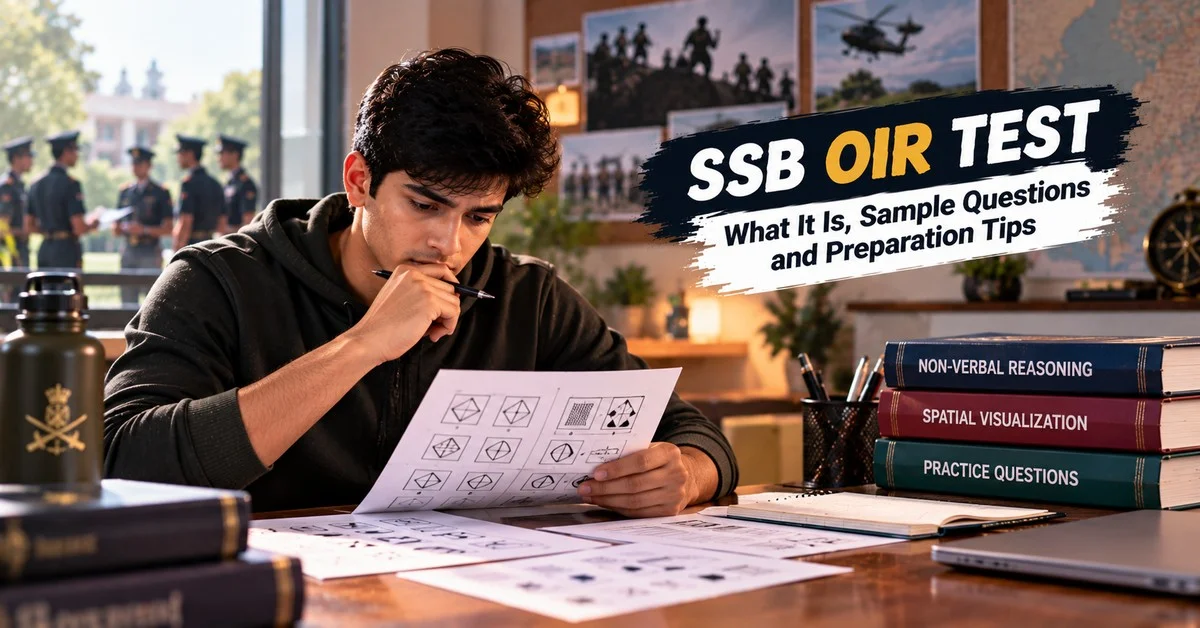
SSB OIR Test: What It Is, Sample Questions and Preparation Tips
Quick summary
Learn everything about the SSB OIR Test, including its pattern, question types, sample questions, preparation tips, common mistakes, and a simple 4-week plan to improve your speed, accuracy, and confidence.
The SSB OIR Test (Officer Intelligence Rating test) is a reasoning test held on Day 1 of the SSB, as part of Stage 1 screening. It usually has two sets, one of verbal and one of non-verbal reasoning, with about 40–50 questions each and roughly 15–20 minutes per set. There is no negative marking. Your rating, together with your PP&DT performance, decides whether you are screened in for Stage 2.
What Is the SSB OIR Test?
OIR stands for Officer Intelligence Rating. The Officer Intelligence Rating test checks how quickly and accurately you can think. It measures basic reasoning skills like spotting patterns, solving small puzzles and making quick decisions, all under time pressure.
An officer often has to take clear decisions quickly, with limited information. The SSB OIR Test gives the board a first look at this ability. It is not a test of your academic knowledge. The questions are at about a Class 10 level; the real challenge is speed.
Where the SSB OIR Test Fits in the Selection Process
The SSB is a two-stage process:
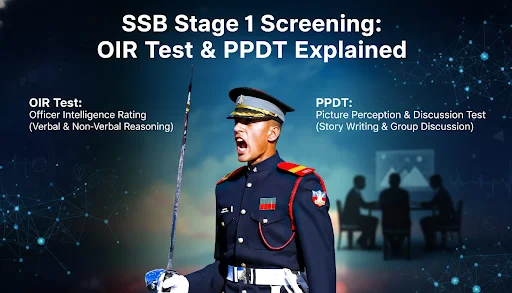
The official CDS notification states that candidates are shortlisted at Stage 1 based on a combination of performance in the OIR test and PP&DT. So the SSB screening test is not decided by the OIR alone. A good OIR score gives you a strong base, and a confident PP&DT completes it.
SSB OIR Test Pattern
The exact pattern can vary a little between selection boards, but it usually looks like this:
With less than 30 seconds per question, you need to move quickly and not get stuck on any one question.
OIR Rating: How You Are Graded
Your score is converted into an OIR rating, generally on a scale of 1 to 5:
OIR 1 and 2: Very good to good
OIR 3: Average; PP&DT performance becomes more important
OIR 4 and 5: Below average
The rating is relative, which means it also depends on how others in your batch perform. Aiming for OIR 1 or 2 gives you the most comfortable position going into PP&DT. Your rating may also be seen by assessors later as an indicator of your reasoning ability.
Types of OIR Test Questions
Verbal Reasoning
The verbal and non-verbal reasoning sets cover different skills. The verbal set includes:
Number and letter series
Analogies (word and number pairs)
Coding and decoding
Odd one out
Blood relations
Direction sense
Ranking and order
Simple arithmetic (percentages, speed, averages)
Arranging words in a meaningful order
Non-Verbal Reasoning
The non-verbal set uses figures and shapes, such as:
Figure series (what comes next)
Figure analogies and odd figure out
Mirror and water images
Paper folding and cutting
Embedded (hidden) figures
Counting figures such as triangles and squares
Dice and cubes
OIR Test Questions: Samples with Answers
Here are some OIR test questions for practice. Try to solve each within 30 seconds before checking the answer.
Verbal Samples
1. Find the next number: 3, 6, 12, 24, ?
Answer: 48. Each number is doubled.
2. Find the next number: 2, 5, 10, 17, 26, ?
Answer: 37. The difference increases by 2 each time (+3, +5, +7, +9, +11).
3. Find the next letter: A, C, F, J, ?
Answer: O. The gaps are +2, +3, +4, +5.
4. Doctor : Hospital :: Teacher : ?
Answer: School. It is the place where each person works.
5. If CAT is written as DBU, how is DOG written?
Answer: EPH. Each letter moves one step forward.
6. Find the odd one out: 11, 13, 17, 21, 23
Answer: 21. All others are prime numbers.
7. Pointing to a boy, Riya says, "He is the son of my father's only son." How is the boy related to Riya?
Answer: Nephew. Riya's father's only son is her brother, so the boy is her brother's son.
8. Ravi walks 5 km north, turns right and walks 3 km, then turns right again and walks 5 km. Where is he now from his starting point?
Answer: 3 km East.
9. In a row of 30 students, Aman is 12th from the left. What is his position from the right?
Answer: 19th (30 − 12 + 1).
10. What is 25% of 240?
Answer: 60.
Non-Verbal Samples
11. Which word will look exactly the same in a mirror placed to its right? TOOT, BOOK, CAKE, DEED
Answer: TOOT. T and O are symmetrical from left to right, and the word reads the same both ways.
12. On a standard die, 2 is on the top face. Which number is on the bottom face?
Answer: 5. Opposite faces of a standard die add up to 7.
13. A square sheet of paper is folded in half once, and one hole is punched through it. How many holes will there be when it is unfolded?
Answer: 2.
14. A triangle has one line drawn from its top corner to its base. How many triangles are there in total?
Answer: 3 (two small triangles and the large one).
In the real test, non-verbal questions show figures instead of words, but the logic is the same: look for the pattern, count carefully and check symmetry.
SSB OIR Test Preparation Tips
Good OIR test preparation is less about studying hard and more about practising smart:
Practise daily for 30–40 minutes. Short, regular practice builds speed better than long sessions once a week.
Use a timer. Solve sets of 40–50 questions in 15–20 minutes, just like the real test.
Learn common patterns. Squares, cubes, prime numbers, alphabet positions (A = 1 to Z = 26) and doubling series appear often.
Don't get stuck. If a question takes more than 30–40 seconds, mark your best guess and move on.
Attempt every question. Since there is no negative marking, never leave an answer blank.
Work on your weak areas. Many candidates find mirror images, paper folding or blood relations tricky. Give these a little extra time.
Review your mistakes. After each practice set, check why you got a question wrong. This is where real improvement happens.
Practise non-verbal questions on paper. Figure-based questions are easier to understand when you see and mark them, rather than only reading about them.
Common Mistakes in the SSB OIR Test
Spending too long on one difficult question
Leaving questions unanswered
Marking the wrong option on the answer sheet in a hurry
Ignoring non-verbal practice and focusing only on verbal questions
Arriving tired or anxious after poor sleep, which affects speed and focus
A Simple 4-Week SSB OIR Test Plan
If your SSB date is sooner, you can shorten this plan. Even two weeks of daily timed practice makes a clear difference.
On the Day of the SSB OIR Test
Sleep well the night before. A fresh mind works faster.
Listen carefully to the instructions given by the testing officer.
Mark answers neatly on the answer sheet as instructed.
Stay calm if a few questions feel hard. Everyone in the room faces the same paper, and the rating is relative.
Stay confident for PP&DT, the second part of the SSB screening test. A calm mind helps you perform well in both.
FAQs
What is the full form of OIR in SSB?
OIR stands for Officer Intelligence Rating. It is a reasoning test held on Day 1 of the SSB interview.
How many questions are there in the OIR test?
Usually about 40–50 questions in each of the two sets, verbal and non-verbal. The exact number can vary by selection board.
Is there negative marking in the OIR test?
No. There is no negative marking, so you should attempt every question.
What is a good OIR rating in SSB?
OIR 1 and 2 are considered good. OIR 3 is average, and in that case your PP&DT performance matters more.
Is the SSB screening decided only by the OIR test?
No. Candidates are screened in based on a combination of their OIR test and PP&DT performance.
How can I improve my OIR score quickly?
Practise timed sets daily, learn common patterns, attempt every question and review your mistakes after each practice set.
Tags
- Officer Intelligence Rating test
- OIR test questions
- OIR test preparation
- OIR rating
- SSB screening test
- verbal and non-verbal reasoning