SSB Medical Test: Process, Requirements and Common Reasons for Unfitness
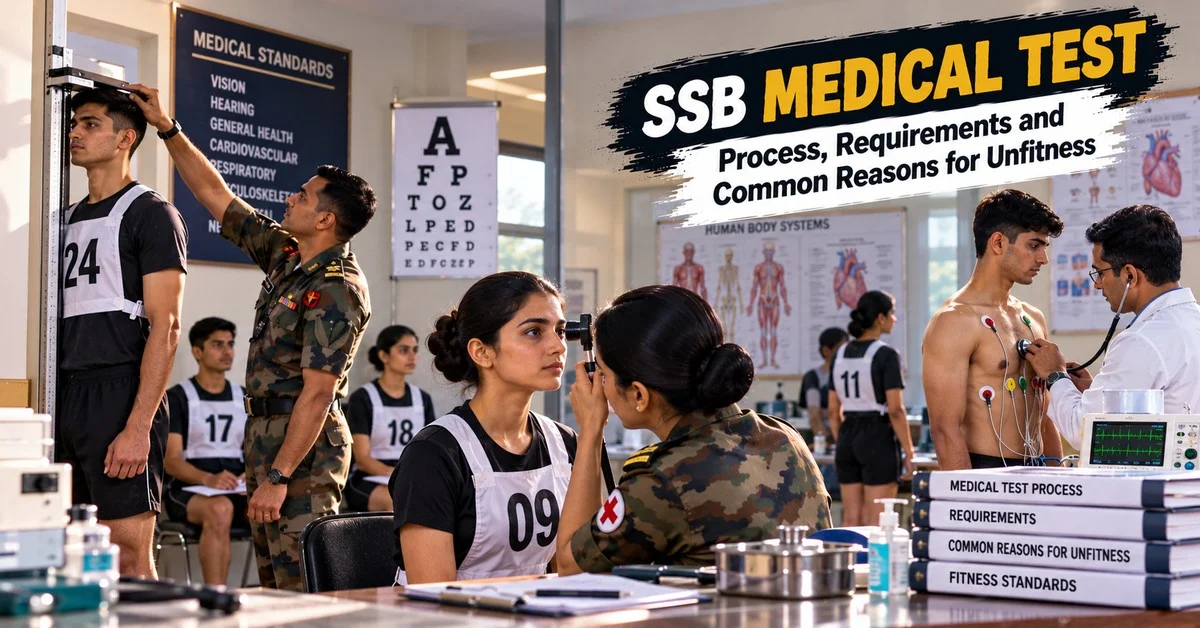
See how the SSB Medical Test works, the key medical standards for height, eyes, teeth and tattoos, the most common reasons for unfitness, what temporary unfit means, and how the Appeal Medical Board can help.
The SSB Medical Test is a detailed medical examination for candidates recommended by the SSB. It is done by a Special Medical Board (SMB) at a Military Hospital and usually takes 4 to 5 days. Doctors check your eyes, ears, teeth, height and weight, posture, blood and urine, X-ray and ultrasound reports, and general health. Common reasons for unfitness include weight outside the limits, eye problems, dental issues, ear and nose problems, posture defects, flat feet, and certain tattoos. Candidates declared unfit can apply for an Appeal Medical Board, usually within 42 days.
What Is the SSB Medical Test?
After the SSB conference, only recommended candidates go through the SSB Medical Test. Its purpose is to make sure you are physically and mentally fit for the demanding training and service ahead.
The official medical standards are published in the Joint Order Manual of Medical Standards for Entry into Armed Forces, which is available on the Indian Army recruitment website, joinindianarmy.nic.in. The CDS and NDA notifications refer candidates to this document.
SSB Medical Process: Step by Step
Here is how the SSB medical process usually works:
-
Medical chest number: Recommended candidates are given a new chest number, usually with a red cross mark, to wear on campus during the medical stay.
-
Reporting to the Military Hospital: Candidates are taken to a nearby Military Hospital (MH) for the medical board.
-
Investigations: Tests usually include a blood test (haemogram), urine test, chest X-ray and an ultrasound of the abdomen. Navy and Air Force candidates may also have liver and kidney function tests, a spine X-ray and an ECG.
-
Specialist checks: Specialists in medicine, surgery, eye, ENT and dental examine each candidate. Women candidates are also examined by a gynaecology specialist.
-
Medical board decision: The board reviews all findings and declares you fit, temporarily unfit or permanently unfit.
-
Next steps: If found unfit, the President of the Medical Board explains how to apply for an appeal.
The whole SSB Medical Test usually takes 4 to 5 days. NDA candidates are generally examined for both the Army and the Navy, unless told otherwise.
Main Medical Standards for Armed Forces
The standards vary by service and entry. Here is a simple overview of the key points.
Height
Some regions and communities, such as Gorkhas and candidates from the North-Eastern and hill regions, get height relaxation as per the rules.
Weight
Weight must match your height and age as per the official charts. Being either overweight or underweight can lead to unfitness. This is one of the most common reasons candidates are declared temporarily unfit.
Eyesight
Eye standards are different for each service and entry. The Air Force flying branch has the strictest standards, while Army entries allow more correction. Colour vision is also checked, and flying and some Navy roles need normal colour perception.
Rules for LASIK and other eye surgery also depend on the entry. For example, recent standards allow it for some graduate entries under conditions, while NDA Army entry does not permit it. Please check the exact rules for your entry in the official manual.
Hearing
Candidates should be able to hear a forced whisper at a set distance with each ear. Ear infections and wax can affect this test.
Teeth
Candidates need a minimum of 14 dental points, calculated from healthy natural teeth. Gum disease, heavy tartar, loose teeth and active braces can also lead to unfitness.
Tattoos
As per the CDS notification, permanent tattoos are allowed only on the inner side of the forearm (from the inside of the elbow to the wrist) and on the back of the hand. Tattoos on any other part of the body are not acceptable. Tribes with tattoo marks as per their custom may be allowed on a case-by-case basis.
Common SSB Medical Rejection Reasons
These are the most common reasons for unfitness in the SSB Medical Test, grouped by area.
1. Weight Issues
Weight outside the permitted range for your height and age. Both overweight and underweight candidates can be declared unfit.
2. Eye Problems
-
Vision below the required standard for your entry
-
Colour blindness (where normal colour vision is required)
-
Squint, keratoconus or retinal problems
-
Eye surgery not allowed for your entry, or done too recently
3. Dental Problems
-
Fewer than 14 dental points
-
Cavities, gum disease or heavy tartar
-
Loose teeth or active braces
4. Ear, Nose and Throat (ENT) Issues
-
Earwax blocking the ear canal
-
Ear infections or a damaged eardrum
-
Deviated nasal septum (DNS), nasal polyps or long-term sinus problems
-
Reduced hearing
5. Posture and Spine Problems
-
Scoliosis (sideways curve of the spine)
-
Excessive curvature of the upper or lower back
-
Spinal defects seen on X-ray
6. Limbs and Joints
-
Flat feet (rigid type)
-
Knock knees or bow legs beyond limits
-
Cubitus valgus (outward angle at the elbow) beyond limits
-
Old injuries that limit joint movement
7. Surgical Conditions
-
Hernia
-
Varicocele or hydrocele
-
Piles
-
Phimosis
-
Keloids or unhealed wounds
8. Internal Health Issues
-
Kidney stones or gallstones
-
High blood pressure or a high resting pulse
-
Low haemoglobin or other blood abnormalities
-
Enlarged liver or spleen
-
In women, some ovarian and gynaecological conditions
9. Skin Conditions
-
Vitiligo on exposed areas
-
Psoriasis
-
Excessive sweating of palms or feet
10. Tattoos
Tattoos on body parts other than those permitted are a common and avoidable reason for rejection.
SSB Medical Test Results: Temporary Unfit vs Permanent Unfit
This result is not the end of the road. Many candidates correct the issue and are declared fit at the appeal stage.
Appeal Medical Board and Review Medical Board
How the Appeal Works
If the SMB declares you unfit, you can usually apply for an Appeal Medical Board (AMB). It is held at a Command Hospital or another designated hospital, and you must normally report within 42 days of the SMB.
This time is often used to correct temporary issues, such as reaching the right weight in a healthy way or completing dental treatment. You may also bring new medical evidence, such as specialist reports.
Review Medical Board (RMB)
If you are declared unfit again at the AMB, you may request a Review Medical Board in some cases. An RMB is not automatic; senior medical authorities approve it at their discretion.
Please follow the exact instructions and timelines given by the President of the Medical Board, as they can differ by service and entry.
Recovery Time After Surgery
If you have had a minor surgery before your SSB Medical Test, you usually need a minimum recovery period before you can be declared fit. The required time depends on the procedure and the service. For example, candidates who have had LASIK are usually expected to wait at least 12 months, and a hernia operation usually needs around six months.
Carry all medical records and discharge summaries of any past surgery.
How to Prepare for the SSB Medical Test
Good preparation for the SSB Medical Test starts well before your SSB date:
-
Get a basic check-up early. A visit to a doctor, an eye specialist, an ENT specialist and a dentist can reveal many issues months before the SSB.
-
Maintain a healthy weight. Follow a balanced diet and regular exercise. Avoid crash diets, which can harm your health.
-
Take care of your teeth. Brush twice a day, get cavities treated and remove heavy tartar at a dental clinic.
-
Get your ears checked. A doctor can safely remove earwax. Please don't put objects in your ears yourself.
-
Work on your posture. Regular stretching and exercise help, but a spine problem should be checked by a doctor.
-
Avoid new tattoos outside the permitted areas.
-
Keep medical records ready, including surgery papers and any specialist reports.
-
Be honest with the doctors. Hiding a condition can create bigger problems later.
On the Day of the SSB Medical Test
-
Follow instructions about fasting before blood tests, if given.
-
Carry your documents and medical records.
-
Wear your medical chest number as instructed.
-
Stay disciplined and cooperative with the hospital staff.
-
Ask politely if you don't understand an instruction.
FAQs
What is the SSB Medical Test?
It is a detailed medical examination for candidates recommended by the SSB, done by a medical board at a Military Hospital.
How many days does the SSB Medical Test take?
Usually about 4 to 5 days.
What are the most common SSB medical rejection reasons?
Weight outside the limits, eye problems, dental issues, ear and nose problems, posture defects, flat feet, surgical conditions and tattoos in non-permitted areas.
What does temporary unfit mean in SSB medicals?
It means you have a condition that can be corrected in a short time, such as earwax or weight issues. You can usually apply for an appeal.
How long do I have to apply for the Appeal Medical Board?
You normally need to report within 42 days of the SMB. Always follow the exact instructions given to you.
Where are tattoos allowed for armed forces entry?
Only on the inner side of the forearm and the back of the hand. Tattoos on other parts of the body are not acceptable, with case-by-case exceptions for tribal customs.
Is LASIK allowed for SSB medicals?
It depends on the entry. It is allowed for some entries under specific conditions and not for others, so check the official medical standards for your entry.