Women in SSB: Process, Tests and What Is Different for Female Candidates
Quick summary
The SSB interview for female candidates follows the same five-day process and OLQ standards as for men. This guide covers each day, the entry routes open to women, test-by-test notes, common myths, and what to pack and wear.
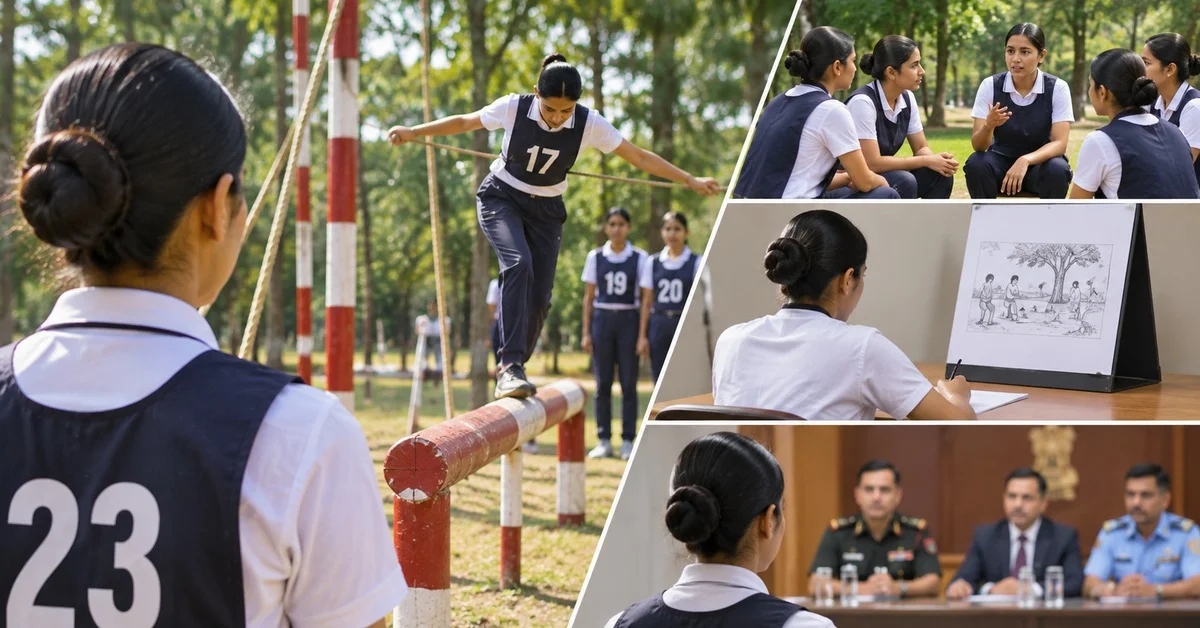
The SSB interview for female candidates follows the same five-day process as for men: screening (OIR and PPDT), psychological tests, GTO tasks, the Personal Interview, and the final conference. The tests and the Officer Like Qualities standards stay the same. What differs is practical: accommodation, staff presence, group composition and dress code.
Your call-up letter has arrived. You’ve read every SSB guide you can find, and almost all of them picture a hall full of male candidates. None of them tell you where you’ll sleep, what to wear on the GTO ground, or whether a question about your family is fair. So the doubts build up quietly.
This guide clears them. You’ll get the five days stage by stage, the entry routes open to women in 2026, a test-by-test answer on what changes, the common myths corrected, and the practical details most guides skip, from separate accommodation to what to pack.
How the SSB Process Works for Women: Day-by-Day Breakdown
The SSB interview for female candidates runs on the same five-day timeline as it does for men. Same tests, same order. The board doesn’t build a separate schedule for women. What you will notice instead are the practical arrangements around you: separate living quarters, and the way groups are formed for screening and GTO.
The assessor panel doesn’t change either. An Interviewing Officer, a Group Testing Officer and a Psychologist each assess you on their own. Your call-up letter is the final word on reporting time and documents, so read it twice. Here’s how the days unfold.
| Day | Stage | What happens |
|---|---|---|
| Day 1 | Screening | Document check, OIR, PPDT |
| Day 2 | Psychology | TAT, WAT, SRT, SD |
| Days 3 and 4 | GTO | Group and individual tasks; PI runs alongside |
| Day 5 | Conference | Full board meets each candidate, results announced |
Day 1: Reporting, Document Check and Screening (OIR + PPDT)
Day 1 decides whether you stay. Report at the time and place your call-up letter gives. At most Army boards that means arriving a day earlier, on Day 0. Original documents and photocopies get checked first, so arrange them in the order listed on your call-up letter.
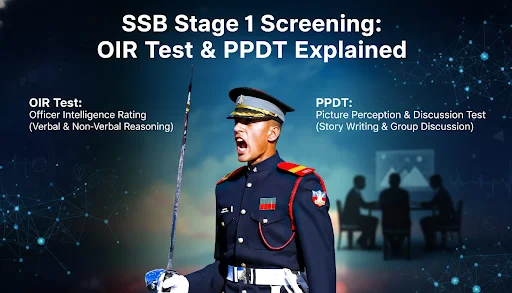
Then comes the OIR, a set of verbal and non-verbal reasoning papers. The PPDT follows. You see a hazy slide for 30 seconds and get four minutes to write a story. After a long wait, candidates are grouped fifteen to a batch for narration and discussion. It’s a harsh filter. About 50 to 60% of candidates are screened out and head home that evening.
Day 2: Psychological Tests (TAT, WAT, SRT, SD)
Day 2 is the Psychologist’s day, and the pace is relentless. You’ll write all four tests in one sitting, with almost no time to think.
- TAT: 12 pictures, 12 stories.
- WAT: 60 words, 15 seconds each.
- SRT: 60 situations in 30 minutes.
- SD: 5 short essays on how others see you.
Women write exactly the same papers. The SD trips up many aspirants because it asks for honest opinions from parents, teachers and friends, so work through this self-description test guide with sample answers before you report.
Day 3 and 4: GTO Tasks
The GTO tests you outdoors for two days. You’ll face group discussions, planning exercises, group obstacle races, the lecturette, the command task and individual obstacles. Format and scoring are identical for every SSB interview for women and men alike.
But fitness does matter here. A sensible baseline for women (a personal training target, since SSB publishes no official fitness standard) is a 1.6 km run in under eight minutes, basic rope climbing, and steady upper body effort across ten individual obstacles. Don’t treat that as optional. Your Personal Interview also usually falls somewhere in these days, slotted around GTO work.
Day 5: Personal Interview and Conference
Day 5 is the conference, where your SSB board recommendation is decided. The Personal Interview itself happens earlier: the Interviewing Officer spends 40 to 90 minutes alone with each candidate. That conversation feeds directly into this final day.
At the conference, the full board meets each candidate for 3 to 10 minutes. That includes the IO, GTO, Psychologist, Deputy President and President. They then deliberate and announce results. Keep your answers short and consistent with everything you wrote and said earlier. Assessors are checking whether one person shows up across all four days, and contradictions get noticed fast.
Which SSB Entries Are Open to Women in 2026: NDA, CDS and OTA Explained
Women can reach an SSB board through several routes: CDS for OTA Chennai, AFCAT, NCC Special Entry and Short Service Commission Women in both Tech and Non-Tech streams. NDA SSB for girls follows the Supreme Court ruling that opened NDA to women. The board, tests and OLQ assessment are the same as for men. For CDS, women aged 19 to 25 qualify for OTA if they are unmarried, or are issueless widows or issueless divorcees who have not remarried. Our CDS OTA guide for female aspirants maps that route in detail. Eligibility for SSC Women (Tech) and each technical entry can change between cycles. Confirm it in the latest UPSC or Indian Army notification before applying.
Are SSB Tests Actually Different for Female Candidates? A Test-by-Test Answer
No. Women and men take the same screening papers, the same psychological test battery, the same GTO series and the same Personal Interview. The differences sit around the tests: who is in your group, how the board forms batches, and the living arrangements during your stay. The Officer Like Qualities you’re judged on don’t change with gender.
That answers the most common forum question, which asks whether girls get an easier paper or a softer board. They don’t. If you want eligibility and entry details for women in one place, read this SSB guide for women in 2026. Below, each test gets one practical note.
OIR (Officer Intelligence Rating)
The OIR is identical for every candidate. You’ll face the same verbal and non-verbal reasoning questions under the same time limits, and there’s no separate women’s paper. Your score combines with your PPDT performance to decide whether you’re screened in.
The trap is speed, not difficulty. Most questions are series completion, coding-decoding, analogies and odd-one-out patterns. Each one is simple on its own. Under a ticking clock, though, they fall apart. Solve two timed sets daily for the last month before reporting. And skip any question that stalls you for longer than a few seconds, because coming back later costs less than freezing.
PPDT (Picture Perception and Discussion Test)
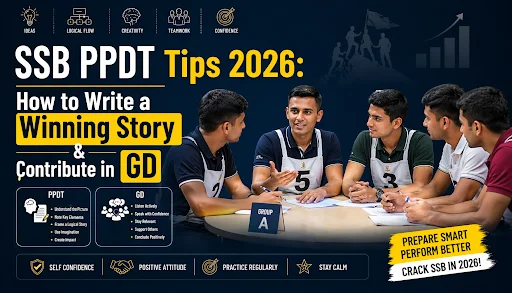
The PPDT format doesn’t change for women. You get the same type of hazy picture, write a story, narrate it, then join the group discussion. What can change is your group. Depending on how many women report to a board in that batch, you may sit with an all-female group or a mixed one.
In a mixed group, don’t wait to be invited into the discussion. Enter early with a clear point, then listen. Volume doesn’t count as leadership, but silence in the opening minutes is hard to recover from. In your story, the main character can be a woman, a man or unclear. Assessors care about what the character does.
TAT (Thematic Apperception Test)
The TAT pictures are the same for everyone, and the Psychologist reads your stories for the same qualities. Your hero can be a woman. That won’t count for or against you.
What does hurt is a passive hero. A common pattern in weak stories is a female lead who notices a problem and then waits for a father, brother or officer to fix it. Assessors don’t penalise the gender of the character. They mark down the missing initiative.
A stronger version has the hero spot the issue, decide fast, organise the people around her and see the result through. Keep the language plain. Twelve modest, believable stories beat two brilliant ones and ten unfinished ones.
WAT (Word Association Test)
The WAT word list is not adjusted by gender. But some words pull female aspirants toward stereotyped replies without them noticing: words like family, marriage, home or mother.
Write a useful sentence, not a definition or a slogan. Two examples show the gap:
- Family: weak reply “Family comes before everything.” Stronger reply “Family support helps a soldier stay focused on duty.”
- Home: weak reply “Home is where a woman belongs.” Stronger reply “Every posting can feel like home with the right attitude.”
Neither strong reply is clever. Each shows a mind that adapts and looks for something positive to do. Practise with a timer and a random word list for 15 minutes a day.
SRT (Situation Reaction Test)
SRT situations are the same for all candidates. Some describe events that may feel more personal to a woman: travelling alone at night, facing harassment in public transport, or family opposition to a career decision.
Respond with action, not emotion. Take a situation like “She is returning from college late and her bus breaks down on an isolated road.” A weak reply is “She gets scared and calls home.” A stronger one is “Informed the conductor, called the police helpline, kept fellow passengers together near the lit area and boarded the next bus once help arrived.”
The stronger reply shows calm, quick thinking and concern for others. Those qualities are scored identically for every aspirant.
Self-Description (SD)
The SD has no gender-specific version. You write what your parents, teachers, friends and you yourself think of you, plus the qualities you want to develop. The headings and the reading lens stay the same.
The common mistake is writing what you think a woman officer “should” sound like. Assessors compare your SD with your PIQ form, your stories and your interview. A polished but borrowed image breaks down by Day 5.
If your parents had doubts about a defence career at first, you can say so honestly and add what changed their view. That is a real opinion with a real outcome. It reads far better than “my parents think I am perfect.”
GTO Task Series
The GTO series runs the same tasks in the same order for women and men, with the same scoring for leadership and group effort. Your Group Testing Officer decides how batches are formed. In a mixed group, you’ll work alongside men on the group obstacle races and the planning exercises.
Take a clear stance here: in a mixed group, the woman who gives the first workable plan scores better than the one who silently carries the heaviest plank. Physical effort matters. But the GTO watches who reads the problem, who suggests the solution and who keeps the group moving.
Don’t step back from the physical parts either. Hold a rope, steady a plank, take your turn on a load. The fitness baseline covered above exists for exactly these moments.
Personal Interview
The Personal Interview follows the same format for women. An Interviewing Officer, a senior officer, conducts it one to one. Questions come from your PIQ form: your education, hobbies, responsibilities, achievements and reasons for choosing the armed forces.
Expect a few more questions on family support, mobility and service conditions. These aren’t a trap. The IO wants to see whether you understand the life you’re applying for and whether your answers match your PIQ.
Fill your PIQ form carefully and keep a copy of every answer in your head. The dedicated PI section below covers sample questions and how to answer family-related ones without undercutting your candidacy.
GTO Tasks for Female Candidates: What’s the Same and What Changes
The tasks themselves don’t change. The Progressive Group Task, Half Group Task, Command Task, Group Obstacle Race and individual obstacles all run in the same format for every SSB interview batch. What varies is your group. Some boards place women in an all-female batch, while others mix them with men, depending on how many report.
In a mixed group, the GTO scores the same things: who reads the obstacle, who proposes a workable plan and who keeps people cooperating. Choosing your helpers well in the Command Task counts too. Don’t expect lighter physical norms. Train to the baseline covered above.
Psychological Tests and Gender-Loaded Scenarios: How to Respond Authentically
Answer every gender-loaded prompt the way an officer would, not the way you think a woman is expected to. Some TAT pictures, Word Association Test words and SRT situations touch on family pressure, talk of marriage or a clash between duty and home.
Before writing, ask one question: what would a capable person do here? Say a relative pushes you to quit training for a wedding. Don’t argue, and don’t give in. Talk it through, agree on a timeline, keep training. The Psychologist applies that same practical lens at every board, including CDS OTA SSB for women.
7 Common Misconceptions Female Aspirants Have About SSB Selection
Most of the fear female aspirants carry into SSB comes from myths, not from the tests. Forum threads repeat the same worries every cycle: easier GTO norms, a softer board, hidden bias, a separate rulebook for NDA girls. Each one sounds plausible. None holds up against how the board actually works.
Believing these myths does real damage. An aspirant who expects a waived obstacle trains less. One who fears looking “aggressive” goes quiet in the group discussion. Here’s what’s true instead.
Myth 1: GTO physical tasks are easier or waived for women
They aren’t waived. The GTO tasks for female candidates are the same obstacles, the same group tasks and the same scoring sheet used for men. Nobody hands you a pass on the snake race or the individual obstacles because you’re a woman.
The myth probably grows from the fact that medical and physical standards for entry differ by gender. On the GTO ground, though, the Group Testing Officer watches effort, planning and how you handle a failed attempt. An aspirant who skips an obstacle out of hesitation loses marks. Train to the baseline covered above and attempt everything.
Myth 2: OLQs are judged on a different scale for female candidates
There is one OLQ framework. The Officer Like Qualities used across all three assessors don’t come in a male and female version, and no separate marking scale exists for women.
Think about how the board works. The IO, GTO and Psychologist each assess you independently, then meet at the conference to compare notes on the same qualities: reasoning, initiative, social adaptability, courage, determination. A lower bar for one group would make that comparison meaningless. So prepare for the standard every officer is held to, because that’s the only one in use.
Myth 3: Assessors expect feminine personality traits over officer traits
Assessors look for officer traits. Full stop. Gentleness, politeness and empathy are fine qualities, and cooperation does count. But they’re scored as part of how you work with people, not as a substitute for decision-making.
Some aspirants soften every answer, hoping to seem “suitable”. That backfires. A Situation Reaction Test reply that only comforts people without solving anything reads as low initiative, whoever writes it. Be warm and decisive at the same time. Officers of any gender need both.
Myth 4: Women have lower selection rates because SSB is biased
SSB is hard for everyone, and that’s the real story behind low numbers. Across all entries, only about 5 to 6% of those who report at the board are recommended, roughly 1 in 20 by coaching-site estimates.
Those figures cover the whole pool, not women separately. And no source we’ve reviewed gives an official gender-wise recommendation rate, so treat any viral percentage on forums with suspicion. A low pass rate reflects a demanding process. It isn’t proof that the board marks women down.
Myth 5: You must avoid appearing “aggressive” or assertive
Assertive and aggressive are different things, and the GTO knows the difference. Interrupting, shouting over others or dismissing ideas hurts any aspirant. Stating a clear plan, defending it calmly and pulling the group back to the task helps any aspirant.
Holding back is the bigger risk. A woman who waits politely through the first few minutes of a mixed group discussion often never gets the floor back. Speak early. Keep your tone even. If someone talks over you, finish your sentence and then invite their point. That’s leadership, not aggression.
Myth 6: The Personal Interview is less intense for women
It isn’t. The Interviewing Officer runs the same depth of conversation, probes your PIQ just as hard and fires the same rapid-fire question sets. Expect cross-checking of every claim you’ve written.
If anything, women often face a few extra questions on family support, postings and service life, as covered above. That adds to the interview rather than softening it. Walk in expecting full intensity. A relaxed expectation is exactly what makes an aspirant stumble when the IO suddenly asks for a detailed account of a weak academic year.
Myth 7: NDA SSB and CDS SSB use different evaluation criteria for women
The evaluation criteria are the same for both. NDA and CDS aspirants go through the same boards, the same tests and the same OLQ assessment. The SSB interview for female candidates doesn’t switch rulebooks based on your entry.
What differs is everything before and around the board. CDS OTA aspirants, for example, write only two papers, English and General Knowledge, each worth 100 marks. NDA aspirants arrive straight from school, so their PIQ, interview questions and expected life experience look different from a graduate’s. The yardstick stays fixed. The material it measures changes with your age and background.
What SSB Assessors Look for in Female Candidates: OLQs That Matter Most
Assessors look for the same Officer Like Qualities in every aspirant. Still, three of them tend to show up clearly for women in the GTO ground and the interview room.
- Initiative: proposing the first plan in the Half Group Task instead of waiting for a male groupmate to speak.
- Social adaptability: pulling a quiet member into the discussion, or settling into a mixed batch without hesitation.
- Courage: attempting the high individual obstacle after a failed first try.
- Composure: answering a pointed PI question on postings calmly, without getting defensive.
None of these earn extra credit for gender. They simply get noticed.
Personal Interview for Female Candidates: What to Expect and How to Prepare
Beyond your PIQ, expect four themes: why you want a uniform, whether your family backs you, what service life demands, and how women serve in the forces today. Know the facts that apply to you. For example, Short Service Commission women receive an initial tenure of 10 years, extendable to 14.
Family questions test your clarity, not your loyalty. Never suggest you’d drop out if your parents objected. Describe their real view, how you discussed postings and risk with them, and where things stand now. Practise these answers aloud before you face the Personal Interview board.
What Female Candidates Should Know About Logistics, Accommodation and Board Conduct
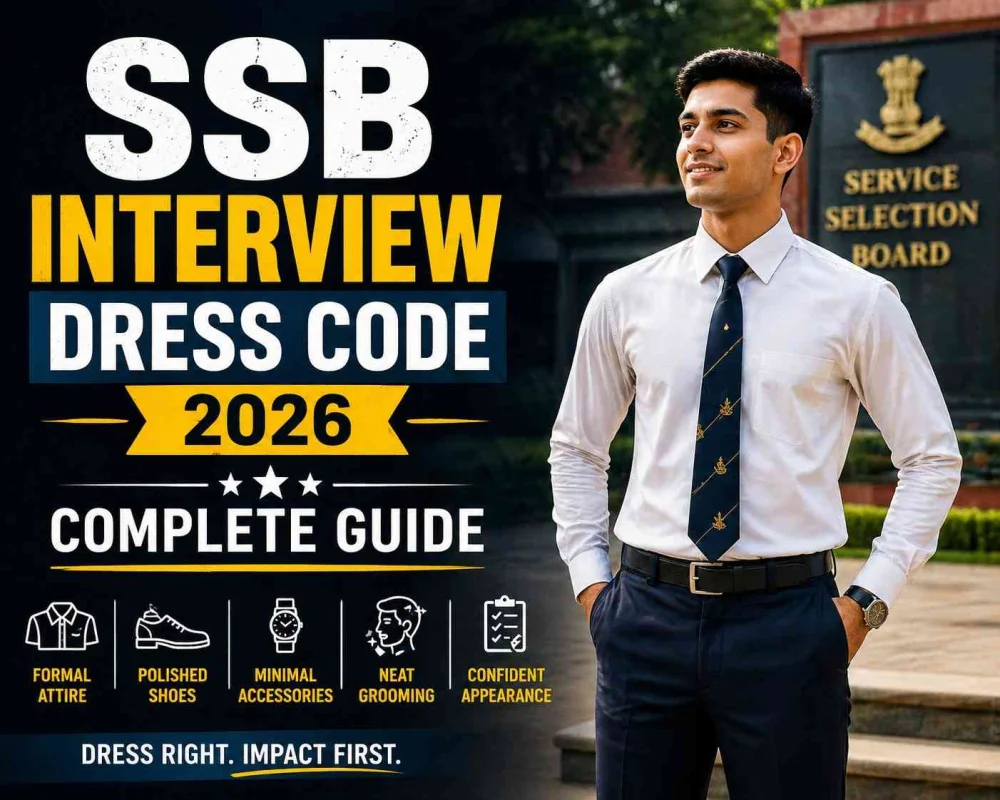
Women stay in separate living quarters, away from the men’s accommodation. Female staff presence varies by board. If something concerns you, raise it politely with the reception staff on arrival. Your dress depends on the task, not on your gender.
- GTO: tracksuit or sports trousers, a plain T-shirt, sports shoes, and hair tied back securely.
- PI and conference: a formal salwar kameez, or trousers with a shirt, and minimal jewellery.
- Screening round PPDT: neat formal or smart casual wear.
- Extras to pack: sanitary supplies, basic medicines, spare hair ties, two sets of sportswear and photocopies of your documents.
Your call-up letter lists the items you must carry. Follow it before any guide, including this one.
What Assessors Cannot Evaluate: Protected Criteria and Your Rights as a Candidate
Assessors don’t grade you on marital status, family background or looks. None of these appear among the Officer Like Qualities, and your Officer Intelligence Rating has nothing to do with them. Eligibility rules are a separate matter. CDS OTA entry, for instance, is open only to unmarried women, issueless widows and issueless divorcees who have not remarried. That rule is checked through your documents, not judged in the interview room.
Your appearance counts only as far as the medical standards in the notification go. Your parents’ jobs or social standing won’t raise or lower your grading. If a question feels improper, answer briefly and calmly. Then raise any real concern with the board’s administrative staff.
FAQs
Is the SSB interview the same for girls and boys?
Yes. The tests, order and OLQ standards are identical.
Can women appear for NDA SSB in 2026?
Confirm current eligibility in the official UPSC NDA notification before applying.
What is the SSB process for CDS OTA entry for women?
It’s the standard five-day SSB.
Are GTO tasks physically demanding for female candidates?
Yes. Train to the full baseline.
How should I answer “Will your family support your service?” in PI?
Honestly, with specifics on how you discussed it.
Do female candidates get a separate batch at SSB?
Sometimes. It depends on reporting numbers.
What should I wear for GTO tasks and the Personal Interview?
Sportswear for GTO, formals for PI.
Is the selection rate lower for women at SSB?
No official gender-wise figure exists.
Tags
- SSB interview for female candidates
- SSB interview
- Officer Like Qualities
- Group Testing Officer
- SSB interview for women
- CDS OTA SSB for women
- GTO tasks for female candidates
- OLQ assessment
- psychological test battery
- Word Association Test
- Personal Interview board
- Situation Reaction Test