SSB Individual Obstacles: Full List, Official Rules and Preparation Tips
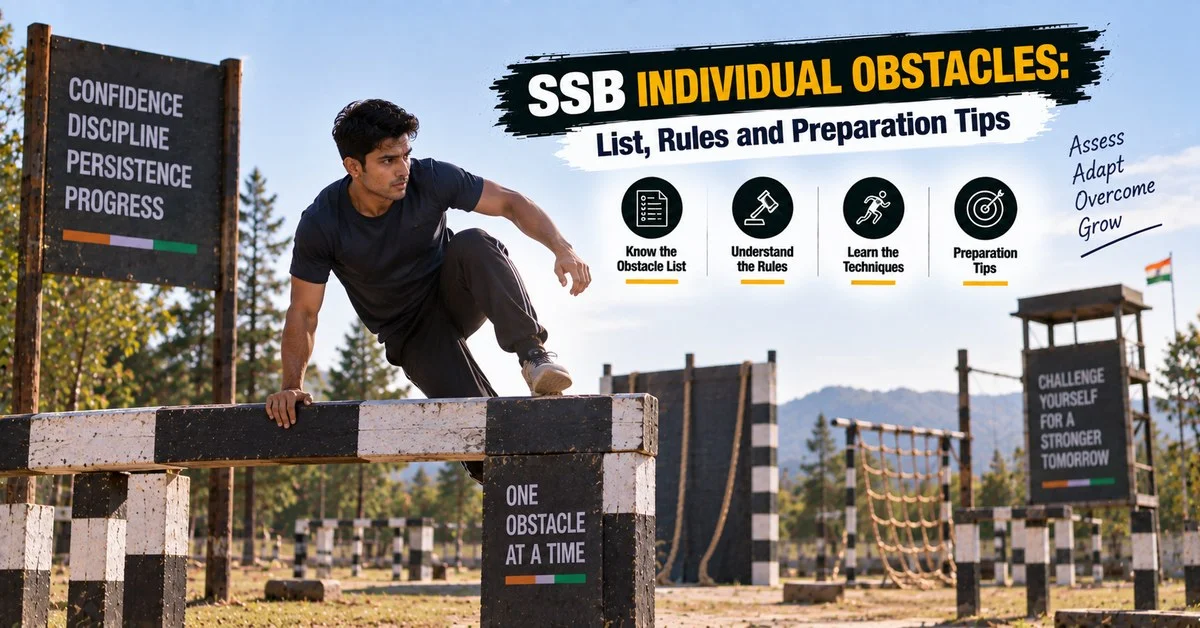
SSB Individual Obstacles tests physical fitness, determination, coordination, and composure through 10 challenging obstacles. Learn the rules, scoring approach, common mistakes, and a 3-month preparation plan.
Most candidates who reach the SSB interview have already cleared a written exam, passed document verification, and survived the first day's Officer Intelligence Rating test. Then comes GTO Day, and nothing quite prepares you for standing in front of the individual obstacle course with a chest number pinned to your shirt and the Group Testing Officer watching quietly from the side. SSB Individual Obstacles is the one task in the entire Services Selection Board selection process where there is no teammate to rely on, no group dynamic to fall back on. It is just you, your body, and 10 back-to-back physical challenges. That reality hits differently when you are actually there, and it is especially true when it comes to SSB GTO tasks individual obstacles.
This guide covers every obstacle by name, the rules that govern the task, how the GTO actually scores you, and a structured 3-month training plan mapped directly to what the course demands. The same logic applies to understanding how to prepare for SSB individual obstacles before you set foot on the ground.
What Are SSB Individual Obstacles? (Quick Overview)
SSB Individual Obstacles is a standalone task within the GTO Day 3 schedule where a candidate attempts 10 obstacles in sequence, without any assistance from fellow candidates. It forms part of the broader SSB interview GTO tasks series, which also includes the Group Obstacle Race and Command Task. The specific purpose is to assess a candidate independent of group behaviour, revealing raw physical fitness, personal initiative, and the determination to push through difficulty alone.
Each candidate is assigned a unique SSB chest number before the task begins. This number identifies your performance record for the Group Testing Officer and prevents confusion when assessors log observations across a large batch. According to SSBCrack's complete list of GTO individual obstacles, candidates are given 3 minutes per obstacle and must attempt all 10 in a fixed sequence without skipping. That detail matters more than most people realise when preparing for SSB interview GTO tasks.
What makes this task particularly revealing is that the GTO is not simply watching whether you finish each obstacle. The officer tracks how you approach a difficult structure, whether you quit after one failed attempt, and how composed you remain physically and mentally under a time constraint. Physical fitness for SSB is a prerequisite, but composure and technique are what actually get logged.
Candidates who treat this as a pure athletics test often underperform. Those who treat it as a demonstration of officer-like qualities, including calm persistence, methodical execution, and controlled energy use, tend to leave a stronger impression regardless of their completion rate.
All 10 SSB Individual Obstacles: Names and Descriptions
The SSB individual obstacles names and descriptions below follow the standard sequence used at most Services Selection Board centres across India. Each entry identifies the key physical demand the structure is designed to test.
-
Jumping over a Wall, A chest-height wall requiring explosive leg drive and upper-body pull-over. Tests jumping power and core control.
-
Jumping over a Ditch, A wide ground gap cleared with a running jump. Tests lower-body explosive strength and approach speed management.
-
Crawling through a Drum, A cylindrical metal drum through which the candidate crawls on hands and knees. Tests body coordination drills and claustrophobia management.
-
Parallel Bars Exercise, The candidate traverses a set of horizontal bars using arm swings without touching the ground. Tests grip strength training and shoulder endurance.
-
High Jump, A bar set at a fixed height that must be cleared from a short approach. Tests explosive vertical leap and nerve.
-
Rope Climb, The candidate climbs a hanging rope to a designated height using hand-over-hand technique. The rope climb technique requires strong forearm and lat engagement without relying on a leg wrap until necessary.
-
Burma Bridge, A swinging rope bridge consisting of a foot rope and two hand ropes suspended at height. The Burma bridge obstacle tests balance, proprioception, and comfort with unstable surfaces.
-
Jump and Catch the Bar, A horizontal bar positioned above standing height. The candidate jumps, catches the bar, and completes a pull-up or hanging traverse. Tests grip and shoulder strength.
-
Tarzan Swing, The candidate swings on a rope from one platform to another across a gap. Tests confidence, timing, and grip endurance.
-
Tiger Leap, A forward dive into a sand pit or across a marked gap, simulating a combat crawl entry. Tests physical courage and commitment.
As detailed on the Centurion Defence Academy GTO breakdown, the sequence is designed to build cumulative fatigue, meaning later obstacles like the Burma Bridge and Tarzan Swing specifically test candidates after their grip and legs are already worn down.
Official Rules Every Candidate Must Know
Knowing the rules before you arrive removes anxiety and prevents the costly time loss that comes from mid-obstacle confusion. The key regulations governing SSB GTO tasks individual obstacles are as follows.
-
Time limit: Each candidate receives 3 minutes per obstacle. A horn or whistle signals the start and close of each attempt window.
-
Starting position: You must begin each obstacle from the designated start mark. Crossing the start line early or repositioning before the signal requires a restart.
-
Touch zones: Certain obstacles mark specific sections of ground or structure in red. Touching a red-marked zone invalidates the attempt and you must restart from the beginning of that obstacle within your remaining time.
-
No assistance rule: No candidate may receive physical help from another candidate, a GTO assistant, or any external support. Accepting help invalidates the attempt.
-
Restart permissions: If you fall or touch a restricted zone, you may restart as many times as the time window allows. There is no penalty for multiple restarts beyond the time they consume.
-
Sequence: Obstacles must be attempted in the order specified. Skipping is not permitted.
-
GTO discretion: The Group Testing Officer holds final authority on whether an attempt counts. If technique is unsafe or a rule is visibly violated, the GTO may invalidate the attempt without a formal appeal available to the candidate.
Key clarification: Failing to complete one obstacle does not disqualify you from the task or the board. The GTO is observing your overall performance across all 10 obstacles, including how you respond to failure on one structure and whether you bring full effort to the next.
How GTO Scores the Individual Obstacles Task
Candidates searching for how SSB individual obstacles are scored often expect a points-per-obstacle breakdown. That model does not reflect how the Services Selection Board actually works. SSB GTO scoring for this task is built on holistic impression scoring, not a per-obstacle tally.
The Group Testing Officer observes five dimensions throughout the task: physical capability, determination, confidence, coordination, and composure under fatigue. Each maps loosely to officer-like qualities tracked across all GTO tasks, not just this one. GTO observation cues include how a candidate reacts after a failed attempt, whether they pause unnecessarily, and whether their body language suggests they have mentally quit before time runs out.
A candidate who completes 8 of 10 obstacles with strong technique, visible effort, and calm restarts will typically outscore someone who finishes all 10 with poor form, visible panic, or excessive hesitation. The number of completions matters, but it is not the only variable.
What does influence scores negatively are patterns: repeatedly touching restricted zones through inattentiveness, abandoning obstacles mid-attempt before time expires, or showing consistently poor grip and balance across the rope and bridge structures. These patterns signal a lack of preparation and physical fitness for SSB, both of which the GTO logs as part of obstacle course training India assessments.
The individual obstacle score feeds into your overall GTO score, which is then combined with your Psychology, Interview, and Group Discussion scores to form the final board recommendation. No single task is assessed in isolation.
Common Mistakes Candidates Make (And How to Avoid Them)
Mapping mistakes to the specific obstacles where they most often occur is the most useful way to address them in training. Here are the most frequent errors and a corrective cue for each.
-
Rope Climb: Gripping with palms instead of fingers. Most candidates lose height or slide back because a palm grip fatigues within seconds. Corrective cue: practise dead hangs and towel pulls daily to build the fingertip grip strength training that sustains the climb.
-
Burma Bridge: Looking down at the foot rope. The Burma bridge obstacle causes disproportionate anxiety because candidates fixate on the gap below. Corrective cue: fix your gaze on a point at the far platform, not the rope under your feet, and move one limb at a time.
-
Parallel Bars: Swinging without lat engagement. Candidates swing their legs hoping momentum carries them, but this drains shoulder endurance fast. Corrective cue: engage your lats during every bar transfer and keep your core rigid through the parallel bars exercise.
-
Tiger Leap: Hesitating at the edge. The hesitation alone costs 10 to 15 seconds and signals a lack of commitment to the GTO. Corrective cue: practise long-jump entries from a run-up so the dive becomes a trained reflex rather than a decision.
-
Tarzan Swing: Releasing the rope too early or too late. Mistimed release causes candidates to fall short of the landing platform. Corrective cue: during body coordination drills in training, count a fixed number of swings before release to build timing muscle memory.
-
General: Wasting time between obstacles. Walking slowly between stations is a pattern the GTO notices immediately. Corrective cue: train with a stopwatch and hold yourself to a 10-second maximum transition between any two stations.
3-Month Physical Training Plan for SSB Individual Obstacles
A structured approach to how to prepare for SSB individual obstacles breaks training into three phases, each with a clear objective and obstacle-specific drill mapping.
Phase 1, Base Fitness (Weeks 1 to 4): Build raw physical capacity before attempting obstacle-specific drills. Focus on pull-ups, dead hangs, push-ups, running, and box jumps. Target: 12 pull-ups, a 5 km run under 25 minutes, and 30 box jumps without rest. This phase develops the grip strength training, cardiovascular base, and explosive leg power that every obstacle demands.
Phase 2, Obstacle-Specific Drills (Weeks 5 to 8): Map training directly to obstacle demands. Rope climb practice at a gym or park covers obstacle 6. Balance beam or slackline work addresses the Burma bridge balance requirement. Towel rope traversals build the forearm endurance needed for the parallel bars. Broad jump intervals prepare you for the ditch and tiger leap. If obstacle course training India facilities are available locally through an NCC unit or coaching centre, begin structured runs through partial courses during this phase.
Phase 3, Timed Practice (Weeks 9 to 12): Simulate the full 10-obstacle sequence under the 3-minute-per-station constraint. Use a partner as a timer or set phone alarms. The goal is not just completion but composure at stations 8, 9, and 10 when your grip and legs are genuinely fatigued. Replicating that fatigue state in training is the single biggest differentiator between candidates who perform well on actual GTO day physical assessments and those who were fit but underprepared for the sequence.
What to Expect on GTO Day: Individual Obstacles Walkthrough
On the morning of GTO Day 3, candidates typically assemble at the ground by 06:30 or 07:00. Dress code is PT kit with sports shoes that have a firm sole. Avoid slippery soles, particularly for the Burma Bridge and Tarzan Swing. Your SSB chest number must be visible at all times during the task.
The Group Testing Officer opens with a briefing of roughly 10 to 15 minutes. The GTO walks through each obstacle, demonstrates the start and restricted zones, and explains the whistle or horn signals. Pay close attention. Candidates who listen carefully during the briefing avoid the most common rule violations, such as touching red zones on the parallel bars or starting from the wrong position on the rope climb.
After the briefing, candidates are sent to the obstacles in batches based on chest numbers. You will not attempt the same obstacle simultaneously as the person ahead of you. This staggered approach gives you a few moments to observe the structure before your turn, which is best used to visualise your attempt rather than watch others with anxiety.
The GTO circulates during the task but rarely speaks to candidates mid-attempt unless a safety rule is being violated. Do not interpret silence as disapproval. Finish each obstacle attempt decisively, move to the next station promptly, and carry consistent energy through all 10 structures. That sustained effort across the full sequence is the core of what the SSB interview selection process is designed to capture through this task.
For a broader view of how this task fits alongside other SSB pathways, the Army vs Navy career comparison guide outlines how selection standards differ across the armed forces for aspirants deciding which commission to target.
FAQs
What are all the individual obstacles in SSB GTO with their names?
The 10 SSB individual obstacles names and descriptions in sequence are: Jumping over a Wall, Jumping over a Ditch, Crawling through a Drum, Parallel Bars, High Jump, Rope Climb, Burma Bridge, Jump and Catch the Bar, Tarzan Swing, and Tiger Leap.
How are SSB individual obstacles scored, is it per obstacle or overall impression?
SSB GTO scoring for individual obstacles involves holistic impression scoring, not per-obstacle marks. The Group Testing Officer evaluates your effort, technique, composure, and determination across the entire task as a single performance unit.
What happens if you fail to complete one obstacle, does it disqualify you?
No. Failing one obstacle does not disqualify you from the task or the board. You move to the next obstacle when time expires. How you respond to that failure, specifically whether you approach the next obstacle with full effort and focus, is what the GTO continues to observe.
What common mistakes do candidates make in SSB individual obstacles?
The most frequent errors include poor grip technique on the rope climb, freezing at the tiger leap, looking down on the Burma bridge obstacle, swinging without lat engagement on the parallel bars exercise, and wasting transition time between stations. Each signals under-preparation to the Group Testing Officer.
How should I prepare physically for SSB individual obstacles in 3 months?
Follow a phased plan: build base fitness with pull-ups, running, and box jumps in month one; shift to obstacle-specific body coordination drills in month two; and run timed full-sequence simulations in month three. Prioritise grip strength training throughout all three phases, since rope, bar, and bridge obstacles penalise weak grip disproportionately. Full preparation guidance is available at Centurion Defence Academy's SSB GTO physical preparation guide.