SSB GTO Tasks: Complete Guide to Group Testing Officer Tasks
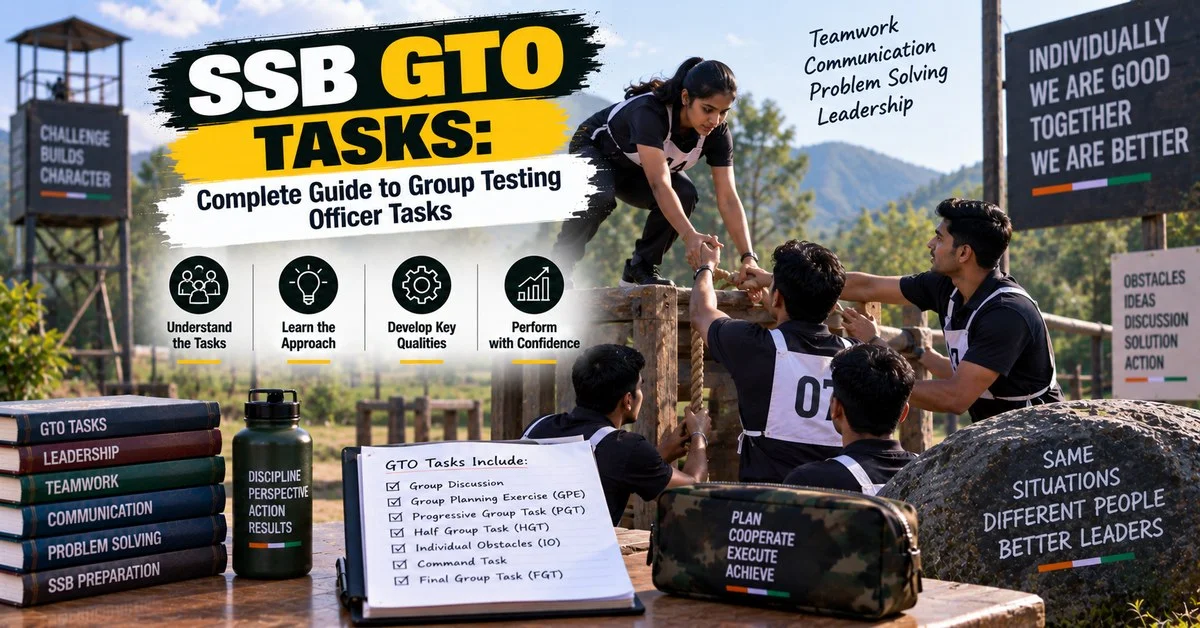
Learn about all nine SSB GTO tasks, including Group Discussion, GPE, PGT, HGT, Individual Obstacles, Command Task, Snake Race, Lecturette, and GTO Interview, along with OLQs, evaluation methods, common mistakes, and preparation tips
Most SSB aspirants know the GTO round exists. Very few understand what the Group Testing Officer is actually watching for. This guide covers every one of the SSB GTO tasks in sequence, explains the OLQ framework assessors use, and gives you preparation strategies grounded in how evaluation actually works, not how it is popularly described. That distinction matters a great deal when it comes to GTO tasks in SSB interview.
What Is the GTO Round in SSB and Why Does It Matter
The SSB group testing officer round is a full-day outdoor and group activity stage of the SSB interview, designed to assess Officer Like Qualities through practical, real-time tasks rather than written tests or interviews. Unlike the psychology or interview stages, the GTO round places candidates inside live group dynamics where behaviour cannot be rehearsed or sustained as a performance over time. The same principle applies to the SSB group testing officer round at every centre.
According to SSBCrack's complete breakdown of GTO tasks, the round typically spans two consecutive days and involves nine distinct tasks, each designed to surface a different facet of leadership and personality. The GTO round carries significant weight in the final SSB recommendation criteria because it gives assessors behavioural data that the interview and written stages simply cannot replicate. Keep that in mind throughout your SSB GTO preparation tips and planning.
Complete List of SSB GTO Tasks (All 9 Tasks Explained)
The nine outdoor group tasks in the SSB interview, covered in detail by Sainik School Blogs, are structured to alternate between group and individual formats. Do not overlook this when thinking about progressive group task SSB requirements.
-
Group Discussion (GD): Two rounds of unstructured discussion on given topics. Candidates speak without a chairperson.
-
Group Planning Exercise (GPE): The group receives a scenario with multiple problems and must produce a collective plan within a set time.
-
Progressive Group Task (PGT): An outdoor obstacle task completed as a full group, with increasing difficulty across four structures.
-
Half Group Task (HGT): The same obstacle format but with the group split in two, increasing individual visibility.
-
Individual Obstacles Course: Ten obstacles attempted solo, each carrying different point values based on difficulty.
-
Command Task: Each candidate acts as commander, selects two or three subordinates, and completes a specific obstacle under GTO observation.
-
Snake Race (Final Group Task): The full group races to complete a final obstacle course while carrying a rope stretched between them.
-
Lecturette: A three-minute individual talk on a topic chosen from a set of four cards.
-
Individual Interview by GTO: A brief informal discussion held at the end of the round.
How the Group Testing Officer Evaluates Candidates: OLQ Framework
The assessor observation methodology used in the GTO round does not score task completion. The Group Testing Officer maps every observable action to one or more of the 15 Officer Like Qualities SSB uses as its evaluation standard. The same holds true for snake race SSB as it does for every other task.
Four OLQs appear most consistently across tasks: effective intelligence, organisational ability, power of expression, and social adaptability. The GTO is trained to watch micro-behaviours, how a candidate reacts when a plan fails, whether they pull others into a solution or wait to be led, and how they communicate under pressure.
As detailed on SSBCrack's evaluation methodology guide, the GTO takes continuous notes throughout each task rather than forming a single end-of-day impression. This makes early-task behaviour just as important as performance in the command task SSB candidates usually fixate on.
Individual Tasks vs. Group Tasks in SSB GTO: Key Differences in Scoring
In individual tasks such as the individual obstacles course and command task SSB, the GTO isolates a candidate's personal initiative, risk tolerance, and decision-making under time pressure. There is no group to lean on and no consensus to hide behind.
In group tasks, the GTO tracks influence dynamics. He notes who generates ideas, who builds on others' suggestions, who withdraws when challenged, and who dominates in ways that damage the group. Leadership under pressure is easier to observe in group settings because the social stakes are higher and behaviour is less guarded.
The scoring logic differs accordingly. Individual task scores reflect personal OLQ expression. Group task scores reflect relational OLQs, particularly social adaptability and the ability to move a group toward a goal without formal authority. Both categories feed into the overall SSB recommendation criteria.
OLQ-to-Task Mapping: What Each GTO Task Is Really Testing
Most Common Mistakes Candidates Make in SSB GTO Tasks
The mistakes that cost candidates a recommendation are almost always behavioural, not physical. Dominating the group discussion SSB stage by speaking over others signals poor social adaptability, not confidence. Staying completely silent to avoid saying something wrong is equally damaging because it registers as low power of expression.
In outdoor group tasks, many candidates ignore the helping rules that govern progressive group task SSB structures. Each structure has defined helping zones, and breaking these rules disqualifies an attempt entirely. Poor time management in the group planning exercise is another frequent failure point, with candidates spending too long debating the problem and producing a rushed or incomplete plan.
Artificial leadership display, performing enthusiasm for the GTO rather than genuinely engaging the group, is immediately identifiable to a trained assessor. The GTO observes dozens of candidates across multiple SSB interview stages and recognises performed behaviour within minutes.
How to Prepare for SSB GTO Tasks: Task-Specific Tips
SSB GTO preparation tips need to be task-specific to be useful. For the group discussion, practice speaking for two minutes on unfamiliar topics daily. The goal is fluent idea-expression under social pressure, not memorising opinions.
For the individual obstacles course, begin physical conditioning at least eight weeks before your SSB date, targeting upper body strength and grip endurance. For the command task, practise a three-step framework: assess the obstacle, brief your team clearly, execute with adjustments. Thinking aloud during practice builds the habit of visible planning that assessors need to observe.
For the progressive group task and half group task, join or organise outdoor problem-solving activities with peers. Carrying awkward loads, navigating timed challenges, and making group decisions under mild stress builds the natural confidence the GTO is looking for. Review Defence Study's GTO preparation guide for additional drill formats.
FAQs
What are all the SSB GTO tasks and how are candidates evaluated on each one?
There are nine GTO tasks in SSB interview: Group Discussion, Group Planning Exercise, Progressive Group Task, Half Group Task, Individual Obstacles, Command Task, Snake Race, Lecturette, and the GTO Interview. Each is evaluated by mapping observable behaviour to the 15 Officer Like Qualities SSB uses as its standard.
How does the Group Testing Officer assess Officer Like Qualities during outdoor tasks?
The GTO takes continuous notes throughout each task, focusing on how a candidate behaves under pressure rather than whether the group succeeds. OLQs such as organisational ability and social adaptability are inferred from repeated micro-behaviours across the full day.
What is the difference between individual and group tasks in the SSB GTO round?
Individual tasks isolate personal initiative and decision-making. Group tasks reveal relational qualities: influence, cooperation, and leadership under pressure. Both contribute separately to the final evaluation, so neither can be ignored in preparation.
What are the most common mistakes that lead to rejection in the GTO round?
The most damaging mistakes are dominating group discussions, staying silent, breaking helping rules in obstacle tasks, poor time management in the group planning exercise, and displaying artificial leadership. Each mistake directly reduces the OLQ scores the GTO records.
How can I improve my leadership and teamwork performance during SSB GTO tasks?
Practice timed group discussions, build physical fitness for outdoor tasks, and rehearse the command task briefing structure. Genuine engagement with group goals always scores higher than performed enthusiasm. Consistency across all nine tasks matters more than peak performance in any single one.
Is the Command Task the most important GTO task for recommendation?
The command task SSB carries high visibility because the candidate leads alone, but it is not weighted above all others. The GTO forms his assessment across the full round. Strong performance in group tasks and consistent OLQ expression throughout both days are equally important for a recommendation.
For further reading, see GTO Tasks in SSB Interview, Complete List & Explanation.