SSB GTO Group Discussion: Topics, Rules and Preparation Tips
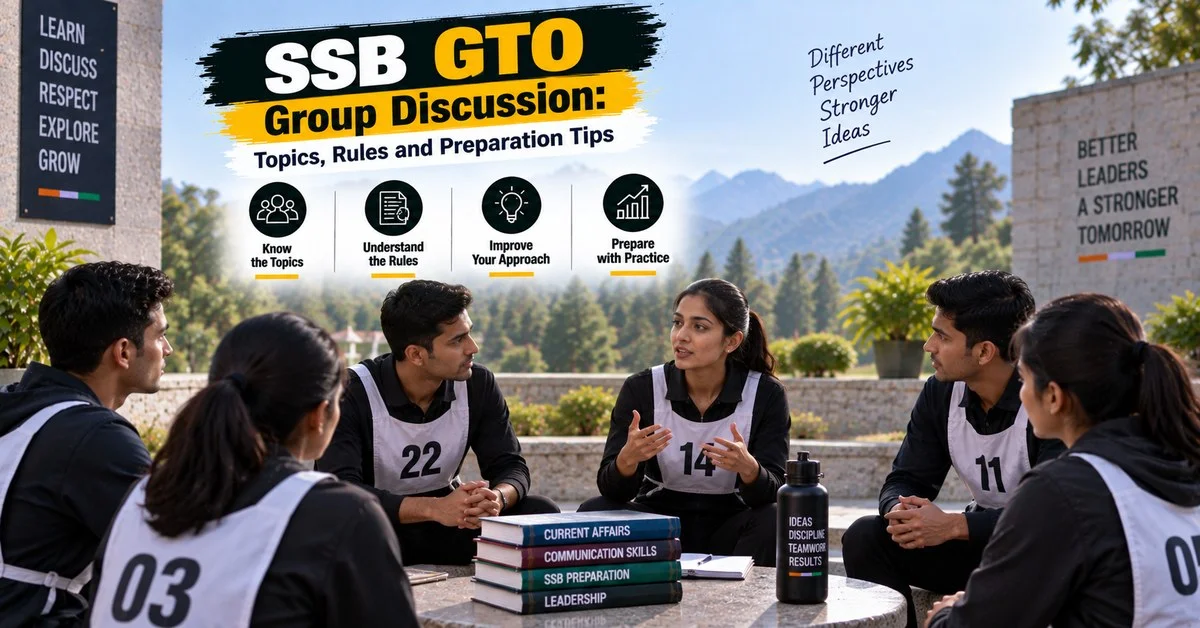
Preparing for the SSB GTO Group Discussion? Learn how the discussion works, what topics you may encounter, practical GD rules, common mistakes, and preparation tips to speak clearly and contribute effectively
Not sure what actually happens in an SSB GTO Group Discussion? Many candidates make the mistake of treating it like a college debate where the loudest person wins.
The SSB GTO Group Discussion is different. Your job is to put forward relevant points, understand other views, respond logically and keep contributing without trying to control the entire discussion.
This guide covers the SSB GD format, common topic areas, practical discussion rules, mistakes beginners make and a preparation method you can actually use.
What Is Group Discussion in SSB?
The SSB Group Discussion is part of the Group Testing Officer (GTO) tasks conducted during Stage II of the SSB selection process. The official UPSC description confirms that Stage II includes the Interview, Group Testing Officer Tasks, Psychology Tests and Conference. It also states that the Interviewing Officer, GTO and Psychologist assess a candidate holistically across the tests.
A GD gives candidates a common topic and asks them to discuss it as a group. The focus is not simply on whether your opinion is correct. Your contribution shows how you think, communicate, respond to different opinions and function within a group.
That is why a candidate who speaks continuously is not automatically performing well.
A useful way to look at the SSB GD is:
Think → Listen → Contribute → Respond → Build
You need all five.
The official SSB framework refers to Officer Like Qualities and says the different assessment techniques are designed to bring out their presence or absence and the candidate's trainability.
What makes an SSB GD different from a normal debate?
In a debate, you may be trying to prove that your side is stronger.
In an SSB GD, the interaction matters just as much as your individual argument.
For example, suppose the topic is:
“Should Artificial Intelligence replace humans in some jobs?”
A weak approach is:
“AI will definitely take all jobs. Humans will become useless.”
A better contribution would be:
“AI may reduce the need for people in some repetitive jobs, but it can also create new roles. The bigger issue is whether education and reskilling can keep pace with the change.”
The second response gives the group something to work with. It also leaves room for another candidate to agree, disagree or add another angle.
That is the kind of contribution you should practise.
What Happens in SSB GTO Group Discussion?
The exact conduct of GTO activities can vary by board and the official UPSC notification does not publish every operational detail of the GD. Some preparation sources describe two GDs, with differences in how topics are provided. SSB Practice and New Careers Academy both describe a two-discussion format, but this should be treated as preparation guidance rather than an official UPSC rule.
In practical terms, you should be prepared for the following:
1. You receive a discussion topic
The topic can be related to current affairs, defence, national issues, social issues, technology, economy or even an abstract subject.
The important part is not memorising hundreds of topics.
It is learning how to build a point when the topic is unfamiliar.
2. Candidates discuss the topic together
There is no need to wait for someone to formally invite you to speak.
At the same time, jumping into every sentence is not participation. It creates noise.
Your objective is to enter the discussion when you have something relevant to add.
3. Different opinions will come up
This is where many candidates lose control.
Someone may completely disagree with you. Someone may interrupt you. Someone may introduce an argument you had not considered.
Do not turn that into a personal fight.
Instead of:
“You are completely wrong.”
Try:
“I look at this differently because…”
Then explain your reasoning.
4. The discussion continues as a group activity
You should listen while others speak and connect your points with what has already been said.
For example:
“Adding to Rahul's point about employment, there is another side to this…”
That is more useful than restarting the entire topic every time you speak.
What Topics Are Asked in SSB Group Discussion?
There is no reliable official list of fixed SSB GD topics. Preparation sources commonly divide SSB GD topics into broad areas such as current affairs, defence and national security, social issues, economy, science and technology, international affairs and abstract themes.
Instead of memorising a random list, prepare by topic buckets.
1. Defence and National Security
Examples include:
-
Defence modernisation
-
Defence manufacturing in India
-
Cyber warfare
-
Border security
-
Drones and modern warfare
-
Artificial Intelligence in defence
-
Women in the armed forces
-
Agnipath
-
India's role in the Indo-Pacific
-
Jointness and integration of the armed forces
For defence topics, don't limit yourself to slogans.
Know the basic issue, its advantages, concerns and possible solutions.
2. Current Affairs and National Issues
Possible areas include:
-
India's economic growth
-
Employment
-
Education reforms
-
Urbanisation
-
Digital technology
-
Social media
-
Population-related challenges
-
Government policies
-
India's development goals
For a current-affairs topic, prepare the issue → causes → impact → possible way forward structure.
3. International Relations
You may encounter subjects connected with:
-
India-China relations
-
India-US relations
-
India's neighbourhood
-
Russia-Ukraine conflict
-
Indo-Pacific
-
BRICS
-
United Nations
-
Globalisation
-
Energy security
Don't try to turn an international topic into a political speech.
Understand India's interests, the major issues involved and the possible consequences.
4. Social Issues
Common practice areas include:
-
Women empowerment
-
Education
-
Youth and social media
-
Drug abuse
-
Mental health awareness
-
Online education
-
Gender equality
-
Rural and urban development
-
Role of youth in nation building
These topics require balance.
If you only give one-sided arguments, your discussion becomes predictable.
5. Science, Technology and Environment
Prepare topics such as:
-
Artificial Intelligence and employment
-
Data privacy
-
Cybersecurity
-
Electric vehicles
-
Renewable energy
-
Space technology
-
Climate change
-
Technology and education
The trick here is to understand both the opportunity and the risk.
6. Abstract Topics
Not every discussion needs a newspaper-style answer.
Practise themes such as:
-
Discipline vs freedom
-
Money vs values
-
Knowledge vs wisdom
-
Success vs satisfaction
-
Rules vs freedom
-
Individual interest vs national interest
For abstract topics, don't panic because there are no obvious statistics.
Define the idea first.
Then give an example.
Then connect it to the larger issue.
What Are the Rules of SSB Group Discussion?
There is no single publicly available UPSC document that lists every GD behaviour as a formal rulebook. So treat these as practical rules for participating effectively, not as official written scoring rules.
Rule 1: Speak about the topic
This sounds obvious, but it is one of the easiest mistakes to make.
If the topic is unemployment, don't spend five minutes discussing your personal career plans.
Keep bringing your argument back to the question.
Rule 2: Listen before responding
A GD is not a collection of individual speeches.
Listen for:
-
What has already been said
-
What point is missing
-
Where you agree
-
Where you disagree
-
Where you can add an example
This makes your next contribution stronger.
Rule 3: Disagree with ideas, not people
You are allowed to disagree.
In fact, blindly agreeing with everyone can make your participation look artificial.
Use phrases such as:
-
“I see another side to this.”
-
“I agree with the first part, but…”
-
“There is one concern with that argument.”
-
“I would look at this from a different angle.”
Then give your reason.
Rule 4: Don't turn the GD into a shouting match
When the group becomes loud, your instinct may be to speak even louder.
Don't.
Wait for a reasonable opening and make a concise point.
If you keep shouting over others, your content can get lost in the noise.
Rule 5: Don't wait for perfect English
A candidate with simple, clear English can make a better contribution than someone using complicated vocabulary without substance.
Focus on:
Clear thought + simple words + relevant example
Not fancy vocabulary.
Rule 6: Don't invent facts
This is especially important for defence and current-affairs topics.
If you remember that India signed an agreement but cannot remember the exact year, don't invent a year.
You can say:
“A recent development in this area shows…”
Or simply make the argument without attaching a questionable statistic.
Wrong confidence is worse than limited information.
SSB GD Tips for Beginners
If this is your first SSB, don't try to become the loudest candidate in the group.
Build these habits instead.
1. Prepare a 30-second opening
When you know the topic, don't begin with a memorised speech.
Start with a simple definition or frame.
For example:
Topic: Social media and youth
“Social media has changed how young people communicate, learn and consume information. Its impact depends largely on how it is used. It can provide access to information and opportunities, but excessive use can also affect attention and social behaviour.”
Now the discussion has somewhere to go.
2. Use the PREP structure
When you don't know what to say, use:
P — Point
State your argument.
R — Reason
Explain why.
E — Example
Give a relevant example.
P — Point
Connect the example back to your argument.
Example:
Point: AI can create new employment opportunities.
Reason: New technology requires people to develop, manage and regulate it.
Example: AI-related roles have expanded across software, data, cybersecurity and business operations.
Point: So the bigger challenge may be skill adaptation rather than technology alone.
Simple. Structured. Easy to follow.
3. Aim for useful contributions, not maximum speaking time
There is no official UPSC rule saying you must speak a particular number of times.
So don't chase a number.
Ask yourself after every contribution:
“Did I add something?”
If yes, it was useful.
If you simply repeated the previous speaker, it wasn't.
4. Build on another candidate's point
Suppose someone says:
“Technology can improve education in rural areas.”
You could say:
“I agree with that point. But access to technology alone may not solve the problem. Internet connectivity, teacher training and digital literacy also matter.”
You have acknowledged the other candidate while adding a new dimension.
That's much better than:
“Yes, exactly. I agree.”
5. Learn how to enter an ongoing discussion
This is one of the most useful SSB GD skills.
Don't wait for complete silence. GDs rarely become perfectly quiet.
Listen for a pause and enter with:
“Adding to that point…”
or
“There is another aspect we should consider…”
or
“I agree with the concern, but I think the discussion should also consider…”
Then make your point.
Common Mistakes in SSB Group Discussion
Speaking too much
Speaking for five minutes does not automatically make your contribution valuable.
If you repeat the same argument in different words, stop.
Staying silent throughout
Some candidates think they should speak only when they have a perfect answer.
That can backfire.
If you have a relevant point, enter the discussion.
Interrupting everyone
There is a difference between entering a discussion and cutting people off.
Repeated interruptions make it difficult for the group to develop a meaningful conversation.
Memorising prepared speeches
This is particularly risky for current-affairs topics.
You may prepare a perfect answer about AI, but the actual topic could ask about AI and employment, AI in defence or AI regulation.
Understand the subject instead of memorising paragraphs.
Using random statistics
One accurate example can strengthen your point.
Five questionable statistics can damage it.
If you aren't sure about a number, leave it out.
Becoming aggressive
Statements like:
“You don't understand the topic.”
or
“That's completely stupid.”
do not make your argument stronger.
Attack the argument, not the candidate.
Trying to become the group leader
Leadership does not mean controlling every sentence.
A better approach is to help the discussion move.
If the group is stuck, introduce a new angle.
If everyone is repeating the same point, summarise what has been discussed.
If the discussion is drifting, bring it back to the topic.
That's more useful than simply speaking more.
How to Prepare for SSB Group Discussion
Don't prepare for SSB GD by memorising a list of 100 topics.
Build a system.
Step 1: Follow current affairs every day
Focus on:
-
Defence and national security
-
Indian economy
-
International relations
-
Government policies
-
Science and technology
-
Social issues
-
Environment
-
Major national developments
You don't need to read everything.
You need enough context to form a sensible opinion.
Step 2: Use the 4-question method
For every major issue, ask:
What is happening?
Why is it happening?
What are the positive and negative effects?
What can be done next?
For example, while preparing AI and employment, don't stop at “AI will take jobs.”
Think about:
-
Which jobs are most affected?
-
Which new jobs can appear?
-
What happens to workers without digital skills?
-
What role should education play?
-
How should businesses adapt?
Now you have several directions for a GD.
Step 3: Practise speaking without notes
Pick one topic.
Give yourself 30 seconds to think.
Then speak for 60–90 seconds.
Record yourself.
Check:
-
Did I answer the topic?
-
Did I repeat myself?
-
Was my point clear?
-
Did I give an example?
-
Did I speak too fast?
-
Did I use unnecessary filler words?
This is much more useful than silently reading GD tips.
Step 4: Practise with people
A real GD feels different from speaking alone.
Ask 4–6 friends or fellow aspirants to sit together and discuss one topic.
Don't just practise your speech.
Practise interruption, disagreement, changing your point and responding to someone else's argument.
Step 5: Practise unfamiliar topics
This is where preparation becomes useful.
Ask someone to give you a topic you haven't prepared.
Take 30 seconds.
Then speak.
The goal is not to produce a perfect answer.
The goal is to show that you can think.
A Better Way to Practise SSB GD Topics
Instead of making a huge list and memorising answers, create a topic matrix.
This gives you multiple arguments from one topic.
And that is the real purpose of SSB GD preparation.
You are preparing your thinking, not memorising a speech.
SSB GD Topics for Practice
Here are some useful areas to practise:
Defence
-
Artificial Intelligence in modern warfare
-
Drones and the future of warfare
-
Cyber warfare
-
Defence indigenisation
-
Border security
-
Defence modernisation
-
Women in the armed forces
-
Agnipath and its implications
-
India's role in the Indo-Pacific
-
Defence technology and national security
National Issues
-
Education reforms
-
Unemployment
-
India's development goals
-
Urbanisation
-
Population growth
-
Digital India
-
Social media and democracy
-
Rural vs urban development
-
Youth and nation building
Economy
-
Startups and employment
-
Cashless economy
-
Gig economy
-
Make in India
-
Foreign investment
-
Privatisation
-
GST and small businesses
Science and Technology
-
AI and employment
-
Data privacy
-
Electric vehicles
-
Space exploration
-
Renewable energy
-
Technology in education
-
Cybersecurity
Social Issues
-
Women empowerment
-
Mental health awareness
-
Drug abuse among youth
-
Online education
-
Cinema and youth
-
Joint vs nuclear family
-
Technology and social interaction
Abstract Topics
-
Discipline vs freedom
-
Money vs values
-
Knowledge vs wisdom
-
Success vs satisfaction
-
Individual interest vs national interest
-
Are leaders born or made?
-
Rules vs freedom
These categories are consistent with the topic areas covered by the reference sources, but they are practice areas, not an official UPSC list of expected questions.
What Should You Do If You Don't Know the GD Topic?
This is a situation you should actively practise.
First, don't panic.
You don't need specialist knowledge to contribute to every discussion.
Use the topic itself.
Ask:
What does this issue mean?
Who is affected?
What are the possible benefits?
What are the risks?
What could be a practical solution?
For example, suppose you get an unfamiliar topic about a new technology.
You can still discuss:
-
Its purpose
-
Potential benefits
-
Possible risks
-
Impact on people
-
Impact on national interests
-
Need for regulation
-
Future challenges
Don't manufacture facts just to sound knowledgeable.
Logical reasoning based on the information available to you is better than a fake statistic.
The 60-Second SSB GD Test
Before your SSB, try this exercise.
Pick any topic.
You get 60 seconds to prepare.
Then answer:
1. What is the issue?
2. What are the two major sides?
3. What is my position?
4. What example can I give?
5. What practical solution can I suggest?
If you can do this consistently, you will be much less dependent on memorised SSB GD answers.
Final Tips for SSB GTO Group Discussion
Remember these points when you enter the GTO ground:
-
Speak when you have a relevant point.
-
Don't wait for perfect English.
-
Listen to the group.
-
Disagree respectfully.
-
Add examples instead of repeating points.
-
Avoid fake statistics.
-
Don't dominate the discussion.
-
Don't disappear into silence.
-
Build on useful points made by others.
-
Keep your argument connected to the topic.
-
Practise unfamiliar topics, not just prepared ones.
-
Focus on the quality of your contribution.
The aim of SSB GTO Group Discussion preparation is not to create a candidate who can speak the most. It is to build a candidate who can think clearly, communicate that thinking and remain useful to the group even when the discussion becomes difficult.