SSB Group Planning Exercise: Format, Example and Preparation Tips
The SSB Group Planning Exercise tests how you analyse multiple problems, prioritise them, use available resources and build a practical group plan. Learn the GPE format with an example and preparation tips.
A Group Planning Exercise can look confusing at first. You get a situation, a map or model, several problems and limited resources. The challenge is deciding what needs attention first and how the group can handle everything logically.
The SSB Group Planning Exercise is a planning-based GTO task. Candidates study the situation, work out an individual solution, discuss their ideas with the group and work towards a common plan. Preparation sources describe the task around problem identification, prioritisation, resource use, time-distance planning and group consensus.
This guide explains the SSB GPE format, how to approach the situation step by step, how an individual plan differs from a group plan, and how to practise with a sample GPE situation.
What Is Group Planning Exercise in SSB?
The Group Planning Exercise (GPE) is a GTO task in the SSB where candidates are given a situation involving multiple problems that need to be handled within the available time and resources.
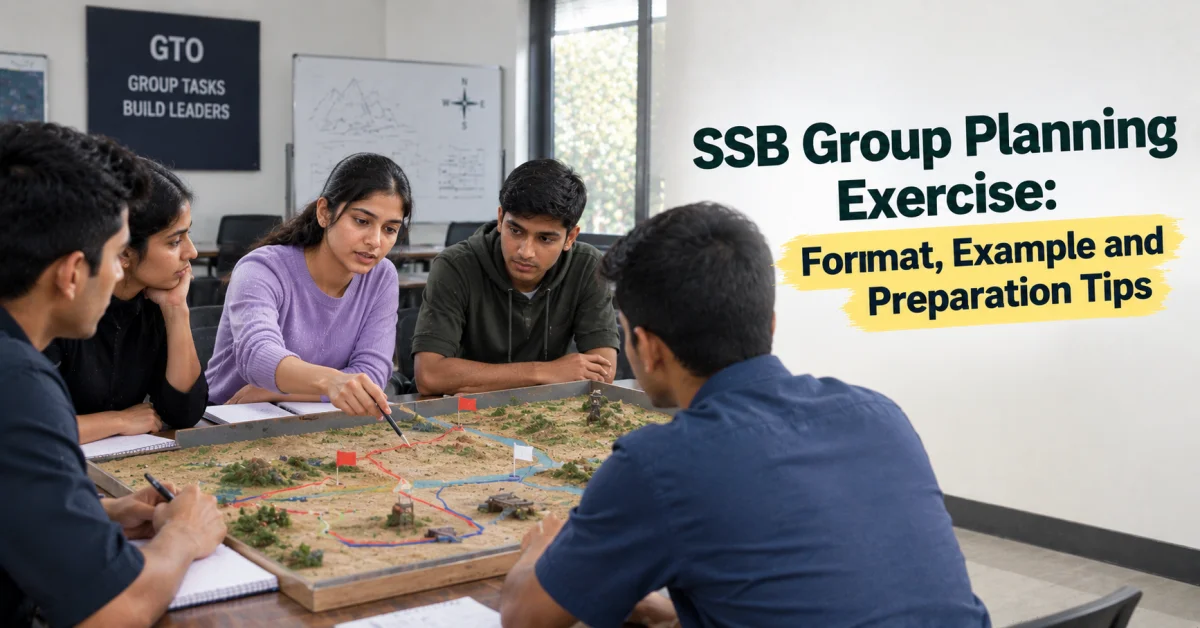
The situation is generally presented around a map or model. Candidates have to understand the locations, routes, distances and resources before deciding how to deal with the problems. Preparation sources describe a process in which candidates first develop their own solution and then discuss it with the group to arrive at a common plan.
The important part is that there is rarely just one thing to solve.
You may have a situation where one problem involves immediate danger to people, another is time-sensitive, and another needs attention but can wait. Your job is to decide the order of action instead of treating every problem equally.
A useful way to think about GPE is:
Identify → Prioritise → Allocate → Plan → Discuss → Adapt
The official UPSC description places Group Testing Officer tasks within Stage II of the SSB selection process. It also states that the Interviewing Officer, GTO and Psychologist assess candidates holistically across the tests rather than assigning separate weightage to individual tests.
What is the purpose of SSB GPE?
A GPE situation requires you to make decisions using the information available to you.
That means you have to think about:
-
Which problem is most urgent?
-
Which problems can be handled at the same time?
-
What resources are available?
-
How much time is available?
-
Which route is practical?
-
How should the group be divided?
-
Can the plan actually be completed?
So, don't approach GPE as a memory-based task. You are not expected to memorise a fixed answer.
You need to understand the situation and build a plan from it.
SSB Group Planning Exercise Format
The exact operational details of GPE are described differently across preparation sources, so candidates should avoid treating one coaching source's timings as a universal official rule.
The broad SSB GPE format is consistent across the sources reviewed: understand the map and situation, prepare an individual solution, discuss solutions with the group and arrive at a common plan.
1. Study the Map or Model
The first step is to understand the information provided.
Look at:
-
Starting point
-
Villages, towns or other locations
-
Roads and routes
-
Rivers or railway lines
-
Distances
-
Available transport
-
Other resources mentioned in the situation
Don't start planning before you understand where things are.
A small mistake in location can affect your entire solution.
2. Listen to the Situation Carefully
The situation is where the actual problems and constraints are introduced.
You may be told about several incidents happening at different locations and times. There may also be people, vehicles or other resources available to you.
Make mental notes of:
Problem + Location + Time + Resource + Constraint
For example:
The point is not to copy this exact format in the SSB. It is a way to organise information while practising.
3. Prepare Your Individual Solution
After understanding the situation, work out your own plan.
Your solution should answer:
-
What will be done first?
-
Who will do it?
-
What resource will be used?
-
How will they reach the location?
-
How much time will it take?
-
What happens next?
The individual solution is important because you should have your own reasoning before entering the group discussion.
4. Discuss the Plans as a Group
The group then discusses different approaches.
This is not simply about proving that your plan is better.
Listen to what others have identified. Someone may notice a route, resource or time constraint that you missed.
At the same time, if you see a problem with another plan, explain it with reasoning.
For example:
“That option may work, but if we send everyone there first, we may not have enough time to handle the second problem.”
That's more useful than simply saying:
“Your plan is wrong.”
5. Build the Common Group Plan
The purpose of the discussion is to arrive at one workable plan.
The final plan should bring together the strongest practical ideas from the discussion.
The Cavalier describes the process as candidates studying a model or map with multiple problems, writing their own solution, discussing it in the group and presenting a common plan.
How to Solve SSB GPE Step by Step
The easiest way to approach an SSB GPE is to stop looking at the entire story as one giant problem.
Break it down.
Step 1: Identify Every Problem
Write or mentally list every issue mentioned in the situation.
For example:
-
Person needs immediate help.
-
A major incident may happen at a fixed time.
-
Another location has a security threat.
-
A minor problem also needs assistance.
Do not start solving yet.
First make sure you haven't missed anything.
Step 2: Prioritise the Problems
Now ask:
What happens if we don't act immediately?
A useful practice framework is:
Immediate threat to life → Major time-sensitive threat → Important problem → Minor problem
This is not an official scoring formula. It is a practical way to organise a complex GPE situation.
For example, in one published sample, the solution places a drowning couple ahead of an injured person, a possible train attack, an idol theft and a drifting boat, based on the urgency and consequences described in that particular situation.
The key lesson is not to memorise that order.
Understand why the priority was assigned.
Step 3: Check the Available Resources
Now look at what you actually have.
Resources may include:
-
Group members
-
Vehicles
-
Boats
-
Local assistance
-
Communication facilities
-
Public transport
-
Other resources explicitly mentioned in the situation
Do not build your plan around a resource that the situation has not provided.
Your plan should work with the information given.
Step 4: Divide the Work
Ask whether different problems can be handled simultaneously.
Suppose there are 10 members and four problems.
Sending all 10 people to solve the first problem may leave the other three unattended.
A better approach may be to divide the group according to the urgency, manpower required and nature of each task.
One published GPE example divides 10 students across four tasks, assigning different numbers of members according to the problem.
But don't blindly divide the group into equal numbers.
Ask:
How many people are actually needed for this task?
Step 5: Consider Time and Distance
This is where many otherwise good plans fail.
Suppose a problem is 10 km away.
You cannot simply write:
“We will reach there immediately.”
Think about:
-
Starting location
-
Route
-
Transport
-
Speed
-
Distance
-
Time available
-
Return or onward movement
The Cavalier specifically highlights time-distance calculations as part of practical GPE planning.
Step 6: Create the Sequence
Now put everything together.
Your plan should have a clear order:
First action → Second action → Third action → Final action
If two tasks can happen simultaneously, show that through sensible group division.
Step 7: Check the Plan
Before you finalise your individual solution, ask:
-
Did I address every major problem?
-
Did I prioritise the urgent issues?
-
Did I use only available resources?
-
Does the time calculation make sense?
-
Is the route practical?
-
Can the group realistically execute this plan?
If the answer to these questions is yes, your plan is much more likely to be internally consistent.
SSB GPE Example With Solution
Let's use a fresh practice situation to understand the planning method.
Sample GPE Situation
Your group of students is travelling from Town A to Town D for a college event.
At 3:00 PM, while passing through Village B, you receive the following information:
-
A school bus has met with an accident near Village C and several passengers need help.
-
A bridge near Town D has been damaged and the road may become unusable after heavy rain.
-
A suspicious group has been seen near a railway crossing, and a passenger train is expected to pass through the area at 4:00 PM.
-
A farmer near Village B has requested help because a fire has started near his storage area.
-
Your group has one vehicle and access to local people for assistance.
Your task is to decide how the group should handle the situation.
Step 1: Identify the Problems
There are four major issues:
-
Accident and injured passengers
-
Railway-related security threat
-
Damaged bridge
-
Fire near the storage area
Step 2: Prioritise Them
A practical priority could be:
1. Accident and injured passengers
There is a direct threat to human life.
2. Railway security threat
The train has a stated movement time, so the issue is time-sensitive.
3. Fire
The fire can spread and cause further damage, so it needs attention.
4. Damaged bridge
The bridge is important for later movement, but based only on the information given, it does not present the same immediate threat to life as the accident.
Notice something important here.
The priority is based on the facts in the situation, not on a memorised GPE rule.
Step 3: Allocate the Group
Instead of sending the entire group to one location, divide the available manpower logically.
For example:
The actual division would depend on the number of candidates and resources given in the real situation.
Step 4: Use the Vehicle Carefully
The vehicle should be assigned where it provides the greatest practical advantage.
If the accident location is difficult to reach without transport and injured people need to be moved, the vehicle may be more useful there.
At the same time, the other teams can use available local assistance where appropriate.
This is the kind of resource-based thinking that makes a GPE solution practical.
Step 5: Build the Group Plan
A possible sequence would be:
First: Send the required members toward the accident location and arrange immediate assistance.
At the same time: Another team coordinates with the appropriate local authorities regarding the railway threat.
Next: The fire team works with available local help to control the fire.
Meanwhile: Another team checks the bridge and identifies whether an alternate route is required.
The important point is that the plan does not treat every problem as a separate event.
It looks at priority, manpower, resources and time together.
What Makes This a Good GPE Solution?
The strength of the plan is not that it sounds impressive.
It is that the plan:
-
Recognises the most urgent problem.
-
Uses different members for different tasks.
-
Considers the fixed time of the railway issue.
-
Uses resources where they are most useful.
-
Does not ignore the remaining problems.
-
Allows multiple actions to happen together where practical.
That's the thinking you should practise.
How to Make an Individual Plan in SSB GPE
Your individual plan does not need complicated language.
It needs clear logic.
Use this simple structure while practising:
Problem → Priority → Action → Resource → Route → Time → Next Action
For example:
Problem: Accident near Village C
Priority: Immediate
Action: Send a team to assist victims
Resource: Available vehicle/local help
Route: Direct route from current location
Time: Based on the distance provided
Next Action: Coordinate further movement after immediate assistance
The exact answer will change with every GPE situation.
That's why memorising model answers is not enough.
How to Participate in the SSB GPE Group Discussion
Once individual planning is complete, the group discussion becomes important.
Don't treat it like a competition where you have to force your solution through.
Instead, listen for three things:
What did I miss?
What did someone else solve better?
Is there a problem with the current group plan?
If Your Plan Is Different
Explain your reasoning.
For example:
“I placed this problem first because the situation gives us a fixed time for it. If we delay it, we may lose the available window.”
That's much stronger than:
“My plan is better.”
If Someone Has a Better Idea
Change your position when the new idea makes more sense.
You are not required to defend your first answer at all costs.
A good group plan can contain ideas from several individual solutions.
If the Discussion Becomes Loud
Don't try to win by shouting.
Wait for a gap and make a short, relevant contribution.
The goal is to move the planning forward.
What Qualities Matter in SSB GPE?
The official UPSC description says that the SSB's IO, GTO and Psychologist use their respective tests to assess the presence or absence of Officer Like Qualities and a candidate's trainability, with the assessment made holistically.
For GPE preparation, that means it is more useful to focus on the behaviours your plan actually demonstrates than to memorise a supposed list of “GPE marks.”
Your approach should show:
-
Logical thinking
-
Practical decision-making
-
Prioritisation
-
Resource awareness
-
Clear communication
-
Cooperation
-
Adaptability
-
Responsibility
These should come naturally through your planning and group interaction.
Common Mistakes in SSB GPE
1. Starting With the First Problem You Notice
A GPE can contain several problems.
Don't automatically solve the first one mentioned.
Read the complete situation first.
2. Ignoring Time
A plan that ignores the time mentioned in the situation is incomplete.
If an event is happening at a fixed time, it should influence your priority.
3. Forgetting Distance
You may have the right idea but an impossible route.
Always check how long movement will take.
4. Using Resources That Don't Exist
Don't casually add another vehicle, extra manpower or special equipment.
Work with the resources provided.
5. Sending Everyone to One Problem
Some situations allow multiple tasks to be handled at the same time.
Look for sensible group division.
6. Treating Your Individual Plan as Final
Your first plan is your starting point.
The group discussion may reveal a better route or priority.
7. Speaking Without Listening
A group plan cannot be built if everyone only repeats their own solution.
Listen and modify when necessary.
8. Trying to Sound Like a Hero
Avoid unrealistic solutions where one person somehow handles several dangerous tasks alone.
Practical planning matters more than dramatic action.
How to Prepare for SSB Group Planning Exercise
Good SSB GPE preparation is not about collecting hundreds of solved situations.
It is about building the ability to solve a new situation quickly.
1. Practise Map Reading
Get comfortable identifying:
-
Routes
-
Distances
-
Junctions
-
Villages
-
Rivers
-
Bridges
-
Railway lines
-
Important landmarks
You should be able to look at a map and understand movement without getting stuck on every detail.
2. Practise Time-Distance Problems
Take simple situations and calculate whether your plan is physically possible.
Ask:
Where are we now?
Where do we need to go?
How will we get there?
How long will it take?
What happens after reaching there?
3. Solve GPE Situations Without Looking at the Answer
This is one of the most important preparation methods.
Take a sample situation.
Set yourself a reasonable practice limit.
Then create your own:
-
Problem list
-
Priority order
-
Resource allocation
-
Timeline
-
Individual plan
Only after finishing should you compare your reasoning with a model solution.
4. Practise With Different Situations
Don't solve the same GPE repeatedly until you remember its answer.
Change the variables.
Try situations involving:
-
Rescue
-
Transport
-
Fire
-
Security threats
-
Medical emergencies
-
Natural obstacles
-
Time-sensitive events
-
Multiple locations
The aim is to practise decision-making.
5. Practise Group Discussion
Individual planning and group planning are not the same.
Sit with other aspirants and compare solutions.
Ask each person to explain:
Why did you make this problem your first priority?
That question forces you to understand the reasoning behind your plan.
6. Review Your Mistakes
After every practice situation, don't just check whether your final answer matches someone else's.
Review your process.
Ask:
-
Did I miss a problem?
-
Did I choose the right priority?
-
Did I use the resources correctly?
-
Did I account for distance?
-
Could tasks have been done simultaneously?
-
Was my timeline realistic?
-
Did I explain my reasoning clearly?
That's where real improvement happens.
SSB GPE Tips for Beginners
If you are preparing for your first Group Planning Exercise SSB, keep these points in mind:
-
Read the complete situation before making a plan.
-
Understand the map and locations.
-
Identify every problem.
-
Prioritise based on urgency and consequences.
-
Use only the resources provided.
-
Check time and distance.
-
Divide manpower logically.
-
Look for practical parallel actions.
-
Keep your individual plan simple.
-
Listen during group discussion.
-
Give reasons for your decisions.
-
Be willing to modify your plan.
-
Don't copy a memorised GPE solution.
-
Don't invent facts or resources.
-
Focus on a plan the group can actually execute.
A Simple SSB GPE Practice Framework
Whenever you practise an SSB GPE example, use this checklist:
1. Identify
What are all the problems?
2. Prioritise
Which problem needs attention first, and why?
3. Allocate
Who or what resource can handle each problem?
4. Calculate
Do the time and distance work?
5. Plan
What is the sequence of actions?
6. Discuss
What can you learn from other candidates' plans?
7. Adapt
Can the final group plan be made more practical?
This approach is more useful than memorising one “perfect” answer because every GPE situation can change its locations, resources, timings and problems.
Frequently Asked Questions
What is Group Planning Exercise in SSB?
The Group Planning Exercise is a GTO task in which candidates analyse a situation involving multiple problems, available resources and time constraints. They prepare an individual solution, discuss their ideas with the group and work towards a common plan.
How does Group Planning Exercise work in SSB?
Candidates study the information provided through a map or model and a situation, identify the problems, prepare their own plan and then discuss their solutions with the group. The group works towards a common solution that can be presented as the final plan.
What is the format of SSB GPE?
The commonly described format consists of understanding the map/model and situation, preparing an individual solution, discussing the solutions as a group and arriving at a common group plan. Exact timings and operational details can vary across preparation sources, so candidates should not treat unofficial timing breakdowns as fixed UPSC rules.
How should I prepare for SSB Group Planning Exercise?
Practise map reading, time-distance calculations, problem prioritisation, resource allocation and situation-based planning. Also practise group discussions so you can explain your reasoning and consider other candidates' solutions.
What should I do if another candidate has a better GPE solution?
Listen to the reasoning and accept a better idea when it solves the situation more effectively. The objective is to help build a workable group plan, not to defend your first individual solution.
Is SSB GPE mainly a maths task?
It can involve simple time-distance calculations, but practical judgement is also important. You need to understand the situation, prioritise problems, allocate resources and create a plan that can realistically be executed.
What is the most important thing to remember in SSB GPE?
Don't memorise solutions. Learn how to identify problems, prioritise them, use available resources and build a practical plan.
Final Tips for SSB Group Planning Exercise
The SSB Group Planning Exercise becomes easier when you stop looking for a ready-made answer.
Every situation can change.
The locations may change. The resources may change. The number of problems may change. The time constraints may change.
Your approach should stay the same:
Understand the situation → Identify the problems → Set priorities → Use resources → Check time and distance → Build your plan → Discuss → Adapt.
That is the skill you should practise before your SSB.