SSB Final Group Task: Procedure, Rules and Preparation Tips
The SSB Final Group Task tests initiative, cooperation, problem-solving, and physical endurance in a self-organising group. Learn the procedure, rules, GTO evaluation factors, common mistakes, and preparation tips.
Most aspirants spend weeks studying the SSB five-day procedure but barely give the Final Group Task a dedicated hour. That is a costly oversight. The SSB Final Group Task is the last collective activity the Group Testing Officer observes before your Conference, and it often forms the sharpest impression of who you are under minimal structure. There is no appointed leader, no sub-group split, and no one telling you which obstacle to attempt next. What the GTO sees in those minutes is you, operating on instinct and values. That's especially true when it comes to SSB GTO tasks procedure.
This guide gives you a complete, task-specific breakdown: what the FGT involves, how it differs from the Progressive Group Task and Half Group Task, the exact rules governing the obstacle field, how the assessor reads your behaviour, and what you can do today to prepare with or without access to an obstacle course. The same principle applies to FGT vs PGT vs HGT SSB.
What Is the SSB Final Group Task?
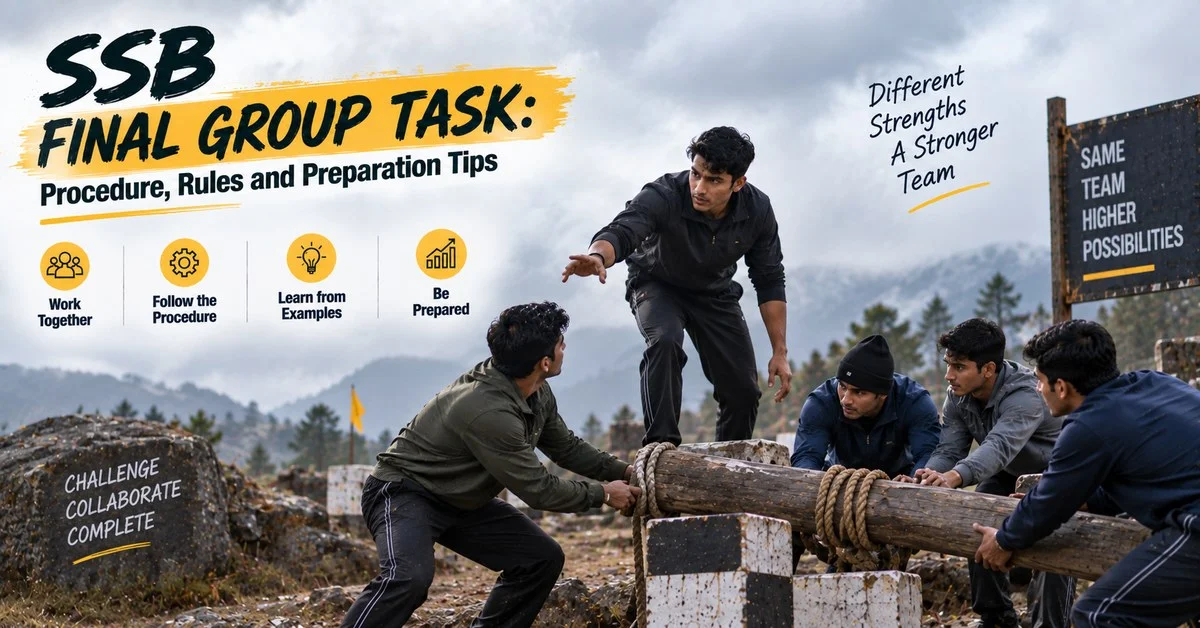
The SSB Final Group Task refers to the concluding obstacle activity in the GTO series, conducted after the Progressive Group Task, Half Group Task, Command Task, and Individual Obstacles. The entire group, typically 8 to 15 candidates, crosses the same obstacle field used earlier in the GTO series but now operates without any designated leader or sub-group division. It's a detail worth keeping in mind for SSB GTO rules.
According to SSBCrack's complete GTO guide, the FGT is designed to let the Group Testing Officer observe each candidate in a self-organising environment where formal structure has been removed. This is significant because it strips away the crutch of a role. In PGT, a semi-structured dynamic emerges naturally; in FGT, nothing is assigned. Don't overlook this when thinking about how to prepare for SSB Final Group Task at home.
The task carries particular weight because it is the final piece of group behaviour the assessor records before the Conference, where all board members meet to finalise each candidate's scores. A strong FGT can consolidate a borderline profile. A passive or chaotic FGT can undermine an otherwise consistent performance across other GTO activities. The same holds for OLQs tested in SSB GTO.
The FGT typically lasts around 20 minutes, and the Group Testing Officer observes from a fixed position, logging behaviours continuously rather than forming a single summary judgement. As Oliveboard's GTO task guide notes, this is not a timed race to complete every obstacle. It is a structured observation of how the group functions when left to itself. This matters just as much for SSB interview GTO tasks.
SSB GTO Task Series: PGT, HGT and FGT Compared
Understanding the FGT vs PGT vs HGT SSB distinction is essential before you can prepare intelligently. Each task in the GTO series serves a different diagnostic purpose, and the rules governing each one differ in ways that directly affect what you should prioritise. That's especially true when it comes to SSB interview GTO tasks.
The key differentiator is structure, or rather its absence. The Progressive Group Task uses sub-groups, which naturally creates smaller leadership opportunities. The Half Group Task halves the crowd, making it harder to hide. The FGT reunites everyone without any organising scaffold. The same principle applies to obstacle course rules.
In the FGT, the group must self-organise from the first second. No one is told to lead. No one is told which obstacle to approach. The group either coheres or it fragments, and the GTO records both outcomes with equal interest. This is why "final impression" is not a casual phrase: the FGT is your last chance to demonstrate Officer Like Qualities in a live group environment. It's a detail worth keeping in mind for SSB conference.
SSB Final Group Task Procedure: Step by Step
The SSB GTO tasks procedure for the FGT follows a clear sequence, though the internal dynamics are deliberately unscripted.
-
GTO Briefing: The Group Testing Officer gathers all candidates and explains the obstacle field rules. This briefing is identical in structure to what was given before PGT, covering out-of-bound zones, helping material restrictions, and physical conduct rules.
-
Obstacle Field Rules Explained: The GTO clarifies which structures are off-limits (marked in colour), which items can be used as helping material, and where candidates must not step or place equipment.
-
Group Self-Starts: Once the briefing ends, no further instruction is given. The group must decide which obstacle to attempt first. This moment, the first ten seconds, is among the most observed in the entire FGT.
-
Task Duration: The FGT runs for approximately 20 minutes. The group is expected to attempt as many obstacles as possible within that window.
-
GTO Observation Position: The assessor stands at a distance and does not intervene. The GTO uses a fixed observation methodology, tracking individual behaviours across multiple obstacles rather than rating a single performance moment.
Critically, candidates are never told which obstacle to attempt or in what order. The decision to propose an obstacle, to agree, to redirect the group, or to simply act and invite others to follow is entirely voluntary. The GTO observation methodology treats that voluntary behaviour as primary evidence of initiative and group cohesion under pressure.
Rules Candidates Must Follow in the Final Group Task
The SSB GTO rules governing the FGT are the same ones that apply across all group obstacle tasks, but understanding them in the context of an unsupervised, self-organising group matters more here than anywhere else.
-
Out-of-bound zones: Certain areas of the obstacle field are marked as out-of-bounds. Stepping into these zones constitutes a rule violation. Candidates must redirect the group without prompting from the GTO.
-
No touching coloured structures: Obstacles marked with specific colours (typically white or red, depending on the centre) represent boundaries or supports that cannot be contacted. Touching them means the attempt on that obstacle is invalid.
-
Helping material restrictions: Items provided as helping material (planks, ropes, barrels) can only be used in ways consistent with the briefing. They cannot be placed in out-of-bound zones or used to bypass the intended challenge of an obstacle.
-
One-at-a-time rules: Certain obstacles require candidates to cross individually. Jumping or crossing simultaneously when the rule prohibits it is noted by the GTO.
A critical point most aspirants miss: rule violations are not automatic disqualification events. The GTO uses violations as behavioural data. How a candidate responds when they realise a rule has been broken, whether they correct it, acknowledge it, or ignore it, is itself evidence of integrity and effective intelligence. The physical endurance assessment matters, but so does how you behave when things go wrong.
How the GTO Evaluates You in the Final Group Task
The OLQs tested in SSB GTO tasks are 15 in total across the full selection process, but the FGT concentrates the GTO's attention on four in particular: physical endurance, cooperation, initiative, and effective intelligence.
-
Physical endurance: The GTO notes whether a candidate attempts every obstacle or selectively avoids demanding ones. Refusing physically taxing obstacles signals low endurance. Attempting them, even unsuccessfully, signals commitment.
-
Cooperation: Assisting a slower or less physically capable peer at an obstacle without being asked is among the clearest cooperation signals in the FGT. It is visible, unambiguous, and logged immediately.
-
Initiative: Proposing the next obstacle without waiting for consensus, or stepping forward when the group stalls, demonstrates initiative. The GTO specifically watches who acts first when the group is uncertain.
-
Effective intelligence: When an obstacle attempt fails, adapting the approach, suggesting an alternative route, or calmly re-planning with the group demonstrates practical problem-solving rather than repetitive failure.
The GTO observation methodology in FGT differs from PGT in one key way: the assessor shifts from watching group dynamics broadly to tracking individual contributions specifically. In the words of experienced SSB observers documented by SSBCrack's assessment guide, the GTO watches who speaks less and does more in FGT compared to earlier tasks. Verbal dominance in PGT is common; quiet initiative in FGT is rare and valued.
Common Mistakes to Avoid in the SSB Final Group Task
The most frequent errors in the SSB Final Group Task share a common source: candidates carry PGT habits into a task that demands different behaviour.
-
Over-talking instead of acting: Candidates who spent PGT building verbal presence sometimes continue that strategy in FGT. The fix is to shift to action cues. Instead of explaining what to do, do it and signal others to follow with a gesture or a short phrase.
-
Ignoring struggling peers: In a self-organising group, the instinct to focus on your own obstacle performance is strong. But cooperative micro-moments, helping a peer cross a high structure, holding a plank steady, offering a hand, are precisely what the GTO is watching for in FGT.
-
Attempting only easy obstacles: Some candidates unconsciously gravitate toward obstacles they completed successfully in earlier GTO rounds. The FGT is the last opportunity to demonstrate physical commitment. Avoiding hard obstacles is noticed.
-
Trying to lead loudly: Announcing decisions, repeatedly calling out instructions, or positioning yourself visibly as the group's organiser backfires in FGT. Quiet initiative, making a sound decision and inviting the group through action rather than announcement, reads far better to the GTO than performed leadership.
Group cohesion under pressure is visible in small moments. The candidate who pauses to help someone before moving to the next obstacle, without any audience or prompting, is demonstrating exactly what the Officer Like Qualities framework is designed to identify.
How to Prepare for SSB Final Group Task: Tips and Home Drills
Knowing how to prepare for SSB Final Group Task at home is a practical concern for the majority of aspirants who do not have access to a purpose-built obstacle course. The good news is that the core competencies tested in FGT can be trained without a single plank or rope.
Academy training options: If you have access to an SSB coaching academy, use obstacle practice sessions to work on physical confidence at height and across varying structures. Timed group problem-solving drills, where the group must complete a task in under five minutes without a designated leader, replicate the FGT's self-organising dynamic accurately.