SSB Conference Round: What Happens, Who Decides & How to Prepare
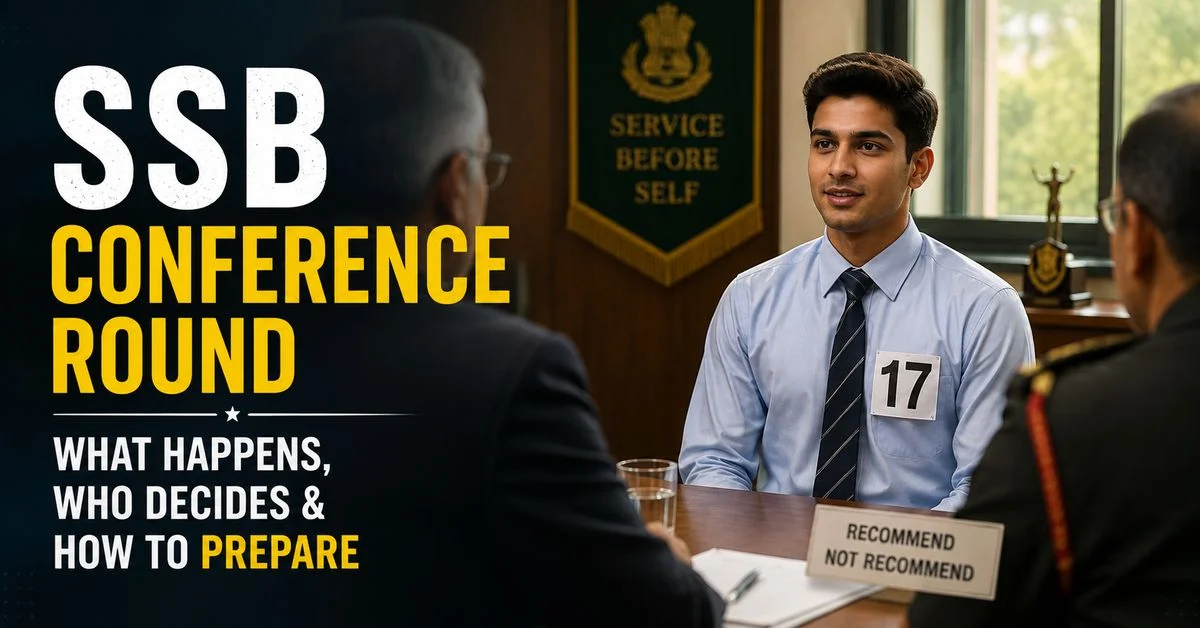
Learn what happens during the SSB Conference Round, who makes the final decision, what assessors evaluate, and how to prepare effectively.
Most candidates spend four intense days grinding through psychological tests, group tasks, and personal interviews, then walk into the SSB Conference Round with almost no idea what actually unfolds inside that room. The conference is not an extension of the interview. It is a structured board decision, and understanding its mechanics gives you a measurable edge over candidates who treat it as an afterthought. That is especially true when it comes to what happens in SSB conference round.
This article explains the full process, identifies who holds decision-making authority, and gives you concrete preparation steps grounded in how the Services Selection Board actually operates. The same principle applies to what happens in SSB conference round.
What Is the SSB Conference Round?
The SSB Conference Round is the final evaluation stage of the 5-day SSB process, conducted on Day 5. This is where all three assessors, the Interviewing Officer (IO), the Group Testing Officer (GTO), and the Psychologist, meet collectively to reach a final decision on every candidate's suitability for officer rank in the Indian Armed Forces. Keep that in mind when thinking about how to prepare for SSB conference.
Unlike the earlier stages where each assessor evaluates candidates independently, the conference brings them together in one room with a shared objective: cross-verify findings and arrive at a consensus recommendation. The process is not adversarial. It is a synthesis of four days of structured observation. That distinction matters when you are figuring out how to prepare for SSB conference.
Every candidate walks out with one of two outcomes: recommended or not recommended. A recommended candidate moves forward to a medical examination and eventually to a merit list. A candidate who is not recommended, commonly called "conference out SSB," ends their current attempt at that point. The same applies to SSB interview Day 5 overall.
Recognizing that this stage is about consistency, not performance under sudden pressure, changes how you approach it entirely. According to procedural guides published by SSBCrack and Centurion Defence Academy, the board is not looking for a final impressive moment. They are verifying that the person sitting in front of them matches the profile built across the previous four days. This matters equally for cross-verification of assessments.
Only around 4 to 5 percent of candidates who appear at an SSB center ultimately receive a recommendation, which shows exactly how rigorous the SSB selection process is at every stage, conference included.
Step-by-Step: What Happens Inside the Conference Room
SSB interview Day 5 begins with candidates assembled and waiting. The conference room holds the full assessment board, presided over by the President of the SSB. Assessors have already reviewed their individual records before the session starts.
The sequence inside the room follows a consistent pattern:
-
Each candidate is called in individually while the rest wait outside.
-
The board greets the candidate, who is asked to sit. This interaction typically lasts between 1 and 3 minutes.
-
The board may ask a single clarifying question or simply observe the candidate's composure under pressure during the brief interaction.
-
The candidate is then asked to leave, and the board deliberates on the recommendation.
-
Once all candidates have been processed, the final results are announced to the group.
Before any candidate enters, the board has already exchanged assessments. What happens in the SSB conference round, from the board's perspective, is essentially a cross-verification of the cumulative data gathered across psychology tests, GTO tasks, and the personal interview. The candidate's brief appearance serves as a final observational checkpoint, not a fresh interview.
Borderline candidates, those whose OLQ evidence is inconsistent or marginal, typically receive closer scrutiny during the board's internal discussion. Their time inside the room may prompt a more pointed clarifying question to help the board resolve ambiguity.
Who Decides Your Recommendation: The Three-Assessor Board Explained
The SSB board decision process involves three independent assessors, each responsible for a specific dimension of candidate evaluation. Their roles are clearly defined and carry equal weight in the final deliberation.
Interviewing Officer (IO): The IO conducts the personal interview, typically on Day 3 or Day 4, and assesses the candidate's personality, life history, intellectual clarity, and values. The IO's input to the conference covers whether the candidate's stated self-image aligns with observable behavior during the interview.
Group Testing Officer (GTO): The GTO observes group tasks, outdoor activities, and individual obstacles across multiple sessions. The GTO's conference input focuses on how the candidate functioned in group dynamics, and whether leadership and teamwork qualities were consistently visible across varied task settings.
Psychologist: The Psychologist assessment is based on written tests administered on Day 1 and Day 2, including the Thematic Apperception Test (TAT), Word Association Test (WAT), and Self Description Test (SDT). The Psychologist presents a personality profile derived from written responses.
The President of SSB, a senior officer, presides over the conference and holds final authority on the recommendation. The SSB final decision requires convergence, meaning the three assessors must collectively agree, or at least reach a majority position, that the candidate either demonstrates or fails to demonstrate sufficient Officer Like Qualities (OLQ).
Board convergence is the operative concept here. If all three assessors independently observed consistent OLQ evidence, the recommendation is straightforward. Where assessors diverge, the President facilitates a structured discussion to reach the final call.
What Assessors Are Actually Evaluating in the Conference
The core evaluation task during the SSB Conference Round is cross-verification of OLQ consistency. Officer Like Qualities, which include courage, initiative, intelligence, effective intelligence, and social adaptability, must appear reliably across all three assessment pillars, not just in one context.
Assessors are asking a specific question during their deliberation: did this candidate display the same personality across psychology tests, group tasks, and the personal interview? A candidate who appeared assertive in GTO tasks but withdrawn during the personal interview raises a flag. A candidate whose Psychologist assessment reveals anxiety-driven motivation, while the GTO recorded impulsive leadership behavior, presents an inconsistency the board must resolve.
Flagged inconsistencies or borderline cases receive deeper scrutiny during the conference. The board may reference specific incidents from GTO observation notes, specific TAT story themes from the Psychologist assessment, or specific responses from the IO's interview record to determine whether the inconsistency reflects a genuine personality gap or a situational response to stress.
The board is also evaluating composure under pressure during the candidate's brief appearance. How the candidate enters the room, responds to a question under board-level scrutiny, and exits all provide behavioral data that supplements the four-day record.
Recommended candidate profiles consistently show OLQ evidence across all three assessment domains. Candidates who display strong OLQs in one domain while showing weak or contradictory evidence in another rarely achieve the board convergence needed for a recommendation.
Common Mistakes That Lead to Conference Out
Understanding SSB conference out reasons is as useful as knowing the procedure itself. Most candidates who are not recommended make one of a small number of identifiable errors.
-
Visible anxiety during room entry: Anxiety that is disproportionate to the brief interaction signals incongruence with an earlier confident performance. The board has observed the candidate across four days and notices the gap immediately.
-
Changing or contradicting earlier answers: If the board asks a clarifying question and the candidate pivots from a position held during the personal interview, it raises consistency concerns. Over-explaining a simple answer only amplifies the problem.
-
Poor posture and eye contact: The brief room interaction is observational data. Slumped posture, a lack of eye contact, or an overly stiff, rehearsed presentation all signal behavioral incongruence.
-
Inconsistent OLQ display across assessment stages: This is the primary conference out SSB trigger. If the IO, GTO, and Psychologist have each recorded conflicting evidence of OLQs, the board will not recommend a candidate who cannot be evaluated coherently across all three pillars.
-
Fabricated background details: Any discrepancy between written psychological test responses and spoken interview answers regarding life history, motivation, or family background creates a credibility problem that is very difficult to recover from at the conference stage.
The SSB board decision process is designed to filter out these inconsistencies. Candidates who were genuine and consistent across four days rarely find the conference threatening.
How to Prepare for the SSB Conference Round
Knowing how to prepare for the SSB conference starts with accepting a counterintuitive truth: there is no new content to create at this stage. The preparation happened across the previous four days. What the conference requires is consistency, composure, and self-awareness.
Consolidate your OLQ display from Day 1: Every Officer Like Quality you demonstrated in GTO tasks, personal interview responses, and psychological tests needs to remain visible in how you carry yourself on Day 5. Do not suddenly become quiet or withdrawn because the pressure has increased.
Practice a 60-second composed entry and exit: Your physical entry into the conference room is your first data point for the board on Day 5. Walk in with deliberate, controlled movement. Greet the board naturally. Sit upright without being rigid. When dismissed, exit with the same composure. Rehearse this sequence physically, not just mentally.
Mental rehearsal for the one-question scenario: Prepare for the possibility that the board asks you a single, direct question. Common examples include "Why do you want to join the forces?" or "How do you think you performed this week?" Answer clearly, briefly, and in alignment with what you have already said across four days. A 45-second answer delivered with steady eye contact is more valuable than a two-minute elaboration.
Manage the waiting period: Candidates spend most of Day 5 waiting. Use that time to stay calm and mentally present, not to rehearse alternate versions of your interview answers. Changing your narrative at this point serves no useful purpose.
For a broader view of how the SSB selection process fits into long-term career planning, see our guide on Indian Army vs Navy: Which Career Is Better in 2026.
FAQs
What exactly happens during the SSB Conference Round?
All three assessors, the IO, GTO, and Psychologist, meet with the President of SSB to review cumulative candidate data. Each candidate enters the room briefly, typically for 1 to 3 minutes, and may be asked one clarifying question or simply observed. The board then deliberates and declares each candidate recommended or not recommended.
Who makes the final call in the SSB board decision process?
The President of the SSB presides over the conference and holds final authority. The IO, GTO, and Psychologist each present independent assessments. The SSB final decision is consensus-based, requiring board convergence across all three assessors. In borderline cases, the President facilitates the discussion to reach a majority position.
What are the most common SSB conference out reasons?
Inconsistency in OLQ display across psychology tests, group tasks, and the personal interview is the leading reason. Other common triggers include visible anxiety during the room interaction, changing earlier answers under questioning, poor eye contact, and discrepancies between written and spoken personal history.
Can a borderline candidate still be recommended at the conference?
Yes. If the board collectively finds sufficient OLQ evidence across all three assessment pillars, a borderline candidate can receive a recommendation. The conference is a final synthesis of four days of data, not a penalty round. Borderline cases simply receive more detailed internal scrutiny before the board reaches its position.
How long does the SSB Conference Round last for each candidate?
Each candidate spends approximately 1 to 3 minutes inside the conference room. The full Day 5 session can run for several hours because every candidate in the batch is processed individually before results are announced to the group.
If you are still deciding which branch of the armed forces to pursue, the detailed breakdown in our Army vs Navy career comparison guide covers salary, lifestyle, and posting realities for 2026.