SSB Command Task: Rules, Procedure and Preparation Tips
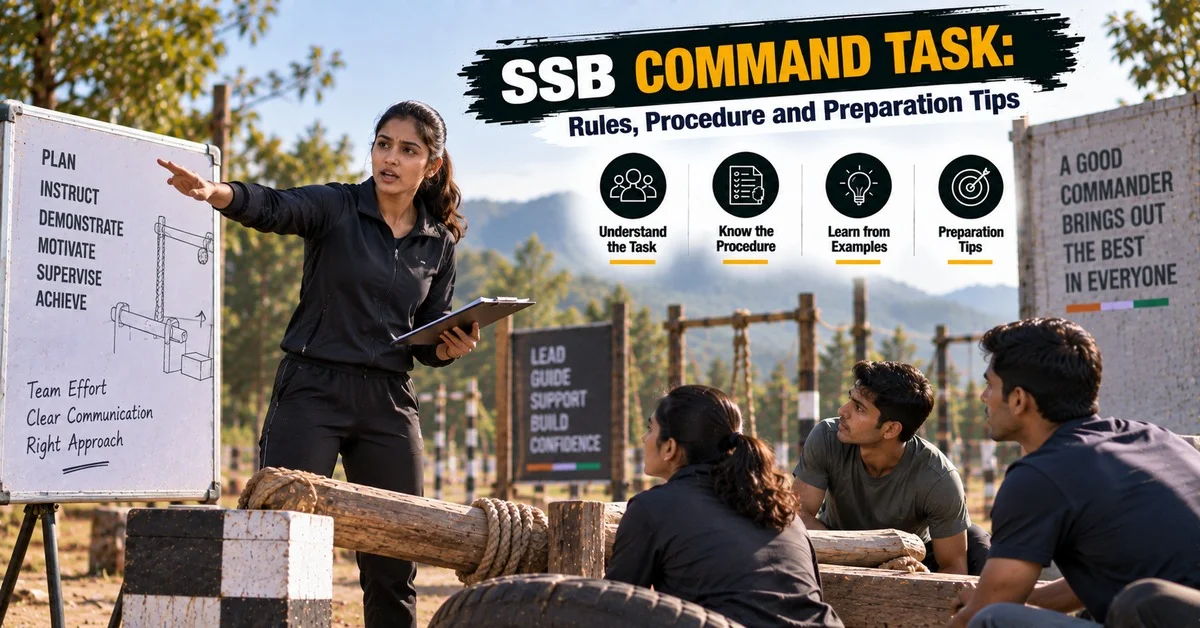
SSB Command Task tests leadership, planning, decision-making, communication, and resource management. Learn the rules, five-step procedure, subordinate selection tips, GTO observations, and preparation strategy.
Most candidates who clear SSB Stage 1 arrive at the GTO series knowing the names of the tasks but not the mechanics behind them. The SSB Command Task is the one that separates the prepared from the rattled. It is the only GTO task where you command, plan, and execute entirely alone, with every decision visible to the Group Testing Officer in real time. That's especially true when it comes to SSB Command Task procedure.
This guide gives you the complete picture: exact rules, the five-phase procedure, what the GTO is actually watching, how to pick the right subordinates, the mistakes that kill recommendations, and a concrete preparation plan you can start today. The same principle applies to what does GTO observe in command task.
What Is the SSB Command Task?
The SSB Command Task is an individual obstacle task within the GTO tasks SSB series. Unlike group tasks where collective performance can mask individual weakness, this task places one candidate in the role of commander with two or three peers as subordinates. The candidate must cross a defined obstacle using only the available helping structures, within a fixed time limit. It's a detail worth keeping in mind for SSB Command Task preparation tips.
It is conducted on SSB Day 4, the final day of the GTO series, after the candidate has already been observed across group discussions, group obstacle races, and the progressive group task. That prior observation is not incidental. The GTO uses patterns from earlier tasks to cross-check the behaviour on display here. Don't overlook this when thinking about the SSB interview GTO series.
The task's purpose is precise: to isolate leadership under observation in an individual setting where there is no group to lean on, no consensus to hide behind, and no scope to follow someone else's plan. According to sources at SSBCrack, the Command Task is specifically designed to assess whether a candidate can function as an officer when given a problem, finite resources, and people to lead. The same holds for recommended candidate SSB.
For aspirants preparing for NDA SSB preparation or the CDS SSB interview, understanding this task's structure is non-negotiable. It is one of the highest-stakes evaluations in the entire five-day process and carries significant weight in the final GTO assessment.
SSB Command Task Rules Every Aspirant Must Know
The SSB Command Task rules are strict and non-negotiable. Breaking even one of them affects your score directly because rule compliance itself reflects discipline, an Officer Like Quality (OLQ) the GTO is actively tracking.
-
Helping structures only. You may use only the props provided, which typically include planks, ropes, barrels, and baulks. Nothing outside the marked area counts.
-
No body contact with the ground or marked out-of-bounds zones. Touching prohibited areas, even briefly, is treated as a rule violation.
-
One candidate commands. The selected candidate leads. Subordinates may carry out instructions but cannot suggest or redirect the plan. Any reversal of roles is penalised.
-
The GTO does not intervene. Once the task begins, the Group Testing Officer observes silently. No hints, no corrections. You manage entirely on your own.
-
A time limit applies. The typical window is around 10 to 15 minutes, though the GTO may vary this. Time management is itself part of the evaluation.
-
No physical assistance beyond task props. Candidates cannot lift subordinates or physically push them across obstacles. Instructions must be given verbally.
These rules exist to create a controlled environment for leadership under observation. A candidate who tries to bend the rules, even with good intentions, signals poor judgment rather than resourcefulness.
Step-by-Step Procedure of SSB Command Task
The SSB Command Task procedure follows five distinct phases. Knowing the sequence in advance removes a significant amount of the anxiety that causes candidates to freeze on the day.
Phase 1: Obstacle Introduction. The GTO walks the candidate through the obstacle, explaining start and end points, marked out-of-bounds areas, and available helping structures. This briefing is brief. You are expected to absorb it quickly.
Phase 2: Planning (approximately 2 minutes). The GTO steps back and gives the candidate silent time to study the obstacle and form a plan. This is not a moment to look uncertain. Use it actively, assess the props, map your sequence mentally, and decide how many subordinates you need and what each will do.
Phase 3: Subordinate Selection. You choose two or three peers from the group. The selection itself is observed. Walk up, pick confidently, and brief them with clear, calm language.
Phase 4: Execution. You command the task from start to finish. Keep instructions direct. Adapt if a step fails, but do not panic visibly. Maintain your role as commander throughout.
Phase 5: Dismissal. Once the task is complete, or time is called, you thank and formally dismiss your subordinates. This step is routinely skipped by unprepared candidates, and the GTO notices immediately.
What Does the GTO Observe During Command Task?
Knowing what does GTO observe in command task is the single most useful piece of knowledge you can carry into the GTO series. The answer is structured around the 15 Officer Like Qualities (OLQs) that SSB assessors formally evaluate.
Each phase of the task maps to specific OLQs:
-
Planning phase: The GTO watches how quickly and confidently you analyse the obstacle. Speed of decision reflects initiative in SSB terms. Hesitation signals poor decision-making under pressure.
-
Task briefing to subordinates: The clarity, tone, and confidence of your briefing language reveals communication ability and effective intelligence.
-
Resource use: How efficiently you deploy the helping structures shows planning and organising ability. Using props in creative but rule-compliant ways signals sound reasoning.
-
Subordinate handling: Whether you maintain command without being authoritarian, and whether you adjust when a subordinate struggles, reflects cooperation and influencing ability.
-
Time awareness: Candidates who either rush recklessly or stall without adapting signal poor stamina and determination.
-
Dismissal behaviour: A confident, composed dismissal indicates social ability and officer bearing.
According to DefenceGuru, the GTO is not hoping you complete the task perfectly. The assessor is looking for how you carry yourself when things get complicated, which is a far more accurate predictor of officer potential than obstacle completion alone.
You can read the full GTO evaluation framework on SSBCrack's Command Task leadership assessment guide.
How to Select Subordinates in SSB Command Task
Knowing how to select subordinates in SSB Command Task is the topic candidates fear most, and with reason. The selection happens in front of the GTO, with your entire group watching, and you have roughly 30 seconds to decide.
The strategic approach involves three principles:
Watch the GTO series performance of your peers. By SSB Day 4, you have spent three days observing your group across multiple tasks. You already know who is physically capable, who follows instructions well, and who tends to take over. Use that knowledge.
Pick capable peers, not dominant ones. Selecting the strongest personality in your group risks a situation where subordinates start redirecting your plan. The goal is to demonstrate your leadership, which is impossible if a subordinate effectively takes command.
Brief them with confidence immediately after selection. Walk up, select your two or three subordinates, and deliver a short, structured briefing. Tell them the objective, their individual roles, and any specific rules to observe. The briefing itself is a leadership demonstration. A candidate who selects well but briefs poorly has wasted the advantage.
Recommended candidates typically keep their subordinate briefing language simple: one sentence on the objective, one sentence per person on their role, and a clear signal to begin. Anything longer starts sounding like over-explanation, which the GTO interprets as anxiety rather than preparation.
Common Mistakes Candidates Make (and How to Avoid Them)
These mistakes appear consistently across GTO assessment reports and coaching feedback from candidates who were not recommended:
-
Over-explaining to subordinates. Fix: Keep your task briefing to under 60 seconds. Three clear instructions are better than a two-minute explanation that confuses everyone.
-
Freezing at obstacles. Fix: If your plan fails at a specific point, verbally acknowledge the problem and adapt out loud. "This isn't working, let's try the plank from this angle." Visible thinking is better than visible panic.
-
Ignoring the time limit. Fix: Mentally divide your available time into three segments: planning, execution, and buffer. If you hit the halfway mark and are not through the first obstacle, adjust your approach immediately.
-
Poor dismissal behaviour. Fix: When the task ends, stand upright, thank your subordinates by name or number, and formally dismiss them. This takes ten seconds and marks you as composed.
-
Selecting dominant peers as subordinates. Fix: Choose peers who were cooperative and responsive during earlier group tasks, not the loudest voices in the room.
-
Letting subordinates handle props independently without instruction. Fix: You must direct every significant action. Silence from the commander during execution is read as loss of control.
Full mistake analysis with candidate examples is available on the SSBCrack mistakes guide for Command Task.
Preparation Tips to Excel in SSB Command Task
These SSB Command Task preparation tips are built around the specific skills the GTO evaluates, not generic confidence advice.
Obstacle familiarity drills. Practice crossing rope-and-plank style obstacles at any academy or training ground. The goal is not to memorise a specific layout but to become comfortable with the physical logic of these tasks so you stop hesitating when props look unfamiliar.
Leadership role practice in mock GTO sessions. In mock SSB sessions, specifically ask to play the commander role in practice scenarios. Repeated exposure to giving instructions under time pressure builds the reflexive calm that recommended candidates display.
Rehearse your subordinate briefing language. Write out three or four briefing templates and practise saying them aloud until the words feel natural. A good structure: state the objective, assign a role to each subordinate, name one rule to remember, and signal the start.
Mental rehearsal of the five phases. Walk through the task mentally from Phase 1 to Phase 5 at least once a day in the week before your SSB. Visualising the dismissal is particularly useful since it is the phase most candidates forget under pressure.
Physical confidence with props. Hesitation around physical props is visible. Practise handling planks, ropes, and barrels so that moving them feels routine rather than effortful.
Candidates preparing for NDA SSB preparation and CDS SSB interview should treat the Command Task as a leadership presentation, not a physical test. The obstacle is the context. Your behaviour as a commander is the content.
FAQs
What are the exact rules of SSB Command Task?
The SSB Command Task rules require candidates to use only helping structures provided, avoid body contact with prohibited zones, maintain the commander role without switching it to a subordinate, operate without GTO intervention once the task begins, and complete the task within the assigned time limit.
What does the GTO observe during Command Task?
The Group Testing Officer observes decision-making under pressure, quality of task briefing, resource use, subordinate handling, time management, and dismissal behaviour. Each observation maps directly to the 15 Officer Like Qualities (OLQs) that define the SSB assessment.
What common mistakes should I avoid in SSB Command Task?
Avoid over-briefing subordinates, freezing when your initial plan fails, ignoring the time limit, skipping the formal dismissal, and selecting dominant peers who may try to redirect your command. Each of these signals a specific OLQ gap to the assessor.
How do I select subordinates in SSB Command Task?
Use your observations from earlier GTO tasks SSB sessions to identify cooperative and capable peers. Avoid the most dominant personalities in your group. Select two or three subordinates confidently and brief them immediately with clear, short instructions. The selection and briefing process itself demonstrates leadership.
What is the step-by-step execution strategy recommended candidates follow?
Recommended candidates use the planning phase actively rather than standing still, deliver a brief and structured subordinate briefing, adapt verbally when obstacles create problems, maintain calm command authority throughout execution, and close with a composed formal dismissal. The approach combines initiative in SSB with clear communication, which is exactly what the GTO is tracking across all five phases.
If you are also weighing your broader career direction within the armed forces, the guide on Indian Army vs Navy after 12th at Defence Study covers service-specific career paths in full detail.