Sheshnag-150 Drone Can Now Launch Without a Runway After Successful Rocket Booster Validation
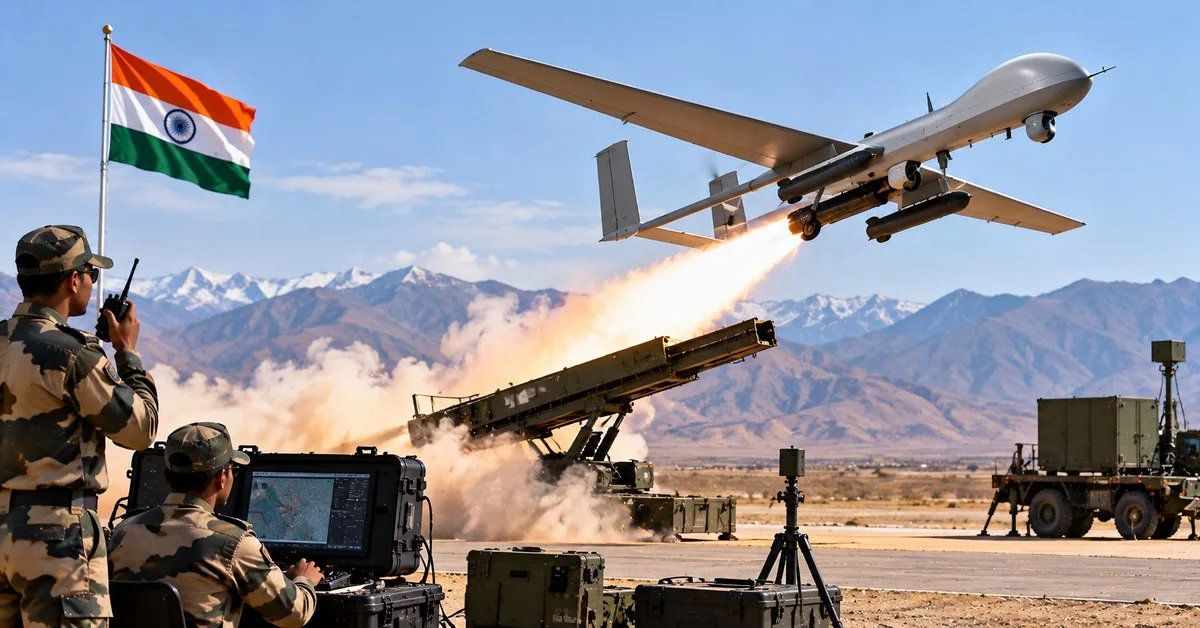
The Sheshnag-150 long-range attack drone, developed by NewSpace Research & Technologies, can now take off without a runway after its Rocket-Assisted Take-Off booster was validated, letting forces launch it from rugged forward areas.
India’s Sheshnag-150, a long-range attack drone built by a Bengaluru-based start-up, can now take off without a runway. Its developer, NewSpace Research & Technologies (NRT), has validated a Rocket-Assisted Take-Off (RATO) booster that lets the drone launch from small, rough and forward areas.
The booster was tested and cleared by GryphonWorks, a team within the company.
What has changed
Until now, the drone could be launched only from vehicles or from mobile launch points on highways. With the new rocket booster, it no longer needs a proper airstrip. The booster gives the drone a strong push in the first few seconds of flight, enough for it to reach flying speed, after which its own engine takes over.
This brings some clear benefits:
-
Flexible launch sites: The drone can be sent up from tight, unprepared or rugged spots close to the front.
-
Less dependence on airbases: Forces would not have to rely on fixed launch facilities, which are easy targets for the enemy.
-
Harder to track: Launching from many different places makes it more difficult for an enemy to predict where an attack will come from.
About the drone
The drone is a one-way attack drone, also called a loitering munition or “kamikaze drone”. Such drones fly to a target area, can hover for a while, and then dive onto the target and explode.
Its key features, as reported, are:
-
Weight class: 150 kg.
-
Range: More than 1,000 km.
-
Flight time: Over five hours in the air.
-
Warhead: A high-explosive warhead weighing between 25 kg and 40 kg.
-
Swarm capability: Several drones can work together as a group using artificial intelligence, to overwhelm enemy air defences.
-
Navigation: AI-based visual navigation that is designed to work even when GPS signals are blocked or jammed.
In earlier strike trials at Pokhran in Rajasthan, the drone flew about 720 km without a break before hitting its target.
Made in India
The drone falls under the IDDM (Indigenously Designed, Developed and Manufactured) category. This is the top category under India’s defence buying rules, given to equipment that is designed and built within the country.
NRT is a private defence start-up based in Bengaluru. Its work reflects the growing role of private Indian companies in building advanced drone systems, an area once dominated by government labs and foreign suppliers.
Why it matters
Recent conflicts around the world have shown how important long-range drones have become. They can strike targets deep behind enemy lines at a much lower cost than fighter jets or missiles, and without putting pilots at risk. Because they are smaller and cheaper, many of them can be launched together, forcing the enemy to use up expensive air defence missiles on each one.
A drone that can be launched from almost anywhere is even more useful. In mountain regions or along long borders, finding a suitable runway is not always possible. A rocket-assisted launch lets troops use the drone wherever they are deployed.
Still more tests to come
The booster validation is an important step, but the drone is not yet ready for regular service. According to the report, more operational testing and evaluation will be needed before it can be inducted by the armed forces.
The report did not share the date of the booster test, its technical details, or which service is likely to use the drone first.
For defence aspirants
Developments like this show how quickly modern warfare is changing. Drones, artificial intelligence and electronic warfare are now central to how the armed forces plan for the future. For aspirants preparing for the SSB interview or written exams such as CDS and AFCAT, keeping up with such indigenous defence projects is useful for current affairs and interview discussions.