China's KJ-3000 AWACS: A Major Leap in Airborne Surveillance Capability
New digital radar-equipped AEW&C aircraft could significantly enhance China's battlefield awareness as India expands its own airborne warning capabilities
China's latest Airborne Early Warning and Control (AEW&C) aircraft, the KJ-3000, is emerging as one of the most closely watched military aviation programmes in the world, with defence analysts viewing it as a significant step forward in Beijing's quest for information dominance in future conflicts.
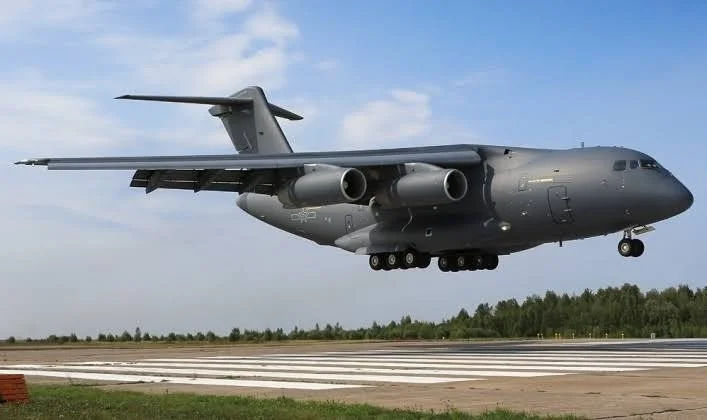
Built on the Y-20B strategic transport aircraft, the KJ-3000 is expected to become the most capable airborne surveillance platform in the People's Liberation Army's inventory. The large indigenous airframe provides the space, endurance and electrical power required for advanced radar systems and long-duration airborne command-and-control missions.
A New Generation of Airborne Early Warning
According to the US Department of Defense, the KJ-3000 is likely to be the world's first airborne early warning aircraft built around a fully digital radar architecture. Unlike conventional radar systems that rely heavily on dedicated hardware, digital radar processes much of its signal through software, enabling faster target processing, greater adaptability and improved resistance to electronic warfare.
The aircraft is also expected to incorporate advanced anti-jamming, passive detection, and target identification technologies, allowing it to detect and track aerial threats while reducing its own electronic signature.
Military experts often describe AEW&C aircraft as force multipliers because they dramatically extend radar coverage beyond ground-based sensors, improve situational awareness and coordinate fighter aircraft across vast operational areas.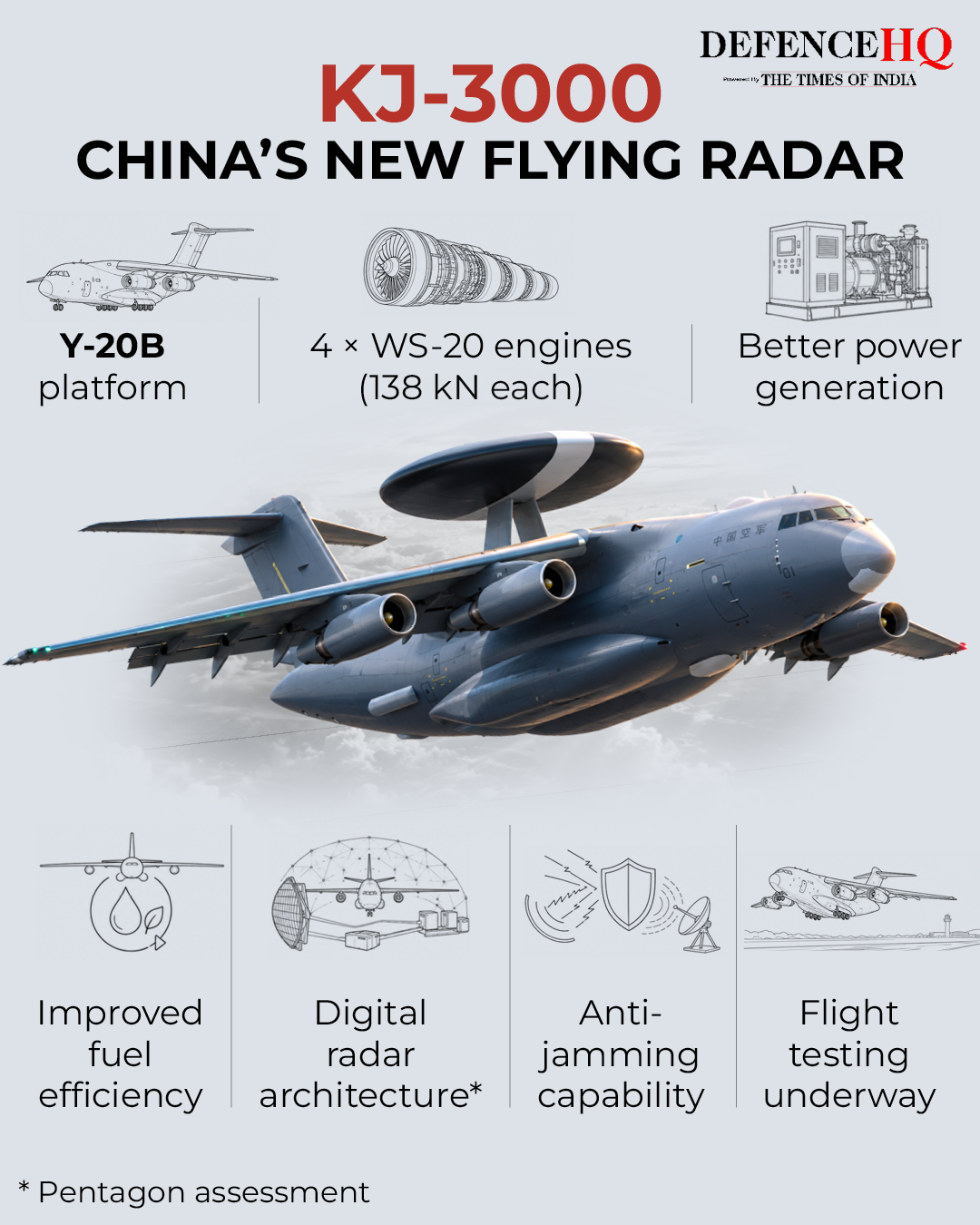
Powered by China's Indigenous WS-20 Engines
The KJ-3000 is currently undergoing flight testing, with at least two prototypes identified so far.
The aircraft is powered by four indigenous WS-20 turbofan engines, each producing approximately 138 kN of thrust. The WS-20 replaces the older Russian-made D-30 engines used on earlier Y-20 aircraft, offering improved fuel efficiency and greater reliability.
The new engines not only increase endurance but also generate the electrical power required for next-generation airborne radar systems, which demand significantly higher onboard energy than previous generations.
Although Beijing has not released official specifications, satellite imagery and photographs indicate that the aircraft features a substantially larger dorsal radar radome than the one fitted on the KJ-500, suggesting a significant increase in detection range and tracking capacity.
Building a Layered Airborne Surveillance Network
Over the past two decades, China has steadily transformed its airborne early warning capability from a limited fleet into one of the world's largest.
The backbone of the People's Liberation Army Air Force's surveillance network is currently the KJ-500, with the International Institute for Strategic Studies (IISS) Military Balance 2025 estimating that the PLA Air Force operates around 40 aircraft, while the PLA Navy fields more than 20, giving China a combined fleet exceeding 60 KJ-500 platforms.
China also continues to operate a smaller number of KJ-2000 heavy AWACS aircraft based on the Russian Il-76 transport, while simultaneously developing the carrier-capable KJ-600 to support its expanding aircraft carrier fleet.
The introduction of the KJ-3000 would further strengthen this layered surveillance architecture, enabling sustained airborne coverage across multiple operational theatres.
US Still Leads, But China Is Closing the Gap
The United States remains the global benchmark in airborne battle management.
The US Air Force continues to operate the E-3 Sentry AWACS, although the Cold War-era platform is gradually being phased out after decades of service. The operational fleet has reportedly declined to around 14 aircraft, while the US Navy fields the highly capable E-2D Advanced Hawkeye for carrier operations.
Despite America's unmatched operational experience in airborne command-and-control, analysts believe China is rapidly narrowing the technological and numerical gap through sustained investment in indigenous surveillance platforms.
India's Capability and Future Plans
Compared to China, India's airborne early warning fleet remains relatively modest.
The Indian Air Force currently operates three Israeli-origin Phalcon AWACS mounted on Russian Il-76 aircraft alongside three indigenous Netra AEW&C systems based on the Embraer ERJ-145 platform.
While these aircraft have significantly enhanced India's surveillance and battle management capabilities, their limited numbers restrict the IAF's ability to maintain continuous airborne coverage across both its western and northern fronts simultaneously.
Recognising this shortfall, India is expanding its airborne surveillance capability through multiple indigenous programmes.
The DRDO is developing the Netra Mk-1A, while the larger AWACS India programme aims to integrate advanced indigenous mission systems onto Airbus A321 aircraft, significantly enhancing endurance, radar performance and command-and-control capabilities.
Information Dominance Will Define Future Air Warfare
China's continued investment in airborne surveillance reflects a broader shift in modern warfare, where information superiority is becoming as important as traditional firepower.
By fielding a large and layered AEW&C fleet, Beijing can maintain persistent surveillance over strategically important regions such as Tibet, the Taiwan Strait, the East China Sea, and the South China Sea, while retaining the flexibility to support operations across multiple theatres simultaneously.
The emergence of the KJ-3000 underscores an important reality of future air warfare: success will depend not only on advanced fighter aircraft or long-range missiles but also on the ability to detect threats early, process vast amounts of battlefield data, and distribute that information rapidly across a networked force.
As regional powers continue investing in next-generation airborne surveillance platforms, the race for information dominance is becoming one of the defining features of 21st-century airpower.