Operation Rajiv: The Daring Assault That Secured India's Hold on Siachen
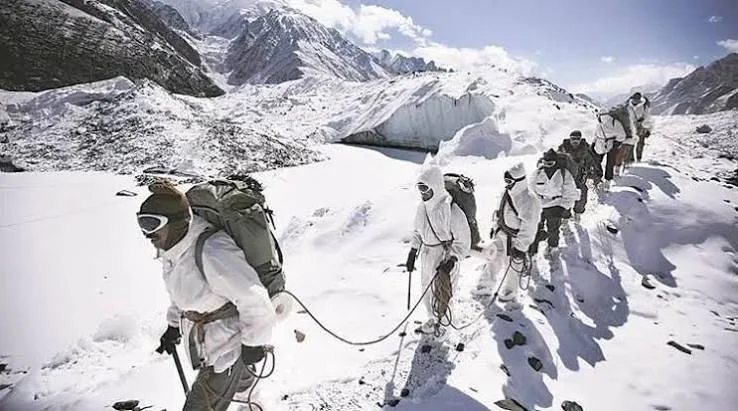
The daring 1987 assault on Pakistan's Quaid Post remains one of the greatest feats of mountain warfare in military history
On 27 July 1949, nearly a year after the first India-Pakistan war over Jammu and Kashmir, representatives of both nations agreed upon the Ceasefire Line (CFL)—the predecessor of today's Line of Control (LoC). However, the demarcation ended abruptly at map reference NJ9842. Beyond this point, the agreement simply stated, "thence north to the glaciers," leaving the uninhabited, glaciated terrain of the eastern Karakoram undefined.
For decades, the area remained largely untouched, considered too inhospitable for military occupation. That changed in the late 1970s and early 1980s, when Pakistan began asserting its claim over the region by sponsoring foreign mountaineering expeditions and increasing military patrols.
Recognising the strategic implications, India launched Operation Meghdoot in April 1984. Led by Captain (later Lieutenant General) Sanjay Kulkarni and supported by the Indian Air Force, Indian troops occupied the commanding heights of the Saltoro Ridge, securing control over the Siachen Glacier—the world's highest battlefield—just days before Pakistani forces could do the same.
The Threat from Quaid Post
Two years later, Pakistan's elite Special Services Group (SSG) established a heavily fortified position at an altitude of approximately 21,500 feet on the western shoulder of Bilafond La. Named Quaid Post after Pakistan's founder Muhammad Ali Jinnah, the position overlooked Indian posts at Sonam and Amar and commanded almost every movement across the glacier.
The post's commanding location enabled Pakistani troops to direct accurate machine-gun fire onto Indian positions and helicopter landing zones, making troop rotation and logistics extremely hazardous.
By 1987, the responsibility for recapturing this dominant feature fell to the 8th Battalion of the Jammu and Kashmir Light Infantry (8 JAK LI).
Siachen: The World's Harshest Battlefield
Combat on the Siachen Glacier presents challenges unmatched anywhere else on Earth.
Troops operate at altitudes exceeding 20,000 feet, where oxygen levels are nearly half those at sea level. Temperatures regularly plunge below -60°C, while vertical ice walls, hidden crevasses, avalanches and hurricane-force winds make survival itself a constant battle.
Against this backdrop, every assault required not only courage but extraordinary endurance.
The Sacrifice of Second Lieutenant Rajiv Pandey
On 29 May 1987, Second Lieutenant Rajiv Pandey led a 13-member reconnaissance patrol tasked with identifying an approach route to Quaid Post.
Lance Havildar Mulk Raj Sharma painstakingly carved footholds into the vertical ice using only an ice axe, fixing ropes for the patrol to climb. The team advanced to within approximately 30 metres of the Pakistani bunker before being detected.
Pakistani machine-gun fire devastated the patrol.
Only two soldiers survived.
Second Lieutenant Rajiv Pandey was posthumously awarded the Vir Chakra for his exceptional bravery.
The ropes fixed during this mission, however, would later become crucial to the final assault.
Operation Rajiv Begins
In June 1987, the Indian Army launched Operation Rajiv, named in honour of the fallen officer.
A 55-member assault force commanded by Major Varinder Singh was assembled, supported by the newly established Army Aviation Corps, which undertook a major effort to transport troops and equipment into the high-altitude battlefield.
By 24 June, the assault team had located the ropes left behind by Pandey's patrol and prepared for the attack.
The first assault, led by Subedar Harnam Singh during the early hours of 25 June, was forced to withdraw after weapons malfunctioned in the extreme cold.
A second attempt under Subedar Sansar Chand also failed as Pakistani fire, altitude and exhaustion took their toll.
For nearly three days, Indian soldiers remained exposed on the mountainside with minimal food, surviving by melting ice for drinking water while awaiting another opportunity.
Bana Singh's Historic Assault
With time running out, Major Varinder Singh made a bold decision.
Instead of waiting for darkness, the final assault would take place in broad daylight under artillery support.
At 1:30 PM on 26 June 1987, Naib Subedar Bana Singh led a five-man assault team up a near-vertical ice wall toward the Pakistani position.
The attack culminated in fierce close-quarter combat inside the cramped bunker, where bayonets and hand-to-hand fighting replaced gunfire.
The Indian assault team successfully overran the position, killing six Pakistani soldiers and capturing Quaid Post.
The post was subsequently renamed Bana Post in honour of the man who led the assault.
For his extraordinary courage and leadership, Naib Subedar Bana Singh was awarded the Param Vir Chakra, India's highest wartime gallantry award.
"We Did What Was Best for Our Country"
Reflecting on the operation nearly four decades later, Honorary Captain Bana Singh recalled the determination that drove his men.
"We did what was best for our country. We were very motivated. We followed the orders we were given and completed the task."
Speaking about the conditions they endured, he added:
"The Pakistanis fought very hard. Our task was difficult, but we were there to do the best for our country and delivered."
Pakistan's Counterattack Fails
Following the loss of Quaid Post, Pakistan launched Operation Qiadat in September 1987 under then-SSG Brigade Commander Pervez Musharraf, aiming to recapture the Bilafond La complex, including Sonam and Amar posts.
The Indian Army responded with Operation Vajra Shakti, successfully repelling repeated Pakistani assaults and inflicting heavy casualties.
Retired Brigadier Rajiv Williams later credited the victory to the leadership displayed by junior commanders and soldiers, particularly those who fought under extreme conditions to retain the strategically vital heights.
A Defining Moment in Indian Military History
The capture of Bana Post transformed the tactical balance on the Saltoro Ridge and secured India's dominance over the Siachen Glacier.
Military historians widely regard Operation Rajiv as one of the finest examples of high-altitude warfare ever undertaken. It demonstrated that determination, leadership and meticulous planning could overcome even the harshest terrain and the strongest defensive positions.
Today, the operation remains a defining chapter in the history of the Indian Army, symbolising the extraordinary courage displayed by soldiers fighting in the world's highest battlefield.