All 9 GTO Tasks in SSB Explained: Marking, OLQs and What Gets You Recommended
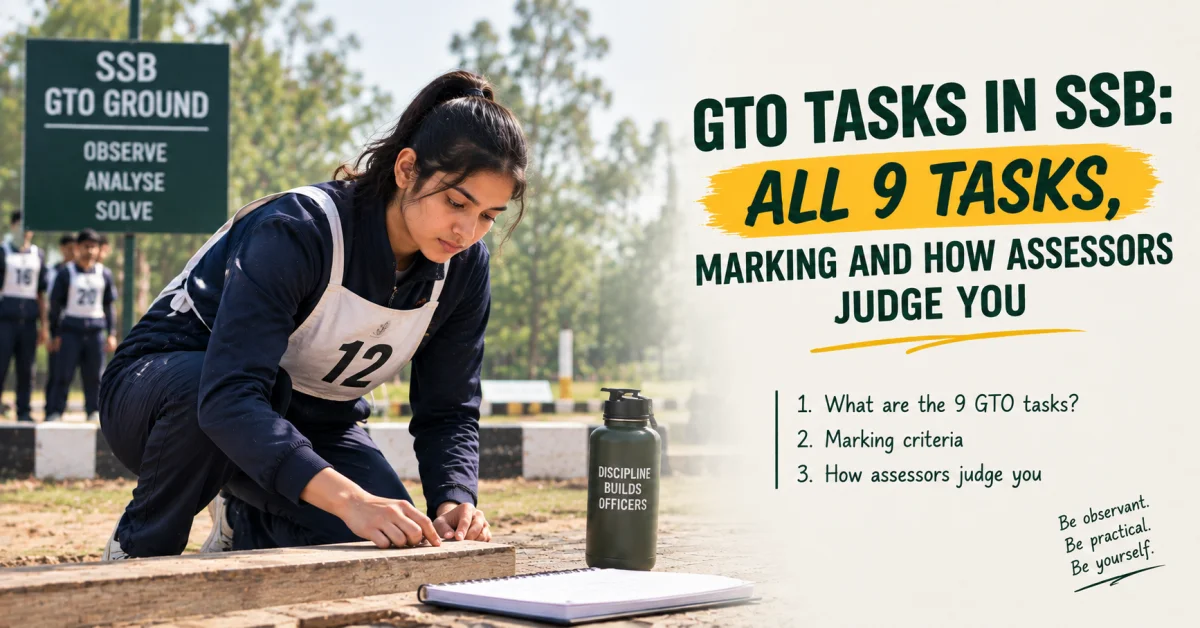
Learn how GTO tasks in SSB are assessed, which OLQs each task tests, common mistakes that can lead to a conference-out, and how recommended candidates approach each task.
Most candidates who walk into the Services Selection Board already know the names of the GTO tasks. Very few understand what the assessor is actually recording while those tasks are being performed. That gap is precisely why capable candidates get conferenced out while others with comparable physical ability and intelligence walk away recommended.
This article covers all 9 GTO tasks in SSB, the officer like qualities each task is designed to surface, the behavioral observation framework assessors use, and the specific mistakes that trigger a conference-out decision. Whether you are appearing for the first time or returning after a conference, the detail here goes well beyond a generic task list.
What Is the GTO Stage in SSB and Why It Carries Maximum Weight
The GTO stage is one of three parallel assessment streams inside the SSB. The Group Testing Officer, the Psychologist, and the Interviewing Officer each evaluate candidates independently before converging at the conference board. This structure is called the three-assessor model SSB, and it exists specifically to cross-verify impressions gathered through entirely different methods.
Of the three streams, the GTO generates the highest volume of raw behavioral data. Psychological tests run for roughly half a day. The IO interview typically lasts 40 to 60 minutes. The GTO stage, by contrast, runs across two full days and places candidates in nine distinct situations. This volume of behavioral observation SSB data gives the GTO disproportionate weight when assessors compare notes at the conference board.
Each GTO task is engineered to stress-test the same officer like qualities SSB GTO evaluates, but under varied conditions. Group dynamics assessment works differently in a timed planning task than in a physical obstacle task. A candidate cannot mask a weak quality across nine tasks the way they might manage in a single interview answer. The assessor records not just whether a quality appeared, but how frequently and how consistently it appeared across the full two-day sequence.
For repeat candidates, this architecture is the critical recalibration point. The conference board compares GTO notes against Psych projections and IO impressions. Inconsistency across streams, where a candidate appears confident in the IO interview but passive in group tasks, is what drives a conference-out decision more reliably than poor performance on any single task.
All 9 GTO Tasks in SSB: Complete Breakdown
Understanding the mechanics of each task is the starting point for any serious SSB interview preparation. Here is a structured breakdown of all 9 GTO tasks SSB explained with the core elements the assessor is watching.
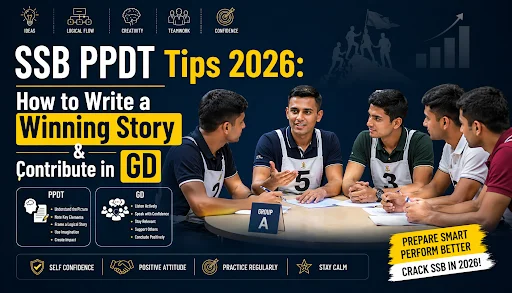
1. Group Discussion (GD): Two rounds, one on a social or current affairs topic and one on an abstract topic. No appointed leader. The assessor watches how candidates contribute ideas, respond to opposing views, and steer the group toward consensus without dominating. The common error is treating this as a debate rather than a collective reasoning exercise.
2. Group Planning Exercise (Military Planning Exercise): The group receives a map model depicting a scenario with multiple problems and limited resources. Each candidate writes an individual solution, then the group discusses and presents a unified plan. This military planning exercise tests analytical reasoning, verbal communication, and the ability to influence without authority.
3. Progressive Group Task (PGT): Four progressive group task obstacles of increasing difficulty, completed using material aids such as planks, ropes, and baulks. The group must cross without touching out-of-bound areas. The assessor watches who initiates, who adapts when a plan fails, and who physically contributes versus who spectates.
4. Half Group Task (HGT): The half group task splits the batch into two halves, reducing the group from roughly 10 to 5 candidates. The smaller group means less cover and more individual visibility. Every candidate's contribution is directly observable.
5. Individual Obstacles: A personal timed circuit of 10 obstacles graded by difficulty from 1 to 10. Individual obstacles SSB scoring rewards both physical confidence and calculated risk-taking. A candidate who attempts all 10 obstacles intelligently scores better than one who completes six easy ones conservatively.
6. Command Task: Each candidate is designated commander and selects two or three subordinates from the group. The command task SSB evaluates leadership quality in a controlled setting. The assessor watches how the commander briefs the team, responds to setbacks, and uses subordinates effectively.
7. Snake Race (Final Group Task): The snake race final group task reunites the entire group for a competitive obstacle task against the clock. Because it comes at the end of two days, it reveals whether displayed OLQs were genuine or performance-driven. Fatigue and competition pressure expose true behavioral defaults.
8. Lecturette: A three-minute individual talk on a topic chosen from four options. The lecturette SSB scores effective intelligence, self-expression, and general awareness. Candidates who choose a topic they know deeply and structure the talk around a clear argument consistently outperform those who pad with vague points.
9. Individual Interview (IO Stage Note): Technically conducted by the Interviewing Officer, not the GTO. It is listed here for completeness. The GTO evaluates only the eight tasks above. Candidates who confuse GTO scope with IO scope often misprepare by treating the interview as a GTO component.
OLQ Mapping Table: Which Task Tests Which Officer-Like Quality
The Services Selection Board assesses 15 officer like qualities grouped into four clusters. The GTO does not evaluate all 15 equally across every task. Each task is designed to surface a primary OLQ cluster, and secondary qualities emerge as supporting evidence.
This mapping is what most competitor resources consistently omit. Knowing which OLQ is primary in each task allows you to calibrate your behavior rather than simply "perform well" in a generic sense.
How SSB Assessors Actually Mark GTO Tasks: The Evaluation Framework
GTO marking criteria SSB operates on behavioral frequency, not overall impression. The Group Testing Officer records specific observable behaviors, not general feelings about a candidate. This distinction is what separates the SSB from most interview formats and is why coaching for surface-level confidence consistently fails.
The assessor records three dimensions for each task. First, frequency: how often did the candidate display the target OLQ? Second, quality: was the behavior effective in the group context, or did it create friction? Third, consistency: did the OLQ appear across tasks or only when conditions were favorable?
Group dynamics assessment sits at the center of this framework. The GTO is not evaluating candidates in isolation. They are watching how a candidate's behavior affects the group's output. A candidate who generates three good ideas but disrupts others' contributions scores lower than one who contributes two ideas and actively builds on them.
Initiative versus group harmony is a specific tension the assessor is trained to observe. Initiative that overrides the group plan is not rewarded. Initiative that moves the group forward when it is stuck is scored positively. Most candidates miss this nuance entirely during SSB interview preparation.
At the conference board, the GTO's behavioral observation SSB notes are placed alongside the Psychologist's projective test analysis and the IO's interview assessment. The conference recommendation is generated where two or more streams align. A candidate rated well by the GTO but flagged by the Psychologist for low social adaptability will face hard questions at conference.
9 GTO Mistakes That Get Candidates Conferenced Out
SSB GTO mistakes drive conference-out decisions far more often than a genuine lack of OLQs. Most candidates are conferenced out for behavioral errors, not ability gaps. Here are nine task-linked mistakes that consistently trigger negative assessor notes.
-
Dominating group discussion: Speaking more than 40 percent of the total discussion time signals poor group awareness, not leadership.
-
Silence in the half group task: The smaller group removes the option of blending in. Silence here is read as absence of initiative.
-
Rule violations in PGT or HGT: Touching out-of-bound areas and continuing regardless is a direct red flag. It signals disregard for constraints, a serious OLQ failure.
-
Choosing easy individual obstacles: Avoiding high-numbered obstacles to guarantee completion is read as risk aversion, not strategy.
-
Poor commander briefing in command task: Jumping into the obstacle without briefing subordinates shows poor organising ability.
-
Individual grandstanding in the snake race: Racing ahead of the group in the final group task scores negatively because it breaks cooperative mechanics.
-
Selecting an unfamiliar lecturette topic: Choosing a topic for perceived impression rather than actual knowledge results in vague, unstructured talks.
-
Inconsistent behavior across tasks: High energy in PGT and visible withdrawal in group discussion creates cross-stream inconsistency the conference board will flag.
-
Repeating the same SSB pattern on a repeat attempt: Returning with the same behavioral defaults after a conference-out is the most avoidable and most common repeat candidate error.
What Recommended Candidates Do Differently in the GTO Stage
Recommended candidates do not simply perform better on individual tasks. They display officer like qualities SSB GTO is designed to measure with consistent frequency across all nine tasks, and they do so in a way that genuinely serves the group rather than signals personal ambition.
Three behavioral markers consistently separate recommended candidates. First, they initiate early in tasks where the group is hesitant but defer appropriately when a stronger plan is already in motion. This balance of initiative and group influencing ability is the single hardest OLQ cluster to replicate across two full days.
Second, recommended candidates maintain energy and behavioral consistency well into the snake race. By the second day, most candidates visibly tire or relax their effort. Assessors note this contrast sharply. Physical stamina and sustained motivation are OLQs, not just fitness markers.
Third, recommended candidates in the command task give a clear brief before acting. They allocate roles, explain the obstacle structure, and check understanding. This takes roughly 90 seconds but generates significantly more positive assessor notes than any physical performance during the task itself.
For repeat candidates specifically, the recalibration required is behavioral, not cosmetic. Clearing the SSB GTO stage on a repeat attempt means identifying which OLQs were inconsistent in the previous attempt and building deliberate practice around those clusters, not rehearsing the same approach with more energy.
How to Prepare for SSB GTO Tasks: Task-Wise Strategy
Preparation for GTO tasks in SSB must be task-specific. Generic confidence-building exercises address the wrong problem. Here is a drill-able strategy per task category.
For Group Discussion and Military Planning Exercise: Practice structured group discussions with peers using a strict time limit. After each session, debrief on who influenced the group direction and what specific language triggered agreement or resistance. Reading one editorial daily builds the reasoning vocabulary that makes contributions in group discussion SSB genuinely substantive.
For PGT, HGT, and Snake Race: Join a coaching programme that replicates the physical obstacle setup. The physical element is secondary to practicing initiative under group pressure. Focus specifically on the moment a plan is failing and the group is stalling. Candidates who can calmly propose a course correction in that moment consistently earn high PGT scores.
For Individual Obstacles: Attempt all 10 obstacle types in training. Map your performance against the scoring weights and prioritise obstacles numbered 7 through 10. Arriving on test day having physically attempted high-value obstacles removes the hesitation that produces the most common individual obstacles SSB errors.
For Command Task: Practice giving structured verbal briefs. Use a three-part format: situation, plan, individual roles. Time your brief to under two minutes. Subordinates in the command task SSB cannot follow a commander who cannot explain the plan clearly.
For Lecturette: Prepare 12 to 15 topics across current affairs, science and technology, social issues, and defence. Practice speaking for exactly three minutes with a clear opening statement, two developed points, and a closing sentence. Record yourself to identify filler words and pacing issues.
For a broader view of officer entry routes and where the SSB sits within them, the guide on Indian Army vs Navy After 12th: Which Career Is Better in 2026 provides useful context on how different service branches weight the SSB in their selection process.
FAQs
Can you explain all 9 GTO tasks in SSB with their marking criteria and what OLQs each task is designed to test?
Yes. All 9 GTO tasks SSB explained above cover the task mechanics, primary OLQs, and what the assessor records. GTO marking criteria SSB involves behavioral frequency, quality, and consistency across all nine tasks over two days, not a single performance score per task.
How do SSB assessors actually score candidates during GTO tasks, is it based on how much you speak or on specific behaviours observed?
Scoring is based entirely on behavioral observation SSB methodology, not speaking volume. The Group Testing Officer records specific observable behaviors aligned to the 15 OLQs. Speaking frequently without contributing substance produces negative notes, not positive ones.
What are the most common mistakes that lead to a conference-out decision in the GTO stage of SSB?
SSB GTO mistakes that drive conference-out decisions most often involve dominating group tasks, silence in the half group task, rule violations during physical tasks, individual grandstanding in the snake race final group task, and behavioral inconsistency across the two-day sequence. See the nine-point list above for task-linked detail.
How is the GTO stage structurally different from the Interviewing Officer and Psychologist stages in the SSB interview?
The three-assessor model SSB places each stream in a parallel, independent evaluation role. The Psychologist uses projective written tests run over half a day. The IO uses a structured personal interview of 40 to 60 minutes. The GTO uses nine group and individual tasks across two full days, generating a far larger behavioral data set that feeds directly into the conference recommendation.
What should a repeat SSB candidate do differently in GTO tasks to avoid repeating the same conference-out pattern?
A repeat candidate must first identify which OLQ cluster was inconsistent in the previous attempt, typically by reviewing which tasks felt weakest. Clearing the SSB GTO stage on a return attempt requires targeted behavioral drilling on those specific clusters. Returning with the same defaults and expecting a different outcome is the most predictable repeat conference-out pattern assessors observe. Resources such as Centurion Defence Academy's GTO task breakdown and Cavalier's complete aspirant guide provide additional task-level reference points for structured recalibration.