CRPF Head Constable Ministerial Exam 2027

Quick summary
The CRPF Head Constable Ministerial exam in one place: the 100-question CBT pattern, negative marking, all five selection stages, subject-wise syllabus, and typing test speed and error rules, with what to update before 2027.
In the recent cycle, the CRPF Head Constable Ministerial written test was a computer-based exam of 100 objective questions in 90 minutes. Each question carried 1 mark, and 0.25 was deducted for every wrong answer. Qualifiers then take a 10-minute typing test at 35 WPM in English or 30 WPM in Hindi. Confirm 2027 details in the official CRPF notification.
You’ve downloaded three PDFs and opened two tabs on typing rules. You still can’t tell whether a backspace counts against you. That’s where most CRPF HCM preparation starts, because the details sit on separate pages that rarely agree.
This guide puts everything in one place. It covers the exam pattern, every selection stage, the full CRPF Head Constable Ministerial syllabus by subject, and the typing speed and error rules. There’s also a section for repeat aspirants on what to update before the 2027 cycle. Where an official 2027 figure hasn’t been released yet, we say so.
Exam Pattern at a Glance: Total Questions, Marks, and Negative Marking
The written test is a single computer-based paper of objective multiple choice questions, and wrong answers cost marks. The question count, time limit and penalty are in the quick answer above. The table below shows what those rules mean when you sit the paper.
| Feature | What it means for you |
|---|---|
| Mode | Computer-based test (CBT), objective MCQs |
| Marking | Every question carries equal weight |
| Negative marking | Four wrong answers cancel one correct answer |
| Next stage | A qualifying typing test follows the written exam |
Guess blindly and you lose marks. A one-page summary of the CRPF HCM exam pattern is useful for a quick look. For 2027, though, rely on the official CRPF notification over any third-party CRPF Head Constable Ministerial syllabus page.
Selection Process: Every Stage in Order
The selection process runs in five stages, and you must clear each one before you move to the next. Only one stage usually decides your rank. The others are pass-or-fail checks.
- Head Constable Ministerial written test: the merit stage, where your score generally shapes your final position.
- Skill test: qualifying only. You need to hit the CRPF Head Constable typing test speed, but a faster speed doesn’t add marks.
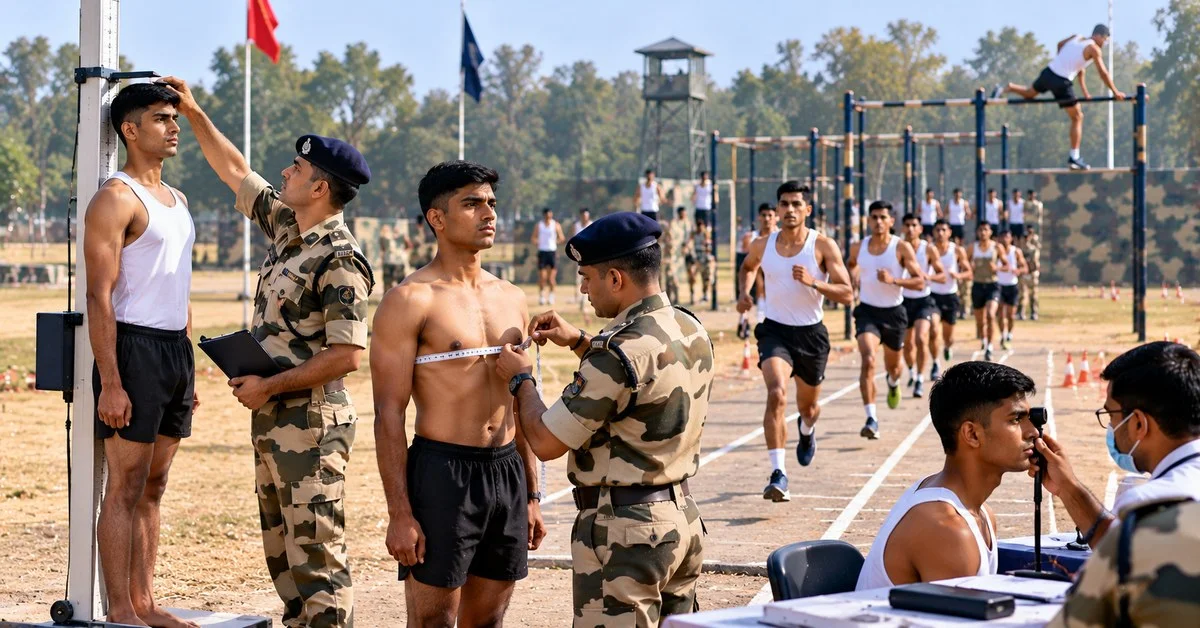
- Physical Standard Test (PST): qualifying. It checks that you meet the physical standards for the post.
- Document verification: qualifying. Officials confirm your age, education and category certificates.
- Medical examination: qualifying. It checks that you’re fit for service.
Order and labels can shift between Central Reserve Police Force recruitment cycles. Check this stage-by-stage selection overview against the official 2027 notification.
Subject-Wise Syllabus Breakdown
The written paper tests four subjects: reasoning, general knowledge, English and numerical aptitude. Most topics repeat from one cycle to the next. The weightage, though, can shift, and CRPF hasn’t yet published an official subject split for CRPF HCM 2027.
Treat the topic lists below as your working map, built from earlier cycles. Cross-check them against this subject-wise HCM syllabus summary and, once it’s out, the official notification. If you’ve already studied reasoning and maths for another force, the CRPF Constable GD syllabus topics overlap heavily, so you won’t be starting from zero.
General Intelligence and Reasoning
Reasoning tests how quickly you spot patterns, and it covers analogies, series, coding-decoding, blood relations and spatial reasoning. The questions are short. Speed comes from recognising the type within seconds.
- Series: 3, 6, 12, 24,? (each term doubles, so the answer is 48).
- Coding-decoding: If DOOR is written as EPPS, how is LOCK written? (Each letter moves one step forward: MPDL.)
- Blood relations: Pointing to a man, Riya says, “He is the son of my grandfather’s only son.” Who is he? (Her brother.)
- Spatial reasoning: mirror images, paper folding and figure completion.
General Knowledge and Current Affairs
General knowledge is the widest section, spanning Indian polity, history, geography, science and technology, and national and international current affairs. Defence and security awareness also appears, which suits a force like the CRPF.
Static GK is predictable. Questions on the Fundamental Rights, the Revolt of 1857 or major Indian rivers come up in some form most years. Current affairs is where people lose marks, because it can’t be crammed in the last week. Read the news daily and keep a one-page monthly summary. Focus on defence deals, joint exercises, government schemes and national awards.
English Language
English checks whether you can read, correct and arrange text accurately. A ministerial post deals with files, letters and records every day, so this section counts for more than many aspirants assume. The usual sub-topics are:
- Reading comprehension passages followed by direct and inference questions
- Grammar: error spotting and fill-in-the-blanks
- Vocabulary, including synonyms and antonyms
- Sentence rearrangement (para jumbles)
Here’s a typical error-spotting item: “Each of the clerks have submitted their report.” The error is “have”, which should be “has”. Grammar rules like subject-verb agreement are worth drilling. They repeat far more often than rare vocabulary does.
Numerical Aptitude / Mathematics
Maths in this exam is mostly arithmetic. The paper doesn’t test advanced theory. Expect percentage, ratio and profit-loss, along with number systems, simplification, time and work, time-speed-distance, and basic geometry and mensuration.
Take a sample question. A shopkeeper buys an item for ₹400 and sells it for ₹460. What’s the profit percentage? The profit is ₹60, so the answer is 15%. Questions at this level reward fast mental calculation more than formula memory. Learn squares up to 30 and the common percentage-to-fraction conversions, and keep practising them. Mensuration is the one area where you do need formulas, so keep area and volume formulas for the cylinder, cone and sphere on a single revision sheet.
Skill Test: Typing Speed Requirements and Rules
The skill test is a typing test, and you choose English or Hindi. The speed targets are the ones in the quick answer above. Over the full test, that works out to roughly 350 net words in English or 300 in Hindi.
It’s qualifying only. Your typing score doesn’t enter the CRPF merit list calculation, so a speed well above the words per minute benchmark earns nothing extra. But falling short ends your CRPF Head Constable Ministerial selection process at this stage, whatever your written score was.
Aim to practise until you can type 5 WPM above your target, so exam-day nerves don’t push you below the cut-off.
Typing Test Rules: Backspace, Errors, and Disqualification Criteria
Errors cost you far more than speed does. Mistakes of up to 5% of the words you type are permitted. Beyond that limit, 10 words are deducted for every wrong word. So one extra mistake cuts your final speed by a full 1 WPM.
The available sources don’t state official CRPF HCM typing test backspace rules or list the actions that lead to elimination during the test. Treat any claim about them as unconfirmed. Check the official notification for the backspace policy and the test software, just as you would for the CRPF Head Constable Ministerial syllabus.
How the Exam Pattern Changed: 2026 to 2027
No official source has confirmed a structural change for 2027. Until CRPF releases its notification, treat any “new pattern” claim as unverified. The paper itself may stay the same, but the details around it shift every cycle.
If you sat the 2026 exam, update these four areas before you restart:
- Current affairs: replace old notes with events from the last 12 months.
- Study books: printed guides currently sold are 2026 editions, so their GK sections will be out of date.
- CRPF Head Constable Ministerial negative marking: recheck the deduction against the 2027 notice.
- Certificates: get category and education documents renewed before document verification.
Subject-Wise Marks Distribution and Time Strategy
There’s no official subject-wise marks split for 2027 yet. Until the notification gives one, plan as if all four subjects carry equal weight. Your timing strategy matters more than guessing at weightage.
Here’s a working split for the written test:
- General knowledge: 15 minutes. You either know the answer or you don’t, so move fast.
- Reasoning: 20 minutes. Spend most of it on series and coding.
- English: 25 minutes. Comprehension passages take the longest.
- Maths: 25 minutes. Leave the long mensuration questions for last.
- Review: 5 minutes for questions you marked to revisit.
What Not to Do: Preparation and Exam-Day Mistakes
Most marks are lost through avoidable habits, not hard questions. Watch for these four:
- Leaving typing practice until after the written result. Speed and accuracy take weeks to build, and a strong CBT score means nothing if you fail the skill test.
- Skipping current affairs. Static GK alone won’t carry the section.
- Misreading negative marking. Guessing on every doubtful question can quietly pull a good score down.
- Getting stuck on English comprehension. In this police exam, answer the grammar items first, then return to the long passages.
Start typing practice in your first week of preparation, even if it’s only 20 minutes a day.
FAQs
Does CRPF HCM 2027 have negative marking?
It did in the recent cycle, as the pattern table above shows. Confirm the 2027 deduction in the official notice.
What is the typing speed required for the skill test in English and Hindi?
The quick answer above lists both targets. Check that they stay the same in 2027.
Are backspace keystrokes penalised in the CRPF HCM typing test?
No source has confirmed this. Check the official notice.
How many stages are there in the CRPF Head Constable Ministerial selection process?
There are five stages, and you must clear each one in order.
Is the skill test qualifying or does it contribute to the final merit list?
It’s qualifying only. Your typing score isn’t added to your merit.
Which subject has the highest weightage in the written exam?
CRPF hasn’t published an official split yet, so prepare all four subjects evenly.
Where can I find the official CRPF HCM 2027 notification and syllabus PDF?
Use the official CRPF recruitment website. Defence Study shares alerts when the notification is released.
Tags
- CRPF Head Constable Ministerial syllabus
- Head Constable Ministerial written test
- CRPF HCM exam pattern
- CRPF Head Constable typing test speed
- CRPF Head Constable Ministerial selection process
- CRPF HCM typing test backspace rules
- CRPF Head Constable Ministerial negative marking
- words per minute benchmark