CRPF Constable (SSC GD) 60-Day Preparation Plan: Written Exam and Physical Test


Quick summary
A 60-day plan for CRPF constable aspirants through SSC GD that trains for the written exam and the PET race together, with the exam pattern, physical standards and daily routine.
Most aspirants treat the written exam and the physical test as two separate battles and then arrive at one of them underprepared. This plan runs both tracks together from Day 1: a morning training block and an evening study block. It covers the exam pattern, physical standards, a phase-by-phase plan and the mistakes to avoid.
Where CRPF fits in: Constable (GD) posts in the CRPF are filled through the SSC GD examination, along with BSF, CISF, SSB, ITBP, Assam Rifles, SSF and NCB.
Status check: The SSC calendar scheduled the 2027 notification for late September 2026, with the computer-based test expected between January and March 2027. I could not confirm an official notification, so check ssc.gov.in. If it is out when you read this, verify every figure below against it.
How the 60-Day Dual-Track Plan Works
Each day has two committed blocks:
Morning block: physical training (running, strength and mobility)
Evening block: structured study on one or two topics, plus revision
The four phases are:
SSC GD Written Exam Pattern
2 marks per correct answer
0.25 marks deducted per wrong answer (confirm in the notification; older articles mention 0.50)
60 minutes, computer-based, matric-level questions
Attempt strategy: With 2 marks for a correct answer and a 0.25 penalty, a blind guess among four options has a positive expected value of about +0.31 marks. Unlike exams with heavy penalties, you should rarely leave a question blank. Eliminate options when you can, and use any time left at the end to guess instead of skipping.
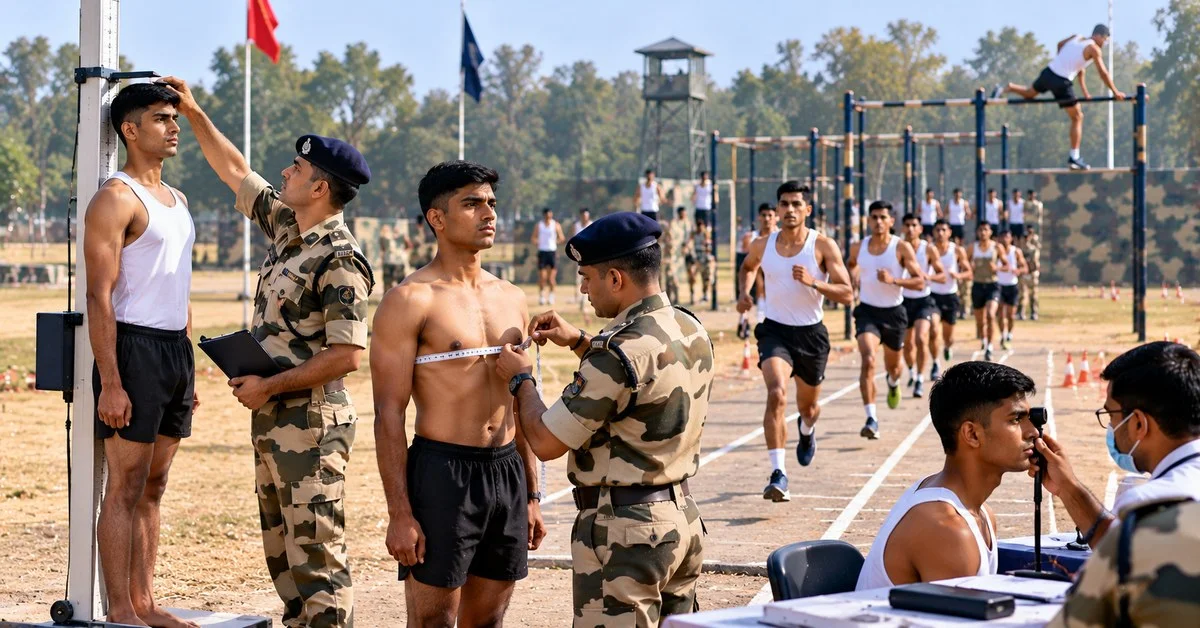
Physical Standards (PET and PST)
Both are qualifying stages after the written test.
PET (race only):
PST:
Further relaxations apply to ST candidates from certain regions and to some other categories. Check them in the notification.
A 5 km in 24 minutes needs a pace of 4 minutes 48 seconds per km. For women, 1.6 km in 8.5 minutes needs about 5 minutes 19 seconds per km. These are the targets your training works toward.
What Score to Target
Do not rely on figures from random websites. Instead:
Find the category-wise cutoffs published in the last result on ssc.gov.in.
Set your target comfortably above the cutoff for your category.
Track your mock scores out of 160 every week and see whether the gap is closing.
Because the paper is out of 160, any cutoff or target figure above that is a sign the source is wrong.
Days 1 to 14: Foundation Phase
Written track
Static GK: Indian history, geography, polity and basic science
Maths: number system, LCM and HCF, basic arithmetic
Reasoning: analogies, series and coding-decoding
English or Hindi: parts of speech and basic vocabulary
Physical track
Day 1: self-timed baseline run (record distance and pace)
Days 2 to 14: run 2 to 3 km, 5 days a week, with one rest day
Add bodyweight circuits: squats, lunges and push-ups
If you can’t run 2 km without stopping, use run-walk intervals and extend this phase
Days 15 to 28: Build Phase
Written track
Current affairs from the past 6 months
Percentage, ratio and profit and loss, with about 20 practice questions a day
Series completion, analogies and coding-decoding drills
English grammar: fill in the blanks and error spotting
One topic quiz every three days
Physical track
Build your run from 3 km to 4 km
One interval session a week (for example, repeated 400 m efforts)
Core and leg strength work twice a week
Days 29 to 42: Intensity Phase
Written track
First full revision of the syllabus
Previous year papers and timed sectional practice
One full-length mock every four days, with every wrong answer reviewed the same evening
Physical track
Reach 5 km continuous, at an easy pace first
One timed 5 km every week
One interval session and one easy recovery run
Days 43 to 60: Final Sprint
Written track
Revise only weak areas from your error log
Two full timed mocks per week under exam conditions
Check your score against your category target and adjust
Physical track
Timed 5 km at target pace every alternate day, with interval work in between
Reduce the load in the last 3 to 4 days so you arrive fresh
Women (1.6 km): short race-pace repetitions and one full timed run each week
Sample Daily Routine
Mock tests replace a study block on mock days. Take one full rest day a week for physical recovery.
Common Mistakes
Treating training as optional on heavy study days. Consistency builds your running base, and long gaps set it back.
Ignoring English or Hindi. It carries 40 marks, the same as every other section.
Delaying mocks until the last two weeks. Question-selection speed needs weeks to develop.
Not logging your timings. Without records, you can’t tell whether you’re closing in on 24 minutes.
Crash-training the race. Increasing distance too fast causes injury. If you have any medical concern, get checked before intense training.
Leaving easy questions blank. The penalty is small, so use your time to attempt every question.
FAQs
What is the best 60-day plan for the SSC GD written exam and physical test together?
Run two blocks every day: a morning training block for running and strength, and an evening study block covering reasoning, GK, maths and English or Hindi. Build your run from 2 km in the first fortnight to a timed 5 km by the end, and take your first full mock by the middle of the plan. This keeps both tracks moving, so neither is left to the last week.
What are the PET and PST standards for CRPF constable recruitment through SSC GD?
The PET is a race: 5 km in 24 minutes for men, and 1.6 km in 8.5 minutes for women. Male candidates from the Ladakh region run 1.6 km in 7 minutes. For the PST, men need 170 cm height and an 80 cm chest with 5 cm expansion, and women need 157 cm, with relaxations for ST candidates. Confirm the standards in the official notification before you train.
Are long jump and high jump part of the SSC GD PET?
Not in the current SSC GD pattern, where the PET is a race. Older articles and some other recruitments list jumps, which is why they still appear on many websites. Jump drills can still help build leg strength, but they are not a qualifying event.
Can I crack SSC GD with only 60 days of preparation?
It is possible if your fitness is reasonable and your basics in maths and reasoning are workable. If you can’t yet run 2 km, or your fundamentals are weak, 60 days will be tight, and you should start the foundation phase at an easier level. The outcome depends on how consistently you follow the plan, not just on the number of days.
Is there negative marking in SSC GD, and should I guess?
The pattern carries a negative mark of 0.25 for each wrong answer, though older articles mention 0.50, so check the notification. With 2 marks for a correct answer, a blind guess among four options has a small positive expected value. Use elimination where you can, and avoid leaving questions blank.
What are the category-wise cutoff marks for SSC GD?
Cutoffs change every cycle with vacancies, the number of candidates and difficulty. The maximum is 160 marks, so any figure above that is wrong. Check the category-wise cutoffs published with the last result on ssc.gov.in, and aim for a safe margin above them.
Tags
- crpf constable preparation plan
- ssc gd 2027 preparation strategy
- ssc gd pet pst physical standards
- GK current affairs for constable exam
- ssc gd syllabus topic wise
- 60 day study plan constable exam
- ssc gd cutoff marks category wise
- ssc gd constable
- SSC GD notification 2027
- CRPF recruitment written test
- physical efficiency test race distance
- reasoning section SSC GD