BITS Pilani Student Builds Pocket-Sized Mesh Radio for Indian Army Use Without Towers, Satellites or SIM Cards

Quick summary
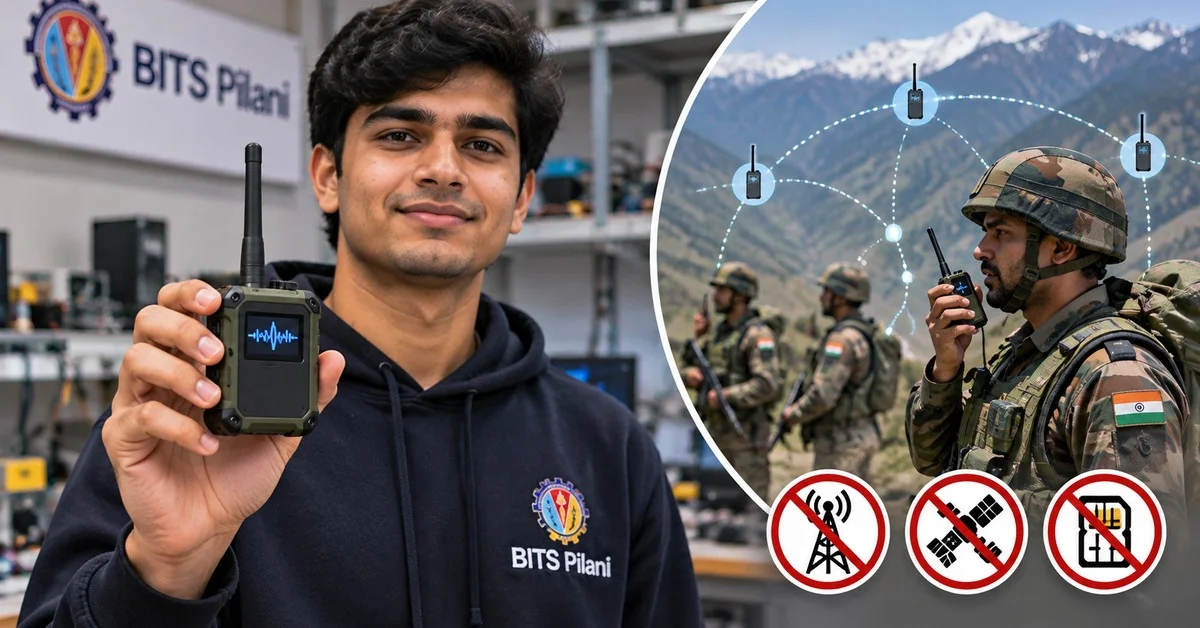
Samarth Alok Srivastava, a BITS Pilani Hyderabad student, has built a pocket-sized mesh radio called Krath Control. It lets soldiers share voice, data and live locations without towers, satellites or SIM cards. The prototype has been evaluated by two Army units.
A 20-year-old founder's prototype aims to give soldiers voice, data and live location sharing where there is no network. It is still at the prototype stage.
A 20-year-old student at BITS Pilani's Hyderabad campus has developed a compact, India-made mesh radio meant to let soldiers talk and share their live positions without mobile towers, satellites or SIM cards.
The team
Samarth Alok Srivastava, a third-year dual-degree student of MSc Physics and BE Mechanical Engineering, founded Krathveil Private Limited in May 2026. His batchmate Shresth Prakash Singh joined later as co-founder and leads technology operations. Both are from Thane. Other BITS Hyderabad students are on the team, which works from the campus.
Srivastava earlier worked with Apollyon Dynamics, another BITS Hyderabad defence startup focused on unmanned systems. There he noticed gaps in ground-level communication for troops working in areas without conventional network coverage.
What the device does
The first product, Krath Control, is a pocket-sized radio weighing under 180 grams. It pairs with a soldier's Android smartphone running apps such as the Android Team Awareness Kit (ATAK) and links with nearby units over an encrypted mesh network. Each radio acts as a node that sends and relays voice, data, live locations, map markers, messages and alerts.
The network heals itself. If a node fails or is destroyed, traffic is automatically rerouted through other paths. The founders say a single hop between two high points, such as hilltops, could in theory cover more than 100 km, though this has yet to be formally field-tested.
Cost and specifications
Conventional voice radios let troops talk but do not give a shared picture of where everyone is. The startup says comparable imported systems with live mapping cost around ₹2 lakh a unit, while it is aiming for about ₹40,000, roughly a fifth of the price. Battery life is reported at 24 to 36 hours. The first prototype transmitted at 156 milliwatts, and the team is raising this to 1 watt and upgrading the antennas after feedback.
Army assessment
Two Indian Army units and the Army Defence College have evaluated the prototype for communication at sub-unit level without network infrastructure and for situational awareness. The feedback has been described as encouraging, with officers noting that no comparable indigenous solution exists.
The evaluation is not a procurement order or an induction. The system has no formal certification. The startup, which is recognised by DPIIT and is seeking incubation support, plans to add the suggested improvements and submit an upgraded version for further evaluation within two to three months.
The bigger goal
Srivastava stresses that Krath Control is a mesh router, not a conventional walkie-talkie. The founders' longer-term aim is a resilient, India-made communication and intelligence layer for military operations in contested areas or places with no infrastructure.
The project reflects a growing role for engineering students and campus startups in defence technology, particularly in cutting dependence on imported tactical communication systems.
Tags
- BITS Pilani student Army radio
- Krath Control
- Krathveil
- mesh radio Indian Army
- tactical communication without network
- indigenous military radio
- BITS Pilani Hyderabad startup
- ATAK Android Team Awareness Kit
- Samarth Alok Srivastava
- defence startup India