DRDO’s Vikram VT-21 Wheeled Combat Vehicle Clears Key Development Trials
Quick summary
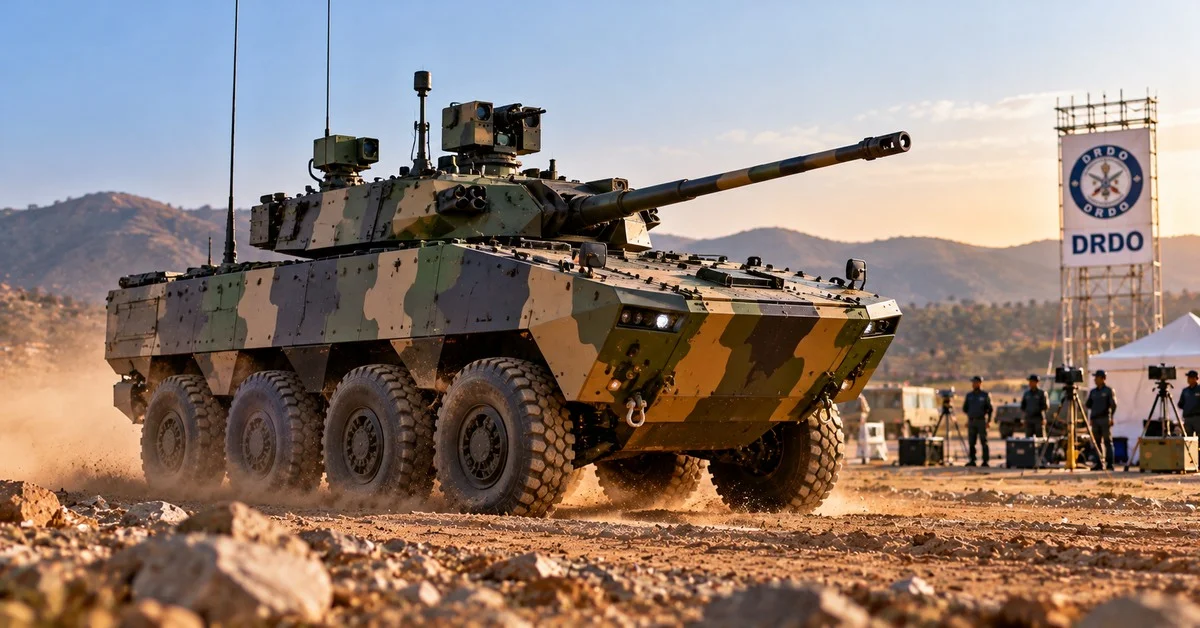
The wheeled version of DRDO’s Vikram VT-21 infantry combat vehicle has met its operational requirements in development trials. Built with Tata Advanced Systems and Bharat Forge, it aims to replace the Army’s BMP-II fleet.
The wheeled version of the Vikram VT-21, a new infantry combat vehicle being developed by the Defence Research and Development Organisation (DRDO), has met its operational requirements during development trials. This is an important step in India’s effort to replace the Army’s ageing fleet of Russian-origin BMP-II vehicles with a home-grown design.
A senior DRDO official described the trials of the wheeled infantry combat vehicle as encouraging. During the tests, it showed good mobility, crossed trenches and performed well in water, all with its turret fitted. Trials of the tracked version are going on side by side.
Who is building it
The vehicle has been designed by the Vehicle Research and Development Establishment (VRDE), a DRDO laboratory in Ahilyanagar, Maharashtra (formerly Ahmednagar). The laboratory has developed both the tracked and wheeled versions.
Industry partners on the project include:
Tata Advanced Systems Limited: Industry partner for development and production.
Bharat Forge Limited: Industry partner working alongside the laboratory on the programme.
MSMEs: Several micro, small and medium enterprises supplying parts and systems.
The project follows the Development cum Production Partner (DCPP) model, under which DRDO handles the design and private firms take up manufacturing. The prototypes were first shown to the public on 25 April 2026.
Key features
The vehicle is designed for modern battlefields, where troops need protection, firepower and speed at the same time. Its main features are:
Unmanned turret: An indigenous 30 mm crewless turret that lets the crew operate the weapon from inside the protected hull.
Weapons: A 7.62 mm coaxial machine gun and the ability to fire anti-tank guided missiles.
Protection: Modular armour meeting NATO STANAG Levels 4 and 5 against bullets, shell splinters and blasts. Level 4 protects against heavy machine gun rounds, while Level 5 is designed to stop rounds from 25 mm cannons.
Amphibious ability: Hydrojets let the vehicle move through rivers and other water bodies.
Engine: A high-output diesel engine with an automatic gearbox, giving it a high power-to-weight ratio.
Indigenous content: About 65% at present, with a target of 90%.
Details such as weight, speed and the number of troops it can carry have not been made public.
Two versions, two roles
The two versions are meant for different kinds of terrain. The wheeled version is suited to fast movement on roads and flat ground, while the tracked version handles rough and difficult terrain better. Both versions earlier cleared the Ministry of Defence’s Technical Evaluation Committee for the wheeled armoured fighting vehicle and Future Infantry Combat Vehicle (FICV) programmes.
Replacing an ageing fleet
The Indian Army has used the Russian-designed vehicle, known in India as the Sarath, since the 1980s. These vehicles carry infantry soldiers into battle under armour and support them with their own guns. Many of them are now old, and the Army has long looked for a modern replacement with better protection, firepower and sensors.
A senior mechanised infantry officer compared the new vehicle’s role with leading designs abroad, such as Germany’s Puma, Sweden’s CV90, the US Bradley and South Korea’s K21. These vehicles combine protection, firepower, surveillance and communication systems in one platform, which is what the Army needs for complex and hybrid warfare.
What comes next
The Indian Army will now carry out its own user trials in deserts, plains and high-altitude areas. These will test mobility, weapon systems, firing and performance in different weather and terrain. Feedback from these trials will be used to make any changes needed.
DRDO is aiming for induction by 2029, if the vehicle clears all tests and is accepted by the Army.
For aspirants
The new vehicle is a good example of the push for self-reliance in defence under Aatmanirbhar Bharat. Aspirants should note the name of the DRDO laboratory, the industry partners, the DCPP model and the vehicle it will replace. These are useful for current affairs questions, SSB lecturettes and group discussions.
Tags
- Vikram VT-21
- wheeled infantry combat vehicle
- VRDE
- BMP-II
- Future Infantry Combat Vehicle
- Tata Advanced Systems
- DCPP model