OmSpace Infinity One Clears Landing-Leg Test, Boosting India’s Reusable Rocket Plans
Ahmedabad startup OmSpace has tested the landing legs of its Infinity One rocket, a key step towards a reusable launch vehicle for small satellites. Here is what the test means, the rocket’s plans and what lies ahead.
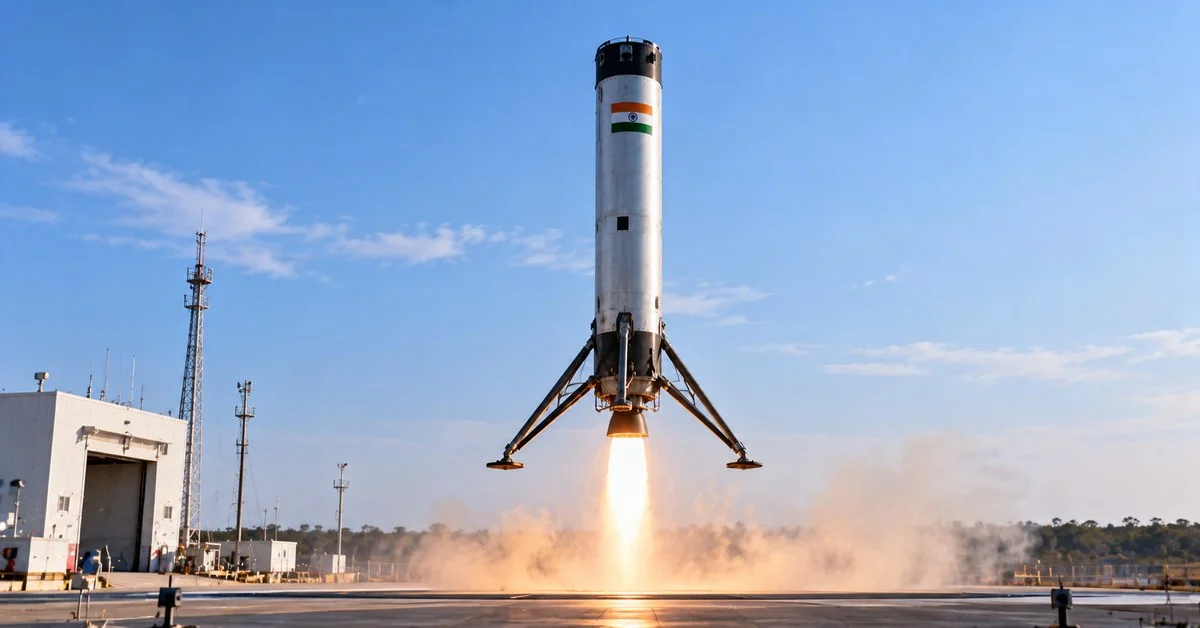
Ahmedabad-based space startup OmSpace Rocket and Exploration has successfully tested the landing-leg mechanism of its Infinity One rocket. The landing legs are designed to hold up the rocket’s first stage as it touches down after a mission, so the stage can be recovered and flown again. The test is a step forward for the company’s plan to build a reusable launch vehicle for small satellites.
The company has not shared the date or location of the test, or detailed test data.
What the test means
Most rockets are used only once. After launch, their stages fall into the sea or burn up in the atmosphere, and a new rocket has to be built for every mission. A reusable rocket aims to bring its first stage back to the ground in one piece, since that stage is usually the most expensive part.
To land safely, the returning stage needs strong, reliable legs that open at the right time and absorb the shock of touchdown. A working landing-leg system is one of the key building blocks of any reusable rocket design.
About Infinity One
Key details of the rocket, as given by the company and in earlier media reports:
-
Purpose: To give small satellites a dedicated ride to orbit, instead of waiting to share space on a larger rocket.
-
Payload: The company’s stated plans put the payload at up to 500 kg to orbit. Earlier funding reports quoted a capacity of 350 kg to an altitude of 800 km.
-
Customers: Commercial, scientific and institutional users.
-
Reuse: After a mission, the first stage is meant to return to the launch site, be inspected and be prepared for its next flight.
-
Quick turnaround: The company says reuse could one day cut the time between launches to days rather than months.
OmSpace has also said it is working on an electric-pump-fed rocket engine. This type of engine uses battery-powered motors instead of a gas turbine to push fuel into the engine.
About the company
OmSpace was set up in 2020 in Ahmedabad, Gujarat. It was incubated at CrAdLE, the startup centre of the Entrepreneurship Development Institute of India. In July 2025, it raised about $3 million (around ₹25 crore) in a pre-seed funding round to develop the rocket.
In March 2026, the startup launched a small single-stage sounding rocket from Bavaliyari village near Dholera, on the Gulf of Khambhat. The rocket reached a height of about 3 km and landed safely using parachutes. The flight was authorised by IN-SPACe, the government body that clears private space activity, and was described as Gujarat’s first sounding rocket launch.
So far, the company has not announced an orbital flight or a firm launch date for Infinity One.
Building on ISRO’s work
The Indian Space Research Organisation (ISRO) has led India’s work on reusable rockets so far. Its RLV programme includes a hypersonic test flight in 2016 and three autonomous landing experiments in 2023 and 2024 at the Aeronautical Test Range in Chitradurga, Karnataka. In these tests, a winged vehicle was dropped from a helicopter and landed on a runway by itself.
Private firms such as OmSpace are now building on this base, helped by reforms that have opened the space sector to private companies since 2020.
Why it matters
Demand for small satellite launches is growing fast around the world, driven by earth observation, communication and research missions. Rockets that can be reused could make launches cheaper and more frequent. If Indian startups can offer such services, the country could win a bigger share of this global market and depend less on foreign launch providers.
There is still a long road ahead. Landing legs are only one part of a reusable rocket. The company still has to prove its engines, carry out flight tests, and show that a stage can be landed and flown again safely.
For aspirants
Space technology is an important current affairs topic for defence and other competitive exams. Aspirants should note the role of IN-SPACe, ISRO’s reusable vehicle tests and the growth of private space startups. Questions on these often come up in written exams and in SSB group discussions.