ISRO Launches NVS-03 on GSLV-F18, Taking NavIC Back to Four Satellites
Quick summary
ISRO has launched the NVS-03 navigation satellite on GSLV-F18, the 20th GSLV flight. The satellite will bring NavIC back to the four satellites needed for standalone positioning, once it reaches its final orbit.
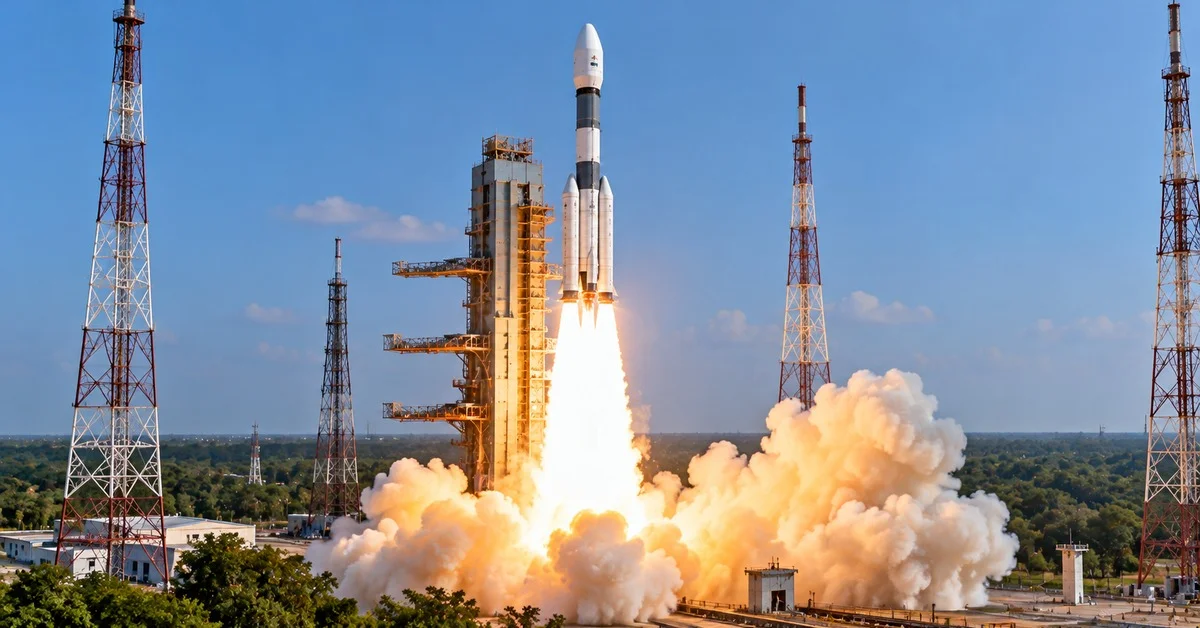
The Indian Space Research Organisation (ISRO) has launched its navigation satellite NVS-03 on the GSLV-F18 rocket from the Second Launch Pad at the Satish Dhawan Space Centre, Sriharikota. Lift-off was at 11:51 pm IST on Friday, October 30, 2026. It was the 20th flight of the GSLV and an important step in rebuilding India’s own satellite navigation system, NavIC.
The three-stage GSLV-F18 stands about 50 metres tall and weighs roughly 420 tonnes at lift-off. After a flight of about 18 minutes, it placed the 2,250 kg NVS-03 into a Geosynchronous Transfer Orbit. The orbit was very close to the target, with a perigee of about 170 km and an apogee of roughly 37,023 to 38,080 km. ISRO said all vehicle systems, including the cryogenic upper stage, worked as planned.
The satellite will now use its own propulsion system to climb to its final geosynchronous slot at 32.5 degrees East. It has a designed life of 12 years. ISRO has confirmed that its solar arrays opened properly and that onboard systems are normal. Orbit-raising is expected to be completed in the coming days, after which data relay and service activation will begin.
Why NavIC needed this satellite
NVS-03 is the third satellite of ISRO’s second-generation NVS series, meant to keep the Indian Regional Navigation Satellite System (IRNSS), known as NavIC, running. Its features include an Indian-made Rubidium atomic clock built by the Space Applications Centre, along with imported clocks, and a new L1 signal added to the existing L5 and S-band signals. The L1 signal makes NavIC easier to use with modern receivers and consumer devices. NavIC provides position, navigation and timing services over India and about 1,500 km beyond its borders.
Before this launch, only three satellites (IRNSS-1B, IRNSS-1I and NVS-01) were working. They could give timing services but not independent positioning, which needs at least four satellites. The older IRNSS satellites had suffered repeated atomic clock failures and had reached the end of their lives. The earlier replacement, NVS-02, was launched in January 2025 on GSLV-F15 and reached transfer orbit, but couldn’t reach its final orbit because a pyrotechnic valve problem stopped oxidiser reaching its engine. For NVS-03, ISRO took extra precautions, including launching with those valves already open.
ISRO’s statements
ISRO Chairman Dr. V. Narayanan confirmed the mission’s success and said the rocket placed the satellite into its intended orbit precisely, with one of the best accuracies any launch vehicle has achieved. He said the gap of 56 days since the previous GSLV flight (GSLV-F17 with EOS-05 in early September 2026) was the shortest between two GSLV missions, and that about 80 percent of the vehicle’s budget went to Indian industry. With NVS-03, NavIC’s position, navigation and timing services are being restored, and NVS-04 and NVS-05 are planned to complete the constellation.
Prime Minister Narendra Modi congratulated ISRO, calling the launch an important step in strengthening NavIC and in self-reliance in critical technologies.
Civil and military use
NavIC is used for road and maritime navigation, live tracking of trains and vehicles, precision farming and disaster management. For the armed forces, it gives strategic independence by reducing reliance on foreign systems such as the US GPS and Russia’s GLONASS.
Tags
- ISRO
- NVS-03
- GSLV-F18
- V. Narayanan