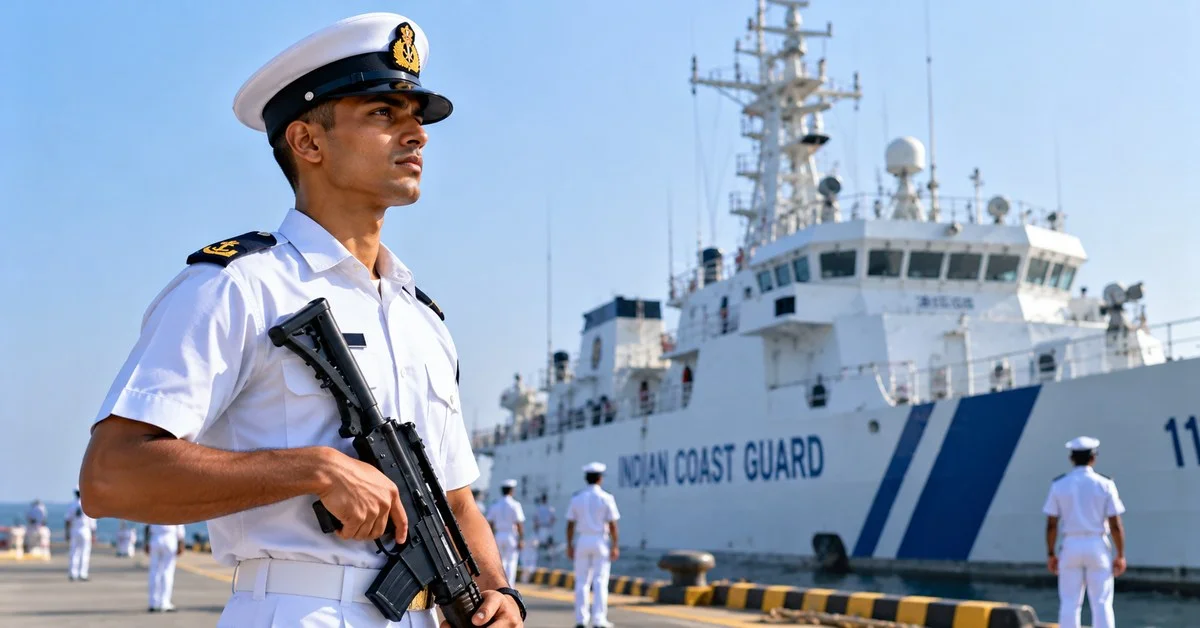
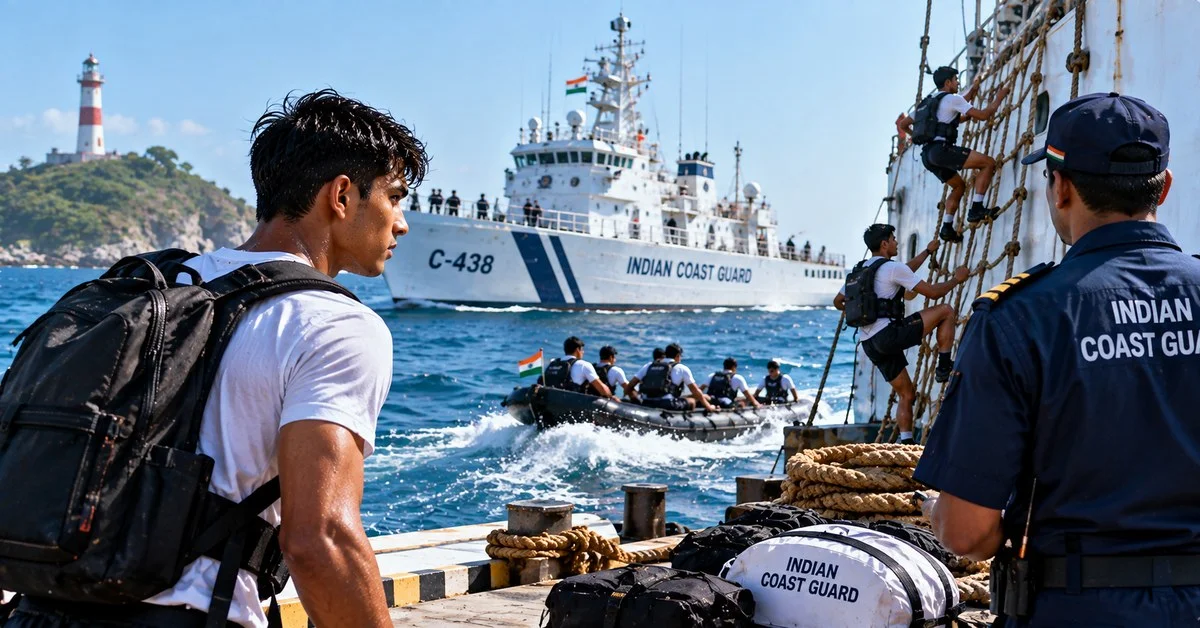
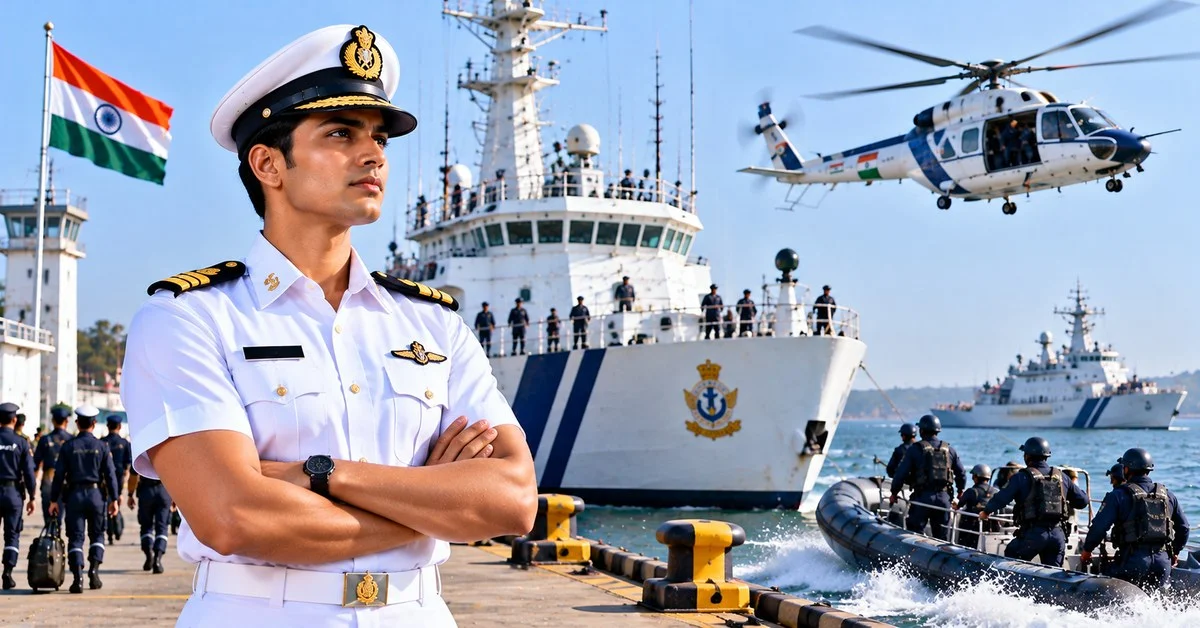
Indian Coast Guard Assistant Commandant
Quick summary
A complete guide to the Indian Coast Guard Assistant Commandant entry: General Duty and Technical branches, age and eligibility rules, CGCAT and FSB selection, medical standards, INA Ezhimala training and common rejection points.
The 2027 batch notification listed two branches, General Duty and Technical, open to male candidates aged 21 to 25. Selection runs through the CGCAT online test, then PSB, FSB, medical and induction at INA Ezhimala. Branches, age limits and standards can change each cycle, so confirm them on joinindiancoastguard.cdac.in before you apply.
The notification drops, your group chat fills with screenshots, and the same doubt comes up again. Does your degree fit General Duty or Technical? Is there still a Law entry? And what happens if your eyesight falls just short on medical day? Many defence aspirants find out they were never eligible only after they’ve paid the fee.
This guide covers the Indian Coast Guard Assistant Commandant entry in one flow. You’ll see each branch, the eligibility rules behind it, every selection stage and life at the academy. It also lists the exact points that get applicants rejected, and what to do after a medical setback.
What Is the Assistant Commandant Entry in the Indian Coast Guard?
The Assistant Commandant entry is how graduates join the Coast Guard directly as officers. It isn’t a sailor post. An Indian Coast Guard Assistant Commandant is placed at Level 10 of the 7th CPC pay matrix, with a starting basic pay of ₹56,100 per month.
- Entry level: officer, after graduation
- Notified by: the Indian Coast Guard, batch by batch
- Applications: online on joinindiancoastguard.cdac.in
- Coast Guard Assistant Commandant eligibility: set fresh in each notification
Batches are named by their joining year. The CGCAT-2027 cycle, for example, was advertised in July 2025. Check the official portal for the current cycle before you plan anything.
Branches Available for Assistant Commandant
Assistant Commandant entry has historically been discussed under three branches: General Duty, Technical and Law. Each one asks for a different degree and leads to a different kind of work. But the current cycle is narrower. The 2025 notification listed 140 vacancies for General Duty and 30 for Technical (Engineering and Electrical/Electronics). No Law posts appeared.
So pick your branch based on your degree, not on what a friend chose. The table below shows the basic match.
| Branch | Degree Required | Main Focus | In the Latest Cycle? |
|---|---|---|---|
| General Duty | Graduation in any discipline, with Mathematics and Physics up to Class 12 | Ship operations and command | Yes |
| Technical | BE/BTech in a notified engineering discipline, with Mathematics and Physics up to Class 12 | Machinery and electrical systems | Yes |
| Law | Law degree (confirm terms in notification) | Legal affairs | Not in the 2025 notification |
General Duty (GD) Branch
General Duty officers run the operational side of the Coast Guard. Their work sits at sea: navigating ships, leading boarding and patrol tasks, and handling search and rescue. Most GD officers start on ships and later move into command, aviation or shore staff roles.
The degree rule is wider than many expect. Any graduation works, as long as you studied Mathematics and Physics up to Class 12. A BCom graduate with PCM in Class 12 qualifies. A BA graduate who took commerce in Class 12 doesn’t.
Technical Branch (Engineering / Electrical)
Technical officers keep ships, boats and their systems working. Engineering officers look after propulsion, engines and hull machinery. Electrical officers handle power generation, weapons electronics, sensors and communication equipment.
You need a BE or BTech in an engineering discipline listed in the notification, plus Mathematics and Physics up to Class 12. That word “notified” matters. A degree in a stream the notification doesn’t list won’t count, so match your exact branch name before you apply. If you hold an engineering diploma rather than a degree, the Yantrik entry for diploma holders is the route to check instead.
Law Branch
The Law branch is for officers who handle the Coast Guard’s legal work. That covers maritime law, cases arising from boarding and seizures at sea, and legal advice to commanders. Entry has normally required a law degree, with conditions such as Bar enrolment or minimum marks set in the notification itself.
Here’s the catch. The 2025 notification didn’t include Law vacancies. Don’t prepare on the assumption that it’ll return in your cycle. If you’re a law graduate, watch joinindiancoastguard.cdac.in for a Law entry, and read its degree, enrolment and percentage conditions line by line before you pay the fee.
Eligibility Criteria for Each Branch
Eligibility comes down to age, education and physical standards. Miss any one and your application stops there, however well you score in the written test. Each notification sets these rules again, so a friend’s eligibility from an older cycle tells you nothing about yours.
Check yourself in this order: date of birth, then degree, then height and vision. It takes ten minutes. For a side-by-side version, see this breakdown of the latest Assistant Commandant eligibility rules, then confirm every line on the official portal.
Age Limits
The age band is the one noted above, but what counts is your birth date. For the 2027 batch, General Duty applicants had to be born between 01 July 2001 and 30 June 2005, both dates inclusive. Work out your age on the cutoff date in the notification, not on the day you apply.
Upper age relaxation applies to these groups:
- SC/ST: 5 years, only where posts are reserved for them.
- OBC (non-creamy layer): 3 years, on the same reserved-post condition.
- Serving personnel, GD: 5 years for Coast Guard personnel, or equivalent personnel in the Army, Navy or Air Force.
- Serving personnel, Technical: 5 years for Coast Guard personnel only.
Educational Qualifications
Your degree decides your branch. The degree rules for each branch are covered above, so here’s how they play out in practice. Class 12 Physics and Mathematics is the filter for both GD and Technical. A strong graduation score won’t fix a Class 12 without those subjects.
An engineering graduate with PCM can apply for GD. A BSc graduate can’t apply for Technical. Among the ICG Assistant Commandant branches, GD, Tech and Law each set their own degree rules. For any minimum percentage or final-year student conditions, read the current notification itself. The sources reviewed here don’t state an official percentage, so don’t trust one from a forum.
Physical Standards
Height and vision rule out the most applicants at this stage. The figures below come from the latest notification:
| Standard | General Duty | Technical |
|---|---|---|
| Minimum height | 157 cm | 157 cm |
| Vision without glasses | 6/6 and 6/9 | 6/36 and 6/36 |
| Vision with glasses | 6/6 and 6/6 | 6/6 and 6/6 |
Weight must be in proportion to height and age, with up to 10% variation accepted. Your chest must be well proportioned, with a minimum expansion of 5 cm. Permanent body tattoos aren’t permitted on any body part. GD vision is far stricter, so get an eye test before you choose that branch.
The reviewed notification was open to men only, so no separate women’s figures are given. If a future cycle opens to women, confirm their standards on joinindiancoastguard.cdac.in.
The Selection Process: Stage by Stage
Selection moves in a fixed order, and each stage filters before the next. For the 2027 batch, the CGCAT came first. A Preliminary Selection Board (PSB) followed, with the Computerised Cognitive Battery Test (CCBT) and Picture Perception & Discussion Test (PP&DT). The PSB is qualifying only, so it adds no marks to your total.
Don’t treat any round as a formality. A high written score won’t carry you past a weak PP&DT. Read your call letter for each stage’s venue and reporting time.
Stage 1: CGCAT Written Examination
The CGCAT is a 2-hour objective test with 100 questions for 400 marks. It’s split into four equal sections:
| Section | Questions | Marks |
|---|---|---|
| English | 25 | 100 |
| Reasoning and Numerical Ability | 25 | 100 |
| General Science and Mathematical Aptitude | 25 | 100 |
| General Knowledge | 25 | 100 |
Each correct answer earns 4 marks, and each wrong one costs 1. What score gets you shortlisted? Nobody outside ICG can say for sure. ICG has published no cut-off marks in the documents reviewed. Skip a question unless you can rule out at least two options.
Stage 2: Force Selection Board (FSB)
The FSB checks whether you think, decide and lead like an officer. It isn’t testing what you’ve memorised. It includes a Psychological Test, a Group Task and an Interview.
- Psychological Test: written responses that show how you react under time pressure.
- Group Task: practical problems solved with other defence aspirants, where assessors watch cooperation and initiative.
- Interview: one-to-one questions on your background, choices and motivation.
- Consistency: assessors compare all three, so honest answers matter more than polished ones.
The sources reviewed don’t fix the number of days, so check your call letter for the schedule. The format is close to an SSB Interview. Defence Study’s free written guides on Psychology, GTO and Personal Interview stages are a useful place to practise.
Stage 3: Medical Examination
Medicals check that you meet the physical standards covered above, and then some. Height, weight, chest, vision and tattoos are all checked again. Doctors also look at hearing, teeth, joints and general health. The notification and your call letter name the medical authority and venue, so rely on those rather than forum posts.
You must be declared fit before your name can reach the final merit list. A strong FSB result won’t override a medical finding. Before reporting, get your ears cleaned and your eyes tested, and carry your prescription glasses if you use them.
Stage 4: Merit List and Final Selection
The final merit list ranks those who clear every stage and are medically fit. The sources reviewed don’t state the exact weighting between the CGCAT and FSB. Read the merit rules in your own notification so you know where your marks count.
Joining orders follow the batch timeline, which is why batches carry their joining year in the name. The wait can stretch for weeks. Use it well:
- Keep running and swimming so you arrive fit for training.
- Store originals and attested copies of every certificate in one folder.
- Check joinindiancoastguard.cdac.in often for merit and joining updates.
- Read up on the Coast Guard Academy training duration and routine, covered in the next section.
Training at the Coast Guard Academy
Training begins with induction at a naval academy. Many guides still mention Goa, but the 2027 batch notification named INA Ezhimala for induction. That means you’ll train in a naval setting, alongside a disciplined routine from day one.
Expect the course to build sea skills and officer habits:
- Seamanship and navigation
- Law of the sea and maritime duties
- Daily physical training and swimming
- Weapons handling and drill
Cadets who complete training pass out as an Indian Coast Guard Assistant Commandant. Per the 2027 batch notification, the Naval Orientation Course at INA Ezhimala runs 44 weeks for General Duty and 22 weeks for Technical, followed by ab-initio training at Navy and Coast Guard establishments and ships. Durations can change between batches, so confirm the current duration on joinindiancoastguard.cdac.in.
How to Apply for Indian Coast Guard Assistant Commandant
You apply online through the official recruitment portal. Dates and fees change every cycle, so treat joinindiancoastguard.cdac.in as the only source to trust for them.
- Wait for the notification, then read the branch and eligibility rules in full before you start.
- Register on the portal with an email address and mobile number you check daily.
- Upload your photo, signature and certificates in the exact format and size the notification asks for.
- Pay the fee. For the 2027 batch it was ₹300 for General, OBC and EWS candidates, and nil for SC/ST.
- Download your admit card once it’s released, and check your name, photo and centre.
The 2025 window stayed open only till July 27, 2025. For any Indian Coast Guard officer entry in 2026 or later, don’t leave your application to the final week.
What Disqualifies an Applicant: Common Rejection Points
Most rejections come from eligibility gaps, not low scores. Check each one before you pay:
- Age overshoot: your birth date falls outside the notified range, even by one day.
- Wrong stream: no Physics and Mathematics in Class 12, or an engineering branch the notification doesn’t list.
- Vision: uncorrected eyesight below your branch’s norm.
- Documents: missing, unattested or mismatched certificates.
- Percentage: missing any minimum the notification sets.
Declared medically unfit? Read your notification for any appeal or review medical process. Then get the condition treated and assessed by a doctor. If you’re still within the age band, a later cycle remains open to you.
FAQs
Can a female candidate apply for all three branches of ICG Assistant Commandant?
Not in the 2027 batch, which was open to male candidates only. Check each new notification for women’s entries.
What is the difference between GD and Technical branch in day-to-day duties?
GD officers run ship operations and seamanship tasks. Technical officers keep machinery and electrical systems working.
How many attempts are allowed for Indian Coast Guard Assistant Commandant?
The sources reviewed set no attempt limit beyond the age band. Confirm in your notification.
Is CGCAT conducted online or offline, and where are centres located?
It’s an online test. Your admit card names your centre.
What happens if I clear CGCAT but fail the FSB?
Your current cycle ends. You can reapply while still within the age limit.
How long is the training at the Coast Guard Academy, and do cadets receive a stipend?
The 2027 batch notification gives 44 weeks for General Duty and 22 weeks for Technical, followed by ab-initio training. For stipend details, check joinindiancoastguard.cdac.in.
Can an engineering graduate apply for the GD branch?
Yes, if Class 12 included Physics and Mathematics.
What is the medical standard for eyesight in the GD branch?
It’s stricter than Technical. See the vision table above.
Tags
- Indian Coast Guard Assistant Commandant
- Coast Guard Assistant Commandant eligibility
- ICG Assistant Commandant branches
- CGCAT
- Coast Guard General Duty branch
- Coast Guard Technical branch
- Coast Guard Law branch
- FSB Coast Guard
- INA Ezhimala training
- Coast Guard Assistant Commandant salary
- Coast Guard physical standards